Quick Take
- Narration: Ebony Mendez brings real energy to the dual-timeline structure, distinguishing the teenage voices from the adult ones with enough subtlety to keep both registers believable.
- Themes: Arranged marriage as second chance, family interference and its costs, the loyalty between love and duty
- Mood: Emotionally driven and fast-moving, with sharp family drama underneath the romance
- Verdict: A marriage-of-convenience story with enough genuine conflict in the family tier to give the central romance real weight.
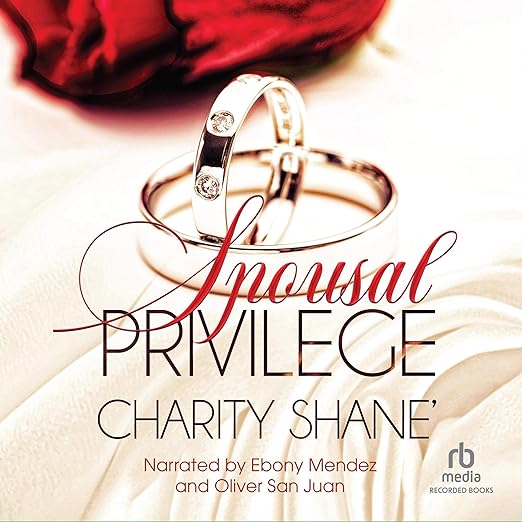
I picked up Spousal Privilege on the recommendation of a reader whose taste I trust, specifically because she warned me it wasn’t the kind of arranged-marriage romance where the conflict is mostly internal, two people fighting their feelings while blushing at each other across the dinner table. She was right. Charity Shane builds the central romance of Dom Kincaid and Zoree Boudreaux against a backdrop of family interference that has genuine menace to it, and that context is what gives this first entry in the Privilege series its best moments.
The setup is one of the more reliable pleasures in contemporary African American romance fiction. Two people who fell in love young are separated by forces outside their control, build separate lives, and are then forced back together by a practical arrangement that neither of them initially wants. Shane executes this with efficiency. The backstory is delivered economically, the reunion has weight because the reader understands what it cost both of them, and the arranged-marriage conceit is tied to specific, plot-driven necessity rather than being purely a romantic device.
The Fathers as Antagonists
The most interesting structural choice Shane makes in Spousal Privilege is centering much of the conflict not in the romantic leads but in their fathers. Both Dom’s father and Zoree’s father are drawn as men who prioritize self-interest and control over their children’s wellbeing. They are not cartoon villains. They have coherent motivations and recognizable patterns of behavior. But they are genuinely dangerous to the people around them, and the damage they’ve done, including the original separation of Dom and Zoree as teenagers, has a specific shape that the audiobook spends real time detailing.
One reviewer who clearly appreciated this aspect of the book noted that she loved how things fell into place for Dom and Zoree despite the mess their fathers made, and that Dom and Zoree ultimately cutting both fathers off when the full truth emerged felt earned rather than dramatic. I agree. Shane is writing about the inheritance of parental damage in a way that takes it seriously rather than using it as convenient backstory.
Pacing and the Question of Secondary Perspectives
Shane moves quickly. One reviewer described finishing this in a single sitting, and that tracks. The novel does not linger over the will-they-won’t-they mechanics that stretch some romance audiobooks past the point of patience. Dom knows early that Zoree is his person, and his certainty functions as a structural anchor that prevents the central relationship from becoming repetitively fraught.
The chapters devoted to secondary characters Kya and Blaise drew more mixed reactions. One reviewer found them unnecessary; another genuinely liked both characters. As someone who tends to find series-building subplot chapters disruptive when they arrive in a first installment, I lean toward the first view, but this is a genre-convention issue as much as a structural flaw. Shane is clearly setting up the wider Privilege world, and readers who plan to stay with the series will likely find these perspectives more rewarding in retrospect.
Ebony Mendez and the Audiobook Experience
Ebony Mendez’s performance is one of the genuinely strong elements of this production. The book has two distinct timelines, the teenage years when Dom and Zoree first meet, and the adult present where the arrangement takes hold. Mendez modulates her voice enough to keep these periods distinguishable without making the shifts feel artificial. She handles the more emotionally charged confrontations, particularly the scenes involving the fathers and the final reckoning when everything comes out, with restraint that lets the writing do its work rather than performing emotion over it.
One dissenting review raised the criticism that Zoree is emotionally immature and prone to catastrophizing, and this is not entirely wrong. There are moments where her internal responses to Dom’s behavior, particularly when she runs rather than communicates, can be frustrating. Whether this reads as a character flaw that the story eventually corrects, or as a persistent irritant, may depend on the listener’s tolerance for this particular type of heroine.
Who Will Connect with This Audiobook
If you enjoy African American romance fiction with family drama as a primary driver of conflict, and you want a central couple whose love story has genuine history behind it rather than just immediate chemistry, this free audiobook delivers both. The marriage-of-convenience structure is handled with more craft than the premise might suggest, and the family tier gives the book real stakes beyond whether Dom and Zoree will end up together. Series readers will want to continue. New readers to the genre will find this a solid, fast-moving entry point.
Frequently Asked Questions
Is Spousal Privilege part of a series, and does it end on a cliffhanger?
Yes, it is Book 1 of the Privilege series. The central romance between Dom and Zoree resolves satisfyingly, though the series continues with other characters from this world.
How explicit is the romantic content in Spousal Privilege?
The book contains adult romantic content but is not classified as erotica. It sits in the contemporary romance range, with sensual scenes that serve the emotional arc rather than being the book’s primary focus.
Is the audiobook narration by Ebony Mendez effective for the dual-timeline structure?
Yes. Mendez handles the teenage and adult timelines with enough vocal differentiation to keep them distinct, and she is particularly effective in the emotionally charged confrontation scenes.
Can I listen to this free audiobook without having read other books by Charity Shane?
Absolutely. Spousal Privilege is a complete standalone entry point to the series. No prior familiarity with Shane’s other work is needed.