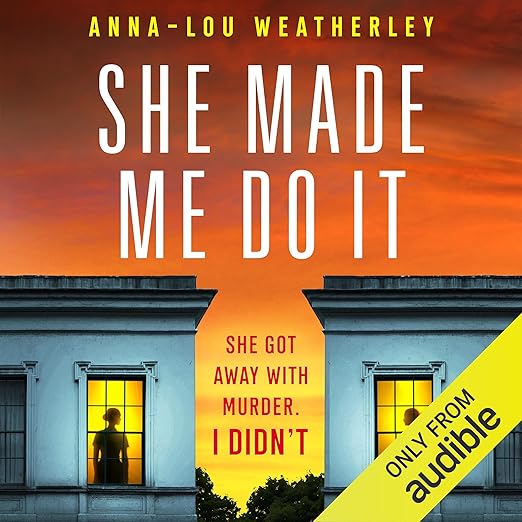
Samantha Valentine does not drift into this narrative; she collides with it. That collision is the hook of Anna-Lou Weatherley's She Made Me Do It, and this audiobook narrated by James Lailey delivers the fallout with sustained urgency across just under eleven hours. The setup is precise: a woman who believes she has a genuine best friend answers a panicked call, rushes to protect that friend, and ends up standing over a stranger's body by the time the police arrive. Then Samantha vanishes. No record of her anywhere. The narrator is left handcuffed, implicated in a murder she neither planned nor understood, holding nothing but the wreckage of a friendship that may never have existed.
Choosing to Trust Becomes Its Own Undoing
Weatherley is working in a tradition of British psychological thriller that has produced a strong run of unreliable-friendship narratives over the past decade, and she earns her place in it. The book's central mechanism, one woman used as an unwitting instrument by another, is not original as a premise, but Weatherley's execution is disciplined. The pacing of revelation is calibrated so that each layer of Samantha's actual identity arrives at the right moment, neither rushing past what needs time to breathe nor stalling where momentum is required. One reviewer called it very twisty while another noted it holds up as a standalone, which suggests Weatherley has achieved the balance between self-contained story and series architecture that many crime writers struggle to sustain.
The book's moral mechanics are interesting. The narrator is not a passive victim but an active participant in her own victimization. She chose to trust Samantha. She chose to rush to her defense without question. Those choices are not condemned, but they are not romanticized either. Weatherley is interested in how ordinary affection and loyalty can be weaponized by someone who understands those emotions and has none of them herself. The question the novel keeps pressing is not merely who is Samantha, but what does it mean that no one thought to ask before now.
At 4.3 stars across over 500 ratings, listener response has been strong, with consistent praise for the twist delivery. One reviewer described the emotional engagement as tugging a reader along, which is an accurate account of the novel's primary technique: it works by making you genuinely invested in a narrator who is, by objective measure, in an increasingly impossible situation, and then demonstrating exactly how she got there.
Lailey Excels at Pacing More Than Interiority
James Lailey is a skilled and experienced narrator who handles Weatherley's pacing well. The first-person female narration is where some male narrators create distance, and there are moments in She Made Me Do It where Lailey's delivery of the narrator's emotional interiority reads slightly formal compared to what the text is reaching for. The panic, the shame, the creeping dread of realizing you have been used: these are rendered accurately but not intimately. That said, Lailey's particular strength is the thriller infrastructure, the pacing of tension, the handling of dialogue scenes involving multiple characters, and the propulsive momentum through the book's central revelation sequences. For a novel where plot mechanics are ultimately more important than character psychology, that is not a disqualifying trade-off.
At just under eleven hours, the runtime is appropriate for a thriller of this complexity. Weatherley does not waste pages, and Lailey does not waste minutes. The audiobook moves with the economy of a well-constructed puzzle being assembled under pressure.
Systematic Investigation Meets an Abruptly Fast Ending
The investigation the narrator conducts after her arrest is where the novel's intelligence is most visible. She approaches the search for Samantha's real identity with a systematic logic that reveals character: this is a woman who, even in shock and legal jeopardy, thinks clearly and pursues information methodically. That competence creates a tension between who she is and what she has allowed to be done to her, and Weatherley exploits that tension throughout the second half of the book.
The ending has divided some readers, with at least one reviewer noting that the resolution arrives somewhat abruptly. The pleasure of watching the story deepen was interrupted by a conclusion that came faster than expected. Whether that reads as tight control or insufficient runway depends on the listener's tolerance for how Weatherley closes the loop. The twist itself is not the problem; the question is whether the aftermath is given enough time to settle.
It is also worth noting that Weatherley's prose has a forward-momentum quality that rewards audio specifically. The short, punchy sentences and scene-level structure suit the format well, and Lailey's delivery keeps that momentum without allowing the compression to feel rushed. This is the kind of thriller that audio genuinely improves over silent reading.
Fans of Logan and McFadden Will Feel at Home
Fans of T.M. Logan, Frieda McFadden, and Daniel Hurst, authors cited in the book's own marketing, will be comfortable here. The thriller mechanics are solid and the pacing is reliable. Listeners who find the psychological thriller subgenre most compelling when it grounds the manipulation in recognizable emotional dynamics, real friendship gone weaponized rather than cartoon villainy, will find Weatherley's approach satisfying.
Those who require significant character depth and interior emotional life alongside their plot mechanics may find the audiobook more satisfying as a thriller than as a character study. The premise is cleverer than the execution of its human interiority, but the premise is very good indeed. Lailey's narration ensures that the cleverness of the mechanics is never lost, and that is ultimately what carries this audiobook through its nearly eleven hours.
At a Glance
- Narrator: James Lailey narrates a first-person female protagonist here, and while his delivery is controlled and clear, some of the emotional texture of the narrator's vulnerability reads at a slight distance. The thriller pacing holds throughout.
- Subjects: Manipulation and coercive friendship, identity trap, the limits of trust
- Tone: Taut and increasingly paranoid
- Bottom line: Anna-Lou Weatherley constructs a genuinely clever identity-trap premise and executes the twist mechanics with care. Lailey's narration keeps the pace urgent even where character interiority suffers slightly.
Common Questions
Is She Made Me Do It audiobook part of a series or a standalone?
One reviewer noted they did not realize the book was part of a series but confirmed it functions fully as a standalone. You do not need prior knowledge of any preceding entries to follow and enjoy the plot. The central mystery is self-contained.
How does James Lailey handle the female first-person narration in this audiobook?
Lailey is controlled and clear throughout, and the thriller pacing holds well under his narration. The emotional interiority, the panic and shame of being betrayed and framed, reads slightly at a remove compared to what a female narrator might deliver. Listeners primarily engaged with plot mechanics will not find this a significant issue; those who listen primarily for emotional immersion may notice it.
Does the She Made Me Do It audiobook deliver on the twist reputation of British psychological thrillers?
Yes. Multiple reviewers specifically praised the twist delivery as satisfying, with several noting the novel offers genuine surprises rather than signposted reveals. Weatherley calibrates the pacing of each revelation carefully enough that the twist arrives at the right moment rather than feeling either rushed or telegraphed.
At nearly eleven hours, is the audiobook paced well enough to sustain engagement throughout?
The pacing is consistently tight. Weatherley writes with thriller economy and Lailey's narration respects that momentum. The second half, where the narrator begins actively investigating Samantha's real identity, is particularly propulsive. The one caveat is that some listeners have found the final resolution slightly rushed relative to the buildup.