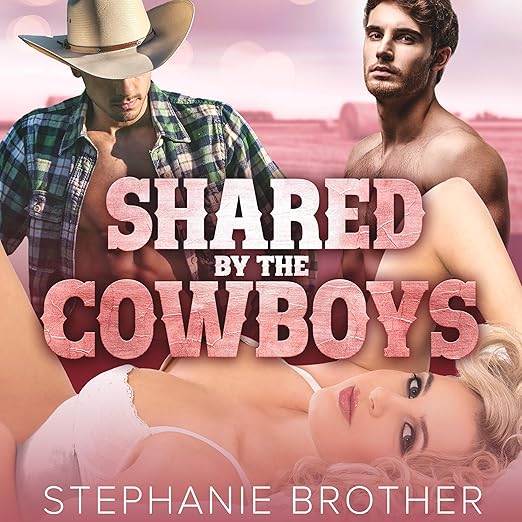
Quick Take
- Narration: Roland Parker handles the male dual perspective with ease, giving Wade and Caleb distinct enough tonal personalities to track the POV shifts. The pacing suits the fast-burn structure.
- Themes: Forbidden stepfamily reunion, protection fantasy, found family
- Mood: Warm and steamy, low-angst with domestic comfort at its core
- Verdict: Stephanie Brother delivers on her reputation for heart alongside heat in this Western menage opener, though the forbidden-family framing requires a willing suspension of concern for real-world dynamics.
I listened to this one on a rainy Sunday afternoon when I specifically wanted something uncomplicated, and Stephanie Brother’s Shared by the Cowboys delivered what it promised. At four and a half hours, it fits into a single sitting if you’re in the right mood for it, and the mood it requires is a willingness to let the fantasy premise run without much interrogation of its real-world logistics.
This is the first book in the Wild Rides series, and it establishes the template clearly: Joelle, a single mother in a precarious situation, returns to the ranch where her stepbrothers Wade and Caleb live. The three were family briefly before Joelle’s mother left following her father’s death. Years of separation have transformed the dynamic, and the brothers have no intention of treating her as a sister now.
Our Take on Shared by the Cowboys
What makes Stephanie Brother’s books work for her dedicated readership is exactly what one longtime reader described here: she builds the world and gives it roots. The ranch setting is not merely decorative. Caleb and Wade have a history, a livelihood, and a way of moving through the world that the story takes seriously. Joelle’s vulnerability as a single mother with limited options is drawn with enough specificity to feel real rather than contrived. Her son is a presence in the narrative rather than a prop, which matters for a premise that ultimately promises a found-family resolution.
The stepbrother framing will be the deciding factor for most listeners. It is central to the premise and the fantasy register, and Brother does not soften it. If that particular dynamic is something you find interesting as a fiction device, the story earns its emotional beats. If it’s not for you, this book is not designed to convert you.
Why Listen to Shared by the Cowboys
Roland Parker narrates from the brothers’ perspectives and handles the dual male POV with competence. Wade and Caleb are distinguishable through their approaches to Joelle: Wade is the more introspective of the two, quicker to name what he’s feeling, while Caleb is more action-oriented. Parker tracks these differences without overstating them, which keeps the storytelling clean across the short runtime.
At four hours and thirty-two minutes, this moves quickly. One reviewer noted it was a fast-burn story, and that’s accurate. The conflict with Joelle’s son’s father arrives late and resolves faster than the romantic beats, which keeps the focus where the audience for this type of book expects it. The emotional resolution involving Joelle’s sense of security and belonging is handled warmly, and that warmth is what reviewers consistently praised.
What to Watch For in Shared by the Cowboys
The synopsis is explicit about the content that some readers may find challenging, including specific kink elements and breeding themes. One reader noted they were not put off by the kink they did not fully understand, which suggests the book handles these elements in a way that keeps the emotional core readable even for listeners who aren’t entirely familiar with the subgenre conventions. A more critical reviewer gave it three stars and described it as low-angst with plenty of adult fun, which is probably the most neutral framing available.
The antagonist, Joelle’s ex, is deliberately underdrawn. His function is purely to threaten what the three protagonists have built, and he is dispatched without much ceremony. Readers who like their conflict to carry more narrative weight may notice the imbalance, but within the expectations of the genre, it works.
Who Should Listen to Shared by the Cowboys
Readers of the Western menage subgenre who are already familiar with Stephanie Brother’s catalog will find this consistent with her other work and will likely want Janey’s story next, as several reviewers have already requested. New listeners should be aware that the forbidden family framing is not peripheral but central to the fantasy. This is emphatically not for readers who want their romance without explicit content or morally uncomplicated setups. If you are specifically a fan of ranch settings, protective heroes, and single-mother protagonists finding safety and belonging, this delivers all three.
Frequently Asked Questions
Is this book part of a series, and does it end on a cliffhanger?
It is the first book in the Wild Rides series. The main romantic resolution is complete by the end of volume one. Secondary characters, specifically Joelle’s friend Janey and the men around her, are set up for future installments, but Joelle, Wade, and Caleb reach a satisfying conclusion.
How explicit is the content, and is the stepbrother framing front and center throughout?
The content is explicit and the stepbrother framing is central to the premise from the first chapter. This is not a story where the relationship is lightly suggested. Listeners who are sensitive to this type of forbidden framing should factor that in before starting.
Does Roland Parker’s narration capture both brothers as distinct characters?
Reasonably so. Parker differentiates Wade and Caleb through pacing and tone rather than radically different vocal registers, which suits the close-knit twin dynamic. The distinction is clear enough that the POV shifts don’t create confusion.
How much page time does Joelle’s son have, and does the story treat the single-mother aspect with care?
The son is present as a genuine motivating factor rather than a narrative afterthought. His safety and wellbeing drive several of Joelle’s decisions, and the found-family resolution includes him. It is not a deep character study of motherhood, but it treats the premise with more care than many books in this subgenre.