Quick Take
- Narration: Cassandra Campbell brings scholarly poise and warmth to Thurman’s dense, layered prose, making 25 hours feel earned rather than exhausting.
- Themes: Biography and creative ambition, gender and transgression in early 20th-century France, the cost of self-invention
- Mood: Rich, leisurely, and deeply textured
- Verdict: Thurman’s Colette biography is one of the most intelligent and stylistically accomplished literary lives you will find in audio form, though listeners should expect depth over pace.
I came to this one with a specific kind of hunger. I had just finished a French novel that kept circling around Colette’s shadow without ever naming her, and I realized I knew embarrassingly little about the actual woman behind all those allusions. So I started Judith Thurman’s biography on a long train ride, intending to sample a few chapters. I finished it eleven days later, often pausing to write down a sentence Thurman had written about Gigi or Sido and finding it was actually a sentence Thurman had written about her own method.
That is the kind of biography this is. It earns comparisons to its subject.
Our Take on Secrets of the Flesh
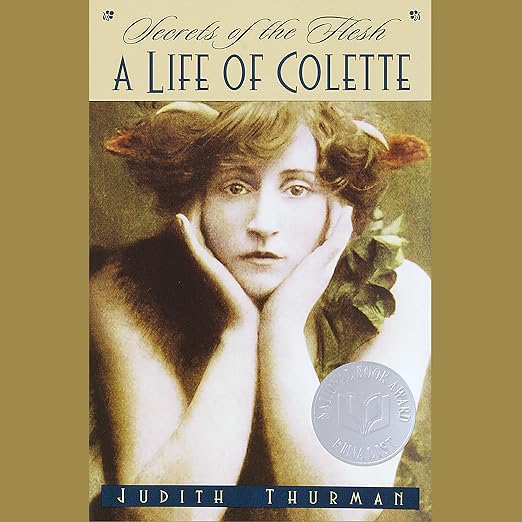
Thurman’s achievement here is enormous and, frankly, not fully captured by the awards pile on the back cover, impressive as it is. This is a National Book Award finalist, an Los Angeles Times Book Award winner, a book Philip Roth called an essential biography by a stylish writer of great sympathetic understanding and intellectual authority. Those descriptions are accurate. What they do not convey is how consistently alive the prose is, how rigorously Thurman distinguishes between what is documented and what is interpretation. One reviewer noted that theories are clearly stated when they are not 100 percent known as facts, and that precision matters in a life as myth-prone as Colette’s. Thurman does not flatten Colette into a feminist icon or a cautionary tale. She holds the contradiction: the woman who gave birth at forty and found the experience more an inconvenience than a revelation; who at forty-seven seduced her teenage stepson; who wrote for the pro-Nazi press during the Occupation while her Jewish husband sat in Gestapo custody. Thurman looks at all of this without flinching and without moralizing, which is the harder thing.
Why Listen to This Audiobook
Cassandra Campbell is an excellent match for this material. Her narration is controlled, unhurried, and gives Thurman’s aphoristic sentences room to land. The prose is smoothly urbane, at times aphoristic, always captivating, as The Washington Post Book World put it, and Campbell honors that quality without tipping into performance. At twenty-five hours, this is not a casual listen, but Campbell’s pacing means you never feel lost inside a paragraph. She handles the French titles and names with natural ease, which matters given how much Colette’s actual writing, Gigi, Sido, Cheri, Break of Day, is woven into Thurman’s analysis.
The audio format suits this book in a specific way. Thurman’s sentences are built for slow reading, and listening at a moderate pace approximates that experience better than skimming a page ever would. This is one of those cases where the audiobook slows you down in exactly the right way.
What to Watch For in This Audiobook
One listener criticism worth taking seriously: the book is long, and not all of it is equally important. Thurman’s analysis of Colette’s actual writing, her reading of the Claudine novels, of Cheri, of the late autobiographical work, is the core of the biography’s intellectual value. The sections covering the years with Willy, Colette’s manipulative first husband who took credit for her bestselling early novels, are gripping. But there are passages where the social gossip accumulates faster than the insight, and the pacing slackens. One reviewer put it plainly: over long. The scholarship is excellent. The biographer cannot always tell the difference between significant or illustrative events and tittle-tattle. That is a fair warning. The book rewards patience, but it requires patience too.
Who Should Listen to Secrets of the Flesh
This biography belongs in the hands of anyone who has read Colette and wants to understand the engine behind the work. It will also work beautifully for readers coming to Colette for the first time, because Thurman provides enough of the actual texts, paraphrased and quoted, to make the literary analysis land even without prior knowledge. Fans of other literary biographies, Hermione Lee on Woolf, Claire Tomalin on Dickens, will feel at home in Thurman’s methodology. Listeners who want a fast-moving narrative biography, something closer to a thriller with footnotes, will find the pace demanding. This is a book that asks you to sit with complexity, and it gives back accordingly.
Frequently Asked Questions
Do I need to have read Colette’s novels before listening to this biography?
No, though having read even one of her works, Gigi or Cheri in particular, will deepen your experience considerably. Thurman weaves enough of Colette’s actual writing into the analysis that you can follow the literary argument without prior knowledge.
Is Cassandra Campbell’s narration well-suited to a biography this dense and long?
Yes. Campbell is measured and precise, which matches Thurman’s scholarly but accessible style. She does not over-dramatize, which is exactly right for material this layered.
How does Thurman handle Colette’s collaboration with the pro-Nazi press during World War II?
Thurman addresses it directly and without excusing it, while placing it in the context of Colette’s simultaneous effort to protect her Jewish husband from the Gestapo. The biography is unflinching on this period and does not simplify Colette’s choices.
Is this the definitive biography of Colette, or are there others worth considering alongside it?
Thurman’s biography is widely considered the strongest English-language life of Colette and earned the Los Angeles Times Book Award and a National Book Award nomination. Reviewers in The New York Times and The Washington Post called it unlikely to be surpassed. For French readers, Herbert Lottman’s earlier biography offers additional archival depth, but Thurman remains the first choice for anglophone listeners.