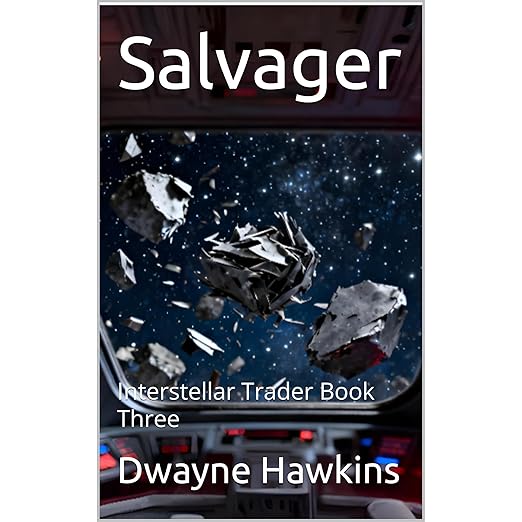
Jericho Rolland turns twenty-one without a berth for the first time since he was twelve, which is where this audiobook picks up a trader who has already made his fortune. The family ship goes into the yard for an extended overhaul and its heir discovers he has nothing to do. Twelve hours and one minute of recording, a March 5, 2026 release, 215 ratings behind a 4.5 average, and a narrator field that reads Virtual Voice. That last item changes what you are buying, so I am not going to bury it at the bottom.
Where This One Lands
Hawkins writes commerce the way other science fiction writers write combat, with the procedure left in. The through-line of the Interstellar Trader books is a license: Jericho is working toward an unlimited shipmaster's ticket and ownership of a large trade ship. Volume three moves him sideways into salvage instead, which is a smart structural choice, because it forces a character who has already won into an apprenticeship again and hands the series a new set of technical detail to spend.
Four years pass inside this book, and the copy admits as much. Jericho is twenty-one when the overhaul begins and approaching twenty-five when the siren call of space starts to sing in his ear again. That is a wide span for one volume, and it produces both the best quality of the book and its worst habit: the plot is a career rather than an incident, so it accumulates where it might have escalated.
Desert Rose is where the volume actually lives. A chance meeting with a likeable old codger in a bar turns Jericho into chief mate and bottlewasher on a salvage ship, a job description with a joke built into it, and wreck work gives Hawkins a fresh vocabulary after two books of cargo runs. It is the most interesting setting this series has used, and the one that most reliably puts its protagonist somewhere his money cannot help him.
Why Salvager Works as an Audiobook
Salvage is a better engine than trading, and the reason is risk. Cargo work rewards planning; wreck work rewards nerve, and it drops one of the richest people around into a berth where he takes orders. The description frames the move as learning an entirely new trade, which is an honest summary. The pleasure of this installment is watching an accomplished young man get told what to do by an old hand and decide to enjoy it.
Money never stops being the subject, and this series is unusual in treating that as a serious topic rather than a wish. The five-star filed on March 7 points at what makes it land in this installment: character development, more of what makes the protagonist tick, and the return of supporting characters from earlier volumes. Continuity is doing real work here, and for anyone who has read one and two the returns compound.
Comparisons in the response pool run mid-century. A five-star posted on March 17 says the book "reads like a R A Heinlien book with the main protagonist being very similar to Libby with the exception of being far more socially skilled." The taxonomy is right whatever you make of the comparison. This is competence fiction in the older mode, where the reward is watching somebody learn a trade correctly and the antagonist is usually a situation rather than a villain.
What Gives Us Pause
Repetition is the complaint, and it arrives from the only response that withholds a fifth star. The March 16 four-star, headed with a warning about an excessive sex addiction theme, argues that too much of book three focuses on the protagonist having a fling with literally every single female he meets, that the excessiveness got old quickly, and that it stole focus away from the creative and entertaining salvager plot. That is a structural objection rather than a squeamish one, and this listing carries no content note of any kind to prepare a buyer for it.
Virtual Voice sits in the narrator field, which means no human reader is attached to this release at all. Synthetic delivery copes reasonably with declarative prose, and a book carrying this much technical explanation has plenty of that to offer. What it copes with worst is precisely what the volume leans on: a bar-room codger, comic job titles, and twelve hours of dialogue where the humor lives entirely in timing. Weigh that as the central purchase risk, and sample before committing.
Pacing of the response pool deserves its own flag. All five signed responses were filed between March 7 and March 17, 2026, inside two weeks of the release date, which describes a series audience buying on publication rather than a verdict formed over time. One of those five consists of a title reading 4.5 and a body reading Stars, submitted as a five. Clicked grades and written grades are not the same measurement here, and the 215-rating average was built from clicks.
Who Should Pick Up Salvager
Trade-and-logistics readers are the natural audience, and that is meant as praise. If you enjoy licenses, ship's tickets, the mechanics of a working crew and the slow accumulation of competence, Hawkins is writing directly at you, and volume three swaps the cargo run for a salvage berth without losing the ledger. Anyone who has finished the first two books will find the returns highest here, since the supporting cast and the license arc both pay forward.
Synthetic narration is the hard stop, and for most buyers it will settle the question by itself. Anyone who listens for a performance should treat the Virtual Voice credit as disqualifying and read the text instead; anyone who listens for information will mind it considerably less. Set that alongside everything this listing declines to describe and the picture is clear enough: the strongest premise the series has had, a readership that turned up within a week, and two facts on this page worth knowing before hour one.