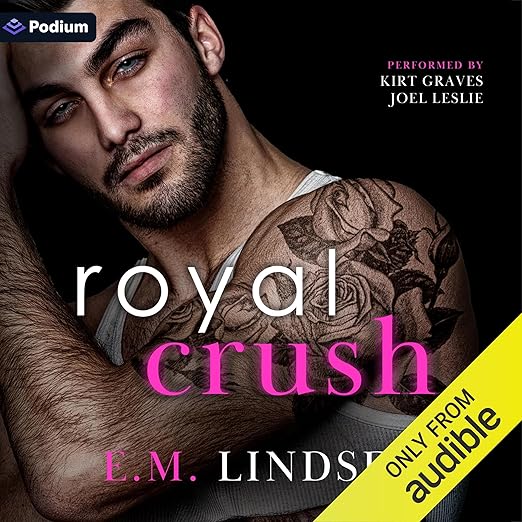
Quick Take
- Narration: Joel Leslie brings both Aleric’s raw vulnerability and Camillo’s dry wit to life with sharp tonal control, making the enemies-to-lovers tension feel earned rather than performed.
- Themes: disability representation, redemption from public failure, identity versus public image
- Mood: Witty and warm with genuine emotional weight underneath
- Verdict: A romance that earns its sweetness by grounding both leads in real damage and treating disability as lived experience rather than plot decoration.
I picked up Royal Crush on a Wednesday evening when I had about two hours to kill and expected something light and easy. I finished it the following morning, having stayed up far later than I intended, which tells you something about how effectively E. M. Lindsey manages momentum. The setup sounds familiar on paper: a disgraced actor gets cast to play a real prince, the prince is hired as a consultant, sparks fly. But Lindsey is doing something more careful here than the premise suggests, and it took me until roughly the halfway point to fully understand what that was.
Aleric, our narrator, is a former child star whose public spiral has left him radioactive in Hollywood. He needs the role of Camillo Soriano, a wheelchair-using royal, to prove he still has something worth watching. Camillo, brought in as a technical advisor to ensure the performance is done correctly, is immediately unimpressed. What Lindsey builds from this collision is not just romantic friction but a study of two men who have both become prisoners of how the world has decided to see them. Joel Leslie’s narration captures this dual quality beautifully. His Aleric has the reflexive charm of someone who learned young to perform likability, while his Camillo carries a bone-dry skepticism that never slides into cruelty.
Our Take on Royal Crush
What separates this book from other celebrity romances is the seriousness with which Lindsey treats both the disability representation and the child actor trauma. Camillo’s wheelchair use is not a device that generates vulnerability or inspires growth in Aleric. It is simply part of how Camillo moves through a world that constantly tries to define his limits for him. Readers noting that the disability is handled in a way that is realistic and not exploited for plot points are correct, and this is harder to achieve than it looks. Lindsey keeps the physical realities of Camillo’s life present throughout without ever turning them into a lesson for Aleric to learn.
The child actor angle lands with comparable specificity. Aleric’s damage isn’t vague self-destructiveness. It has an origin, a pattern, and consequences that still shape how he reads situations. When he encounters someone who sees past his public image, the response feels proportionate to how long he has gone without that experience.
Why Listen to Royal Crush
Joel Leslie is one of the more reliable narrators in MM romance, and his performance here is among his better work. He resists the temptation to make Camillo imperious or Aleric pitiable, which would have been the easy interpretive choices. Instead he plays both men as intelligent people with reasonable defenses, which makes the moments when those defenses drop feel significant rather than obligatory. The banter lands. The snark has timing. The emotional turns don’t feel telegraphed because Leslie keeps a lid on sentiment until the book earns it.
At just over eight hours, the pacing is tight. Some readers have noted the ending feels rushed, and that criticism is fair. The emotional reckoning that the third act requires arrives quickly, and a handful of plot threads, including what eventually happens to the villainous Christoph, get resolved at a summary distance rather than in real time. For a book that spent its first two-thirds moving slowly and attentively through its characters’ interiors, the final sprint can feel slightly mismatched. But the core relationship never loses its coherence, and the happily ever after feels grounded in who these two men actually are rather than who the genre requires them to become.
What to Watch For in Royal Crush
Pay attention to the scenes on set. Lindsey uses the filmmaking context with more specificity than most romance writers would bother with, and the absurdity of filming intimate scenes in front of a crew becomes a recurring source of both comedy and genuine awkwardness. There’s a particular sequence involving blocking and camera angles that is genuinely funny and also quietly revealing about how Aleric has learned to use performance as armor.
The secret dating element is also handled well. It could easily feel like a genre obligation, but Lindsey uses the secrecy to create space where Aleric and Camillo can be versions of themselves that neither of them shows publicly. Those scenes are where the relationship actually develops, and they carry a warmth that the banter-heavy early chapters promise but take time to deliver.
Who Should Listen to Royal Crush
This one is for readers who want their MM romance to do some actual character work. If you come to the genre primarily for steam and banter, you’ll find both, but the book asks you to sit with some harder material too. Listeners who appreciate authors like KJ Charles or Alexis Hall, who treat the emotional architecture of a relationship as seriously as the romantic beats, will likely find Lindsey operating at that level here. Readers looking for a lighter, faster-moving read with a tidier resolution might find the pacing front-heavy and the ending compressed. Listeners who are themselves wheelchair users or disability advocates will probably have the most to say about how successfully Lindsey manages the representation, and the reviews suggest that response is largely positive.
Frequently Asked Questions
Does Joel Leslie’s narration work for the dual dynamic between Aleric and Camillo?
Yes. Leslie differentiates the two men clearly without resorting to obvious vocal gimmicks. Aleric’s narration carries a performer’s self-awareness while Camillo’s dialogue has a clipped precision that reads as genuine rather than affected.
How explicitly is Camillo’s disability addressed in the story?
It’s present throughout but not foregrounded as an issue to be overcome. Lindsey addresses practical realities of wheelchair use, including how it intersects with intimacy, without making those moments instructional or sensational.
Is this a standalone or does it require familiarity with other E. M. Lindsey books?
Fully standalone. Lindsey describes it explicitly as such, and there are no references or dangling threads that suggest a wider series context.
Several reviews mention the ending feeling rushed. How serious is that problem?
It’s real but not fatal. The core emotional resolution between Aleric and Camillo is handled, and the happily ever after feels earned. What’s thin is the resolution of secondary plot elements, particularly around Christoph. Readers who want full closure on every thread may feel shortchanged.