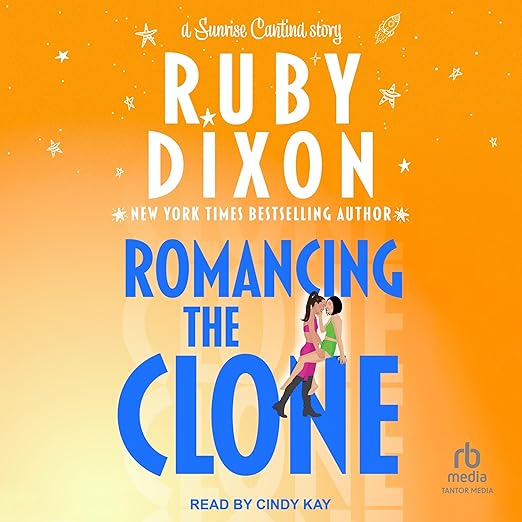
Quick Take
- Narration: Cindy Kay brings warmth and dry humor to both leads; the enemies-to-lovers dynamic works in audio because she differentiates Simone’s exasperation from Ruth-Ann’s prickliness clearly.
- Themes: Hostility as displaced attraction, belonging in an alien world, the vulnerability of caring too much
- Mood: Light and sweet, with the banter carrying more emotional weight than the short runtime suggests
- Verdict: A brief, enjoyable sapphic sci-fi romance that does not overstay its welcome, from Ruby Dixon operating comfortably in the novella format.
At three hours and twelve minutes, Romancing the Clone is not asking for a significant commitment. I finished it during an afternoon that needed a break from something heavier, the kind of listening experience where you want to know going in that the ending will be warm and that the central couple will, inevitably, find their way to each other. Ruby Dixon has been building the Sunrise Cantina universe across multiple novellas, each centered on a different pairing, and Simone and Ruth-Ann are the third entry. Cindy Kay narrates, and her handling of the enemies-to-lovers dynamic is light enough to feel playful without losing the underlying earnestness that makes the format work.
The setup is a specific kind of comedy. Simone has established a bakery cart on Risda III despite not knowing the difference between a biscuit and a babka. She is selling everything she makes, which is the part that bothers Ruth-Ann, a clone and apparent perfectionist who cannot walk past Simone’s cart without noting everything technically wrong with the product. They interact daily, briefly, with mutual irritation. Then Simone’s cart does not appear one morning, and Ruth-Ann discovers she has strong feelings about that absence.
Our Take on Romancing the Clone
The enemies-to-lovers shorthand does not quite capture what Dixon is doing here, because the enemies part is mild. Neither character is genuinely hostile to the other; what they are is avoidant about the fact that they have been paying close attention. Ruth-Ann’s daily critique of Simone’s baking is not cruelty; it is the behavior of someone who has found an excuse to maintain contact while maintaining plausible deniability about why. Dixon is good at writing this kind of indirection, and the moment when Ruth-Ann realizes she might care too much is handled with the right amount of quiet recognition rather than dramatic revelation.
One reviewer noted that the alien pet Pluto and the texture of life on Risda III give the novella more grounding than a straightforward romance would have. The Sunrise Cantina setting, including the clones, the backstory of how Simone arrived on the planet after being kidnapped by aliens, and the community of characters from previous books who appear in supporting roles, creates a world that feels inhabited rather than staged. Listeners new to the series should know that prior books are referenced without being required reading; the emotional arc of Simone and Ruth-Ann is entirely self-contained within these three hours.
Why the Clone Dynamic Adds Something Real
Ruth-Ann’s nature as a clone is not incidental. Dixon uses the background to raise, briefly and without heavy-handedness, the question of how much of Ruth-Ann’s personality was chosen versus inherited from whatever original she was copied from, and whether the distinction matters for how she experiences connection and desire. The novella does not develop this into a thesis; it is a three-hour romantic comedy, not a philosophical inquiry. But the texture is there, and it gives Ruth-Ann a specific kind of interiority that a more conventional character setup would not have provided.
What to Watch For in the Baking Scenes
The baking thread is not simply comic business. When Ruth-Ann steps in to run the cart while Simone is sick and ends up teaching her, the dynamic reversal is the emotional hinge of the story. Ruth-Ann’s expertise, which she has been deploying as critique, becomes an act of care when she applies it directly and without the protective frame of daily complaint. Dixon uses the shift without underlining it, trusting Cindy Kay and the listener to feel the change in what the same behavior means in a different context. It is a small structural move, but it is exactly right and it is what gives the resolution its warmth rather than just its inevitability.
Who Should Give These Three Hours
Ruby Dixon’s readership will find this a dependably satisfying installment. The Sunrise Cantina universe continues to deliver the cozy sci-fi romance it promises, and the sapphic pairing in this entry has a freshness that keeps the series from formula repetition. Listeners new to the series can start here without confusion; the emotional arc is fully self-contained. Those who want to start from the beginning of the Sunrise Cantina series should note that each entry centers a different couple, and none of them requires prior knowledge of the others. Skip this one if you need a full-length novel for the investment to feel worthwhile; this is designed as a short, warm, uncomplicated pleasure, and it delivers precisely that.
The Sunrise Cantina series as a whole reflects something Dixon does particularly well: constructing a universe that is hospitable to short-form romance without feeling like a delivery mechanism for it. The world has internal logic, recurring characters who feel like a genuine community, and enough ongoing plot threads across the series to reward readers who follow it sequentially rather than dipping in and out. Romancing the Clone contributes to that community texture while being entirely accessible to a newcomer. The combination is a genuine craft achievement in a genre where the pressure to be accessible often produces stories that feel thin, and the pressure to build a coherent world often produces stories that feel inaccessible. Dixon navigates between those pressures with the ease of someone who has been doing it long enough that it no longer requires visible effort.
A note on Cindy Kay’s narration for listeners who are new to the Sunrise Cantina audio productions: Kay has narrated the series consistently, which means that returning readers will find her characterizations of the clone community familiar and grounding. For new listeners, her handling of the difference between Simone’s confident-but-improvising energy and Ruth-Ann’s precise-but-uncertain emotional register is the clearest signal of what the book is doing. The comedy of their daily sparring at Simone’s cart depends on both voices being legible as distinct personalities rather than as two versions of generic romantic-comedy leads, and Kay maintains that distinction throughout the short runtime without making it feel effortful.
Frequently Asked Questions
Is Romancing the Clone the right starting point for the Sunrise Cantina series, or should I begin with book one?
Each Sunrise Cantina novella centers a different couple and functions as its own complete story. Simone and Ruth-Ann’s arc is fully self-contained, and you will not be lost starting here. Characters from previous books appear in supporting roles, but their backstories are referenced lightly rather than relied upon. Starting at book one gives more context for the overall world, but book three works independently.
How explicit is the content, and does the sapphic romance get the same treatment as other Ruby Dixon pairings?
The novella contains mature themes as noted in the product description, with romantic and sensual content between the two leads. Dixon applies consistent treatment across her pairings regardless of gender combination. The content is present but not the dominant register: the banter and the emotional arc take up more of the three hours than the explicitly romantic scenes.
One reviewer mentioned Simone’s alien pet Pluto. Is the alien setting integral to the romance, or is it essentially a contemporary setting with sci-fi decoration?
The alien setting is more than decoration but less than the focus. Risda III has its own social logic, with clones, a cantina, and the community dynamics that come from humans living in an alien environment. That texture gives the story more grounding than a straight contemporary romance would. Pluto the alien pet is mostly a charm detail rather than a plot device, but the world-building is genuine.
At three hours and twelve minutes, does Romancing the Clone feel complete, or does the length leave the relationship underdeveloped?
Dixon is practiced at the novella format and constructs the enemies-to-lovers arc with economy rather than compression. The important beats, daily contact, the disruption when contact stops, the care expressed through action, the acknowledgment of feeling, are all present and earned. The brevity is a feature of the format rather than a limitation on the story.