Quick Take
- Narration: Finn J. D. John reads with appropriate pulp energy and handles the range of Howard’s voice, the hypnotic, incantatory prose, better than many Conan audiobooks that have come before.
- Themes: secular mythology, the Hyborian Age as imagined prehistory, sword-and-sorcery as founding genre
- Mood: Epic, violent, and densely atmospheric, a sustained immersion at 35 hours
- Verdict: The most comprehensive Conan collection available in audio, with biographical context that makes it genuinely valuable for both newcomers and longtime fans of Howard’s work.
I spent the better part of three weeks with this one, commutes, evening walks, a long drive to visit my sister in the countryside, and I came away with a different relationship to Robert E. Howard than I had going in. I knew the character well enough. I had read several of the stories in scattered anthologies over the years, and I was familiar with the argument that Howard had essentially invented the sword-and-sorcery subgenre. What I had not experienced before was the full corpus in sequence, with the biographical framing that Pulp-Lit Productions has built around it, and that changes the reading considerably.
At thirty-five hours, this is not a casual commitment. It is a proper literary excavation. And the introduction’s framing, that Howard was creating a secular mythology, an imagined prehistory capacious enough to contain anything he might want to include, helped me understand the Conan stories differently than I had before. The comparison to historical fiction set in a pre-historical period is exactly right. The Hyborian Age is not fantasy world-building in the Tolkien sense. It is something older and stranger: a space where Howard could place snake-things, sorcerers, and undead creatures without the scaffolding of secondary world logic, because the whole premise is that the record is lost.
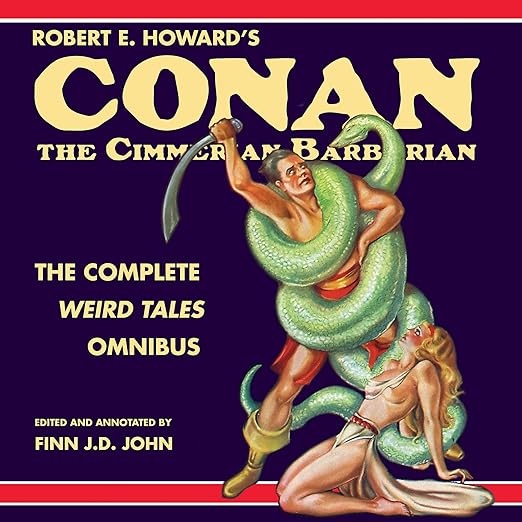
Our Take on Robert E. Howard’s Conan the Cimmerian Barbarian
The collection includes all of the Conan stories published during Howard’s lifetime, which is both the selling point and the caveat. These are stories of their era, and one reviewer’s note that they contain extremely problematic representations of women and non-Western cultures is accurate and worth stating plainly. Howard’s racial imagination is a documented problem in his work, and the Conan stories are not exempt from it. For readers who want to engage with the material as literary history, understanding where these tropes come from and why they proved so influential, that knowledge is part of the critical apparatus. For readers looking for escapist entertainment without those complications, the caveats are real.
What the collection does exceptionally well is demonstrate the range of what Howard could do within the form he invented. The better Conan stories are not simple barbarian-hits-things narratives. They are baroque and atmospheric, with a particular quality of dread that Howard achieves through accumulation and pacing. The evil races of sentient snake-things the introduction mentions are genuinely unsettling in the audio format, where Finn J. D. John’s measured delivery gives them the weight they deserve.
Why Listen to Robert E. Howard’s Conan the Cimmerian Barbarian
Finn J. D. John is an interesting narrator choice for this material. He does not perform the stories as pulp action, he reads them with the reverence of someone who understands that Howard’s prose has a ritual quality, a cadence that rewards attention. The hypnotic opening passages of the best stories land well in audio, and John sustains the energy across a very long runtime without the kind of fatigue that afflicts lesser narrators of long collections.
The inclusion of an interactive PDF with the audiobook is a genuinely useful feature for a collection this long. Having chapter numbers that correspond to the audio makes navigation practical rather than theoretical. The fact that reviewers are noting the value of this alongside the narration suggests it is actually being used, which is the test of whether supplementary materials are worth providing.
What to Watch For in Robert E. Howard’s Conan the Cimmerian Barbarian
The biographical contextualizing sections between stories are one of the collection’s strongest features and one that will matter more to some listeners than others. For those coming to Howard without a background in pulp magazine history or the history of weird fiction, those sections are essential. They explain the publication context for each story and give a sense of Howard as a figure, a young, isolated Texan who created one of the most enduring characters in genre fiction before dying at thirty. That context makes the stories sadder and stranger than they are without it.
The sheer length demands a particular kind of listening commitment. This is not a book that rewards half-attention. The density of names, places, and mythological invention in the Hyborian Age setting requires engagement, and if your listening sessions are fragmented, you may find the world less immersive than it should be.
Who Should Listen to Robert E. Howard’s Conan the Cimmerian Barbarian
Existing Howard fans who want the definitive collected edition in audio, with context, will not find better. Genre readers interested in tracing sword-and-sorcery back to its origin will find this indispensable. Newcomers who want to understand why Conan matters before diving into modern adaptations should start here. Skip it if the ideological baggage of early twentieth-century pulp fiction is a dealbreaker for you, or if thirty-five hours of a single fictional world feels prohibitive.
Frequently Asked Questions
Does this collection include the Conan stories written by other authors, like L. Sprague de Camp?
No, this is strictly Robert E. Howard’s original stories published during his lifetime. The editorial decision to exclude posthumous collaborations and pastiches is a deliberate choice that makes this the purest Howard collection available in audio.
Is this a good starting point for someone who has never read any Conan?
Yes, with the caveat that the biographical framing between stories assumes some interest in Howard as a literary figure rather than just in Conan as a character. Listeners who want action-first can skip those sections, but they add real value.
How does Finn J. D. John handle the different female characters across the stories?
The female characters in Howard’s Conan stories are largely underdeveloped by contemporary standards, and John narrates them accordingly, competently, without overplaying. The problem is in the writing rather than the performance.
Is the interactive PDF accessible on mobile Audible apps?
According to the publisher, the PDF is available via the Title column in your Audible library. Access through the mobile app has been inconsistent for some users; checking via the desktop or web player is recommended if you plan to use it.