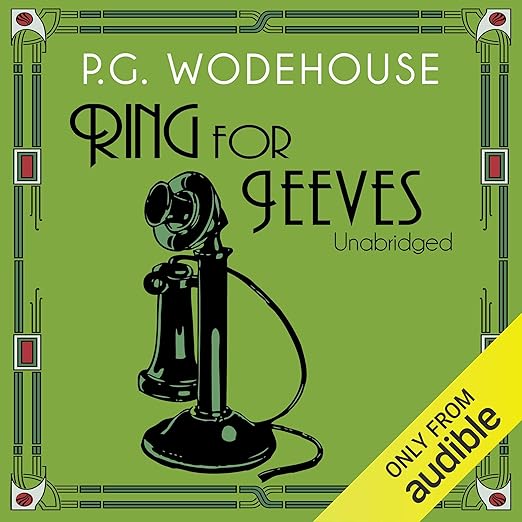
Quick Take
- Narration: Nigel Lambert delivers Wodehouse’s prose with the exact comic timing the material demands, making every sentence of impeccable Edwardian absurdity land cleanly.
- Themes: Aristocratic decline with a smile, the butler as the only competent person in the room, romantic and financial entanglement
- Mood: Light and buoyant, comfortably ridiculous
- Verdict: The only Jeeves novel written without Wooster is also one of the sharpest in the canon, and Lambert’s narration makes it feel like an afternoon in the best possible company.
I came back to Ring for Jeeves on a long train journey after a particularly draining few weeks, specifically because I knew it would ask nothing of me except to laugh. I have read Wodehouse since my early twenties, when a professor handed me The Code of the Woosters and told me it would recalibrate my sense of what prose could do. He wasn’t wrong. Ring for Jeeves, the tenth entry in the Jeeves and Wooster series, is unusual in the canon: Bertie Wooster is entirely absent, occupied somewhere off-page taking a course in self-sufficiency. Jeeves, temporarily at large, attaches himself to Bill, Lord Rowcester, and the results are exactly as satisfying as you’d expect.
Nigel Lambert’s narration is a genuine pleasure. He doesn’t oversell the comedy, which is the correct instinct. Wodehouse’s prose is so precisely calibrated that the humor emerges naturally from the sentence construction itself. Lambert trusts it, finding the rhythm of each line and letting the absurdity accumulate. One reviewer described Lambert as not to be missed, with comic timing that will have you in stitches. That’s not hyperbole.
The Aristocrat in the Gumbo
Bill, Lord Rowcester, is in the gumbo. He is, as the synopsis puts it, well and truly so. His finances are a disaster, his ancestral home Abbey is crumbling around him, and his engagement to the admirable Jill Wyvern depends on him achieving some form of solvency. His solution is to set up as a Silver Ring bookie at the races, which is exactly the kind of scheme Bertie Wooster might have devised and which requires Jeeves to quietly dismantle and replace with something less catastrophic. What follows involves borrowed jewelry, a Derby dinner at the Abbey, a formidable American widow named Mrs. Spottsworth, and a set of mauve pajamas that become a minor plot point in a way only Wodehouse could make feel logical.
The novel originated as a stage play written specifically for a production that did not feature Wooster, and this theatrical background is noticeable in the tighter scene construction and the somewhat more prominent role of the female characters. Jill Wyvern has more backbone than most Wodehouse love interests. Mrs. Spottsworth has more intelligence. The result is a novel that feels slightly different in texture from the classic Wooster-narrated books, but not lesser. Jeeves operates with his usual preternatural competence, and the fish-fed mastermind’s genius remains undimmed even without his usual charge to extricate.
What Changes When Wooster Isn’t Watching
Reading Jeeves without Bertie’s narration reveals something interesting about the series. When Bertie tells us what is happening, we see Jeeves through the warm lens of affectionate incomprehension. Bill Rowcester views Jeeves differently, with something closer to awestruck gratitude from the start, and the dynamic shifts accordingly. Jeeves is perhaps slightly less enigmatic when observed by someone who doesn’t try to explain him. He is simply the person who fixes things, and the novel doesn’t linger long on how.
One reviewer noted that Ring for Jeeves is the only novel in the canon where Jeeves appears without Wooster, and that fact gives the listen a specific interest for committed Wodehouse readers. You get to see what the manservant is like outside his primary relationship, and the answer is: essentially the same, only perhaps a fraction more visible. Lambert’s narration leans into this slightly, giving Jeeves a measured gravity that coexists comfortably with the surrounding farce.
Who Should Listen and Who Should Start Elsewhere
If you have not read Wodehouse before, this is not the ideal entry point. The pleasure of Ring for Jeeves is partly the pleasure of recognition, of seeing Jeeves operate without his usual principal, and newcomers will miss that dimension. Start with Right Ho, Jeeves or The Code of the Woosters and come back to this one after you’ve developed an affection for the world.
If you already love the series, this is essential listening. It’s a richer, sharper novel than its light premise suggests, and Lambert’s performance is consistent with the best Wodehouse audio adaptations. Fans who enjoy comedy that rewards attention as much as it rewards simple listening will find plenty to appreciate in the subsidiary plotting, the secondary characters, and the quietly devastating sentence-level wit that Wodehouse deployed with unfailing precision across six decades of writing. The six hours and forty-nine minutes pass remarkably fast.
Lambert’s Comic Inheritance
It is worth pausing on what Lambert actually does in this recording. Wodehouse sentences are long, loaded, and syntactically adventurous in ways that can become confusing read badly and brilliant read well. Lambert has the architectural instinct to build each sentence so that the punchword or punchclause arrives at exactly the right moment in the listener’s ear. He never rushes through the setup to get to the joke. He knows the setup is half the joke. The mauve pyjamas passage, the borrowing of Mrs. Spottsworth’s pendant, and the various Derby dinner complications are all managed with the control of someone who understands that Wodehouse’s comedy is essentially musical, a matter of rhythm and return as much as of content. This is not accidental. It is craft, and it rewards repeated listening from anyone who wants to understand how spoken comic prose actually works.
Frequently Asked Questions
Does Ring for Jeeves work if I haven’t read other Jeeves and Wooster books?
It functions as a standalone story, but the specific pleasure of seeing Jeeves without Wooster will be lost on newcomers. The comedy is self-contained, but series readers will get considerably more from it.
Why is Bertie Wooster absent from this novel?
The book originated as a stage play written for a production that didn’t feature the character. In the novel, Bertie is off at a school teaching aristocrats to fend for themselves, which is its own Wodehousian joke.
How does Nigel Lambert’s narration compare to other Jeeves audiobook narrators?
Lambert is widely praised for his comic timing and feel for Wodehouse’s rhythms. He doesn’t attempt to match the blustering warmth of a Bertie-led narration since this novel has a different register, and his cleaner, more observational delivery suits it well.
Is the humor accessible to American listeners unfamiliar with British class culture?
Largely yes. Wodehouse’s comedy operates on universal principles of incompetence, pretension, and well-timed chaos. Some in-jokes about the British aristocracy will land harder for UK listeners, but the broad absurdity travels well.