Quick Take
- Narration: Zehra Naqvi gives Naima a voice that balances a young girl’s eagerness with the genuine weight of her situation, and handles the Bangladeshi cultural context with evident care.
- Themes: Traditional art as identity and value, gender and economic constraint, resourcefulness and repair
- Mood: Warm and urgent, with the particular tension of a child trying to solve an adult problem
- Verdict: A compact and affecting story about a Bangladeshi girl whose skill with a traditional art form becomes the unexpected means of saving her family from debt.
I listened to Rickshaw Girl on a Tuesday afternoon, drawn in by a recommendation I had flagged months earlier and then forgotten. At just over an hour, it is the kind of audiobook that asks very little of your time and delivers considerably more than you anticipated when you started.
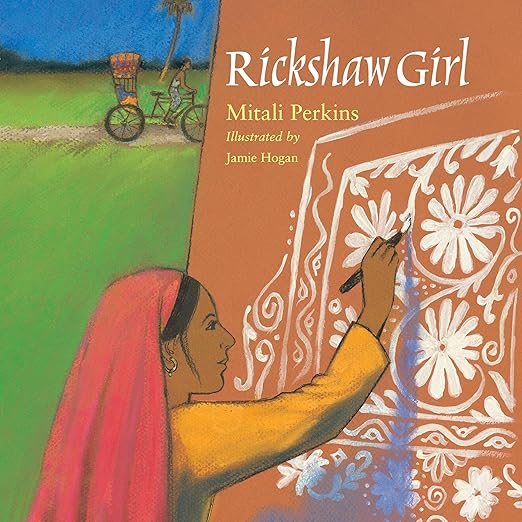
Naima is one of the most talented painters of alpana patterns in her village in Bangladesh. Alpana are traditional decorative designs that women and girls paint on houses for festivals and celebrations, intricate geometric and floral forms that carry cultural and spiritual significance. Naima is gifted at this art. She is also profoundly frustrated that her gift does not translate into the thing her family needs most, which is money. Her best friend Saleem earns income for his family. Naima cannot, because she is a girl in a context that does not provide that path.
The Alpana Pattern as More Than Symbol
Mitali Perkins is careful to treat alpana not as a decorative element but as a genuine art form with cultural depth. The novel grounds Naima’s skill in an actual Bangladeshi tradition rather than using it as a vague exotic backdrop. This precision matters. It means that when Naima’s art eventually becomes the key to resolving the family’s crisis, the resolution has a logical integrity. Her skill at alpana is not metaphorical; it is a transferable practical ability, and the story traces how that ability finds an unexpected application. The path from traditional art to practical solution is surprising without being implausible.
Zehra Naqvi and the Weight of a Short Listen
At seventy-three minutes, this audiobook does not have room for slow development. Naqvi works efficiently, establishing Naima’s warmth and impatience in early scenes with the kind of characterization that would take a lesser performance twice as long. The Bangladeshi setting is rendered with specificity: the heat, the family’s financial situation, the social world that limits Naima’s options. Naqvi navigates the class and gender dimensions of the story without overdramatizing them, allowing the listener to understand Naima’s constraints through the texture of daily life rather than expository explanation.
What the Rash Decision Costs and What It Repairs
The central plot turn, Naima making a rash decision that puts her family deeper in debt, is handled with the right kind of gravity. It is not a trivial mistake, and the consequences are real. The story does not rush past the weight of what Naima has done, which is important for young listeners learning to calibrate the relationship between intention and consequence. The eventual repair involves her artistic skill, her resourcefulness, and an unusual application of both that I will not detail here. The resolution is earned rather than gifted.
Who Should Listen, Who Should Skip
This is a natural recommendation for ages eight to twelve, particularly for children interested in global perspectives and girls navigating systems that underestimate them. Teachers have found it an excellent classroom read-aloud for introducing discussions of gender, traditional art forms, and economic constraint in a narrative that does not require prior cultural knowledge. The brevity makes it accessible even for reluctant listeners. It has been adapted for film, which younger audiences may find interesting as a gateway. Those expecting a longer, more complex story arc should note the book’s compact scope, which is a feature of its form rather than a limitation.
Frequently Asked Questions
What is alpana, and does the audiobook provide enough context to understand its cultural significance?
Alpana are traditional decorative patterns painted by women and girls on the walls and floors of homes during celebrations in Bangladesh and parts of South Asia. Perkins provides sufficient context within the narrative; no prior knowledge is required to understand what the art form means to Naima and her community.
How does the story handle the gender constraints Naima faces without making the book feel like a lesson?
Perkins embeds the constraints in the texture of Naima’s daily life rather than stating them as problems to be solved. Naima’s frustration is specific and personal, which makes the larger social dimension feel lived rather than illustrated. The resolution does not dismantle the gender norms but shows Naima finding agency within them.
At 73 minutes, is this audiobook complete enough to feel satisfying, or does it feel truncated?
The length is appropriate to the story’s scope. This is a focused narrative about a specific crisis and its resolution, not a sprawling family saga. Reviewers have consistently found the pacing satisfying. It functions more like a long short story than a novel, which suits the listening format well.
The book has been adapted for film. Does the audiobook anticipate or reference that in any way?
The audiobook edition predates the film. The mention of an upcoming movie adaptation appears in the marketing copy for some editions but is not part of the audiobook experience itself. The story works entirely independently of any film version.