Quick Take
- Narration: Listed as ‘à venir’ (forthcoming), this French-language edition from Audiolib was pending its narrator assignment at time of release.
- Themes: Obsession and fanaticism, the dangerous edges of scientific inquiry, addiction and recovery
- Mood: Slow-burning and electric, with a finale that several readers describe as a slap in the face
- Verdict: A Stephen King novel that earns its Lovecraftian ambitions through patience, this French-language edition from Audiolib gives francophone listeners access to one of his most unsettling later works.
Revival is not one of Stephen King’s louder books. It doesn’t announce itself with a haunted hotel or a killer clown. It accumulates. I read the English-language original several years ago, and coming back to it in the context of this French-language Audiolib edition, I found myself thinking about how well the novel’s architecture actually works. The slow burn that some readers find frustrating is, in fact, the engine of everything that comes after.
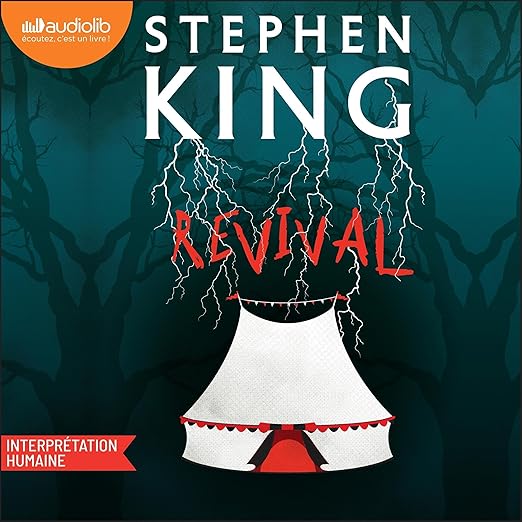
This is the Audiolib French edition, released April 2026, which means it’s aimed squarely at francophone readers who want King’s prose in their native language. The translator’s choices matter enormously for a novel that depends on tone and register, and from what the reviews suggest, the edition delivers what King’s admirers expect. One French reviewer called it a King that changes things, and the opening observation that the children are there from the beginning tells you something about what she noticed and valued.
Jamie, Jacobs, and the Long Shadow of Electricity
The novel spans decades. Jamie Morton meets the charismatic Reverend Charles Jacobs as a child in the small Maine town of Harlow, and their shared obsession with electricity creates a bond that neither man can fully escape. When Jamie encounters Jacobs again thirty years later, Jamie has become a guitarist consumed by substance abuse, and Jacobs has shed his ministry for something far more dangerous. The synopsis frames their reunion with the word “renaissance,” which in French carries a weight beyond simple rebirth, and that double meaning runs through the whole novel.
King’s explicit invocation of Edgar Allan Poe, Nathaniel Hawthorne, and Lovecraft is not decorative. Revival is a novel in the tradition of what Lovecraft called cosmic horror, the kind of dread that comes not from monsters you can see but from truths you cannot unfind. The electricity that connects Jamie and Jacobs is both literal and metaphorical, and King is careful never to fully separate those registers.
The Slow Start That Earns Its Ending
The reviews, even the admiring ones, share a recurring observation: this book starts slowly. One reviewer noted it always takes time to start but delivers a slap in the face at the end. Another who was less impressed felt that King had conditioned readers to expect more. That division is meaningful. Revival is a novel that demands you invest in Jamie’s ordinariness, his failed relationships, his years of addiction, his drifting life on the road. Without that investment, the final act lands with less force than King intends.
The addiction and recovery arc that runs through the middle section is one of King’s more grounded and quietly effective treatments of substance abuse in his fiction. It doesn’t play for sympathy in obvious ways. Jamie isn’t a likable protagonist so much as a recognizable one, and that distinction matters for how you receive what happens to him by the novel’s end.
The French Edition and Its Audience
A note on the edition itself: several reviews on the English-language version complained about receiving the French edition by mistake, which is simply a matter of selecting the wrong format during purchase. The Audiolib edition is specifically for francophone listeners and is not a translation error. The narration was listed as forthcoming at the time of the data pull, meaning the narrator assignment had not yet been confirmed for the April 2026 release. Human narration is confirmed in the edition description, which is the right call for material this atmospherically dependent.
For French-speaking King fans who want to experience Revival in their primary language, this edition fills a real gap. The novel’s particular combination of small-town Maine nostalgia, spiritual crisis, and Lovecraftian horror translates well, and the Audiolib catalogue has generally maintained strong production values for their King releases.
Who This Edition Is For
Revival in any edition is best suited for readers who have patience for slow, character-driven buildup and who appreciate horror that operates through implication and dread rather than explicit violence. Francophone listeners who already enjoy King’s work in translation will find this edition a strong addition to the catalogue. Those who prefer his more kinetic novels, IT or The Shining or Pet Sematary, may find the pace here harder to settle into.
Skip it if you want King at his most propulsive. This is a different kind of book, quieter and more philosophically ambitious, and the payoff is proportionate to the patience you bring to it.
Frequently Asked Questions
Is this the French-language edition of Stephen King’s Revival, and does that affect the story?
Yes, this is the Audiolib French-language edition released in April 2026. The story and plot are identical to the English original. The difference is the language and translation, French-speaking listeners get King’s novel in their native tongue, which for a novel this atmospheric can actually enhance the immersion.
The narrator is listed as ‘à venir’, does this edition have a human narrator or AI narration?
The edition description confirms human narration, with the narrator’s name listed as forthcoming at the time of data collection. Audiolib is a reputable French publisher with strong audiobook production standards, so the narration quality should reflect that.
How disturbing is Revival compared to King’s other work? Is the horror graphic or more psychological?
Revival is primarily psychological horror in the Lovecraftian tradition. It builds dread through accumulation and implication rather than graphic violence. The ending is disturbing in a cosmic, existential sense. It’s not King at his most visceral, but the unease it generates is durable.
Do I need to have read other Stephen King novels to appreciate Revival?
No prior King reading is required. Revival works as a standalone. King’s references to Poe, Hawthorne, and Lovecraft enrich the reading if you know those authors, but they’re not necessary for the emotional or narrative impact.