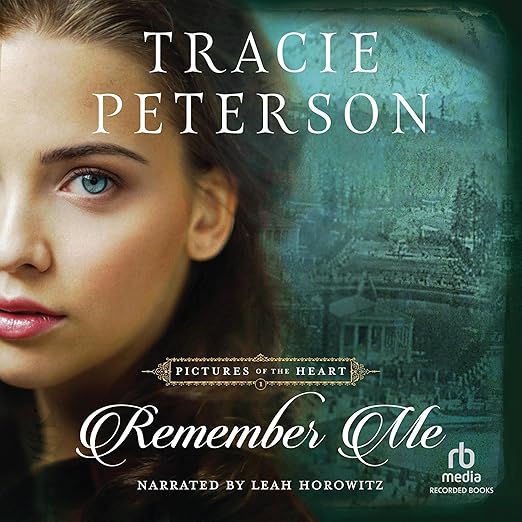
Quick Take
- Narration: Leah Horowitz brings the historical period to life with warmth and clarity, well matched to Peterson’s conversational prose style.
- Themes: shame and forgiveness, faith as foundation for healing, historical photography at the turn of the century
- Mood: Tender and unhurried, with the cadence of a Christian historical romance that takes its emotional stakes seriously
- Verdict: A well-crafted opener to the Pictures of the Heart series, strongest in its historical detail and its handling of shame as a spiritual problem rather than a plot obstacle.
I picked up Remember Me on a slow Sunday, the kind where the weather makes you want something that will settle you into another time and place entirely. Tracie Peterson has been writing Christian historical fiction for decades, and she has developed an instinct for the particular comfort her readers are looking for: a well-researched historical world, emotional stakes that feel genuine rather than manufactured, and a faith framework that functions as the architecture of healing rather than decoration on top of it. This first book in the Pictures of the Heart series delivers on all three.
The premise centers on Addie Bryant, a woman whose past carries a specific kind of shame, having been sold to a brothel owner after her father’s death before managing to escape, and whose present life in 1909 Seattle is organized around concealment. She is training Camera Girls to sell Brownie cameras at the Alaska-Yukon-Pacific Exposition, which is a lovely historical detail: this was the period when photography was transitioning from a professional speciality to something accessible to everyday people. Peterson uses this setting with care, and reviewers who note the educational quality of the book are responding to genuine research.
Our Take on Remember Me
Peterson’s handling of Addie’s shame is the strongest element of the novel. In less careful hands, the brothel backstory might function as a simple obstacle between heroine and hero, a secret to be revealed, weathered, and forgiven in roughly that order. Peterson is interested in something more interior. Addie’s shame is not primarily about what Isaac will think when he discovers the truth; it is about what she has allowed herself to believe about her own worth. The faith dimension of the book operates precisely here, in the argument that forgiveness is not earned but given, which is a theological claim that Peterson dramatizes rather than simply stating.
One reviewer quoted a passage directly: No one is worthy. We don’t get forgiveness because we have earned it. It’s a gift. This is the emotional and spiritual center of the novel, and Peterson builds the rest of the narrative architecture around getting Addie to the place where she can receive that claim rather than deflecting it. The romance with Isaac is secondary to this interior journey, which is an unusual choice in the genre but the right one for this particular story. Readers accustomed to romance that places the relationship at the center will notice that Peterson is primarily interested in Addie’s relationship with herself and with God, and the love story is the vehicle rather than the destination.
Why the Historical Setting Does More Than Provide Backdrop
The Alaska-Yukon-Pacific Exposition of 1909 is not a well-known historical event for most readers, and Peterson uses this to her advantage. The world’s fair context provides natural opportunities for the kind of reunion that romance plots require, but it also situates Addie’s work in a specific moment of technological and social change. Women entering the workforce in new roles, photography becoming democratic, Seattle positioning itself as a gateway to the Pacific Northwest during a period of rapid development: these details give the novel a texture that distinguishes it from generic historical romance.
Leah Horowitz’s narration suits the material well. She has a warmth that matches Peterson’s prose style, and she handles the period dialogue with a naturalness that avoids the staginess that sometimes affects historical fiction narration. The pacing is unhurried in keeping with the genre conventions, which some listeners will find comfortable and others will find slow. Peterson is not writing for readers who want their romances compressed; the emotional journey she is charting requires time, and the audiobook respects that without overstaying it.
What to Watch For in the Series Architecture
This is the first book in a series, and it is structured accordingly. The resolution of Addie and Isaac’s story is complete enough to be satisfying, but the Camera Girls program and the world Peterson has built around it are clearly positioned for continuation. Secondary characters are introduced with enough dimension that returning to them in subsequent books will feel natural rather than perfunctory. Readers who find themselves drawn to the specific premise of women navigating professional identity through photography in a transitional historical moment will want to continue into the series.
One reviewer noted it was not their favorite Peterson book while still recommending it, which is the honest calibration for longtime fans of her work. Within the full Peterson catalog this may not be the place to start, but for readers coming to her for the first time, it is a solid and characteristic entry point that represents her strengths faithfully.
Who Should Listen to Remember Me
Christian historical romance readers who enjoy Tracie Peterson’s established voice will find this a satisfying series opener. Listeners who appreciate historical fiction with genuine research depth, particularly around Pacific Northwest history and early photographic technology, will find the setting rewarding in its specificity. This is not a book for readers who want fast-paced plots or romance with significant physical tension; it is a slow and interior story about faith and shame that resolves with warmth rather than drama. First-time Peterson readers looking to understand her appeal will find this a representative and welcoming entry point.
Frequently Asked Questions
Does Remember Me need to be listened to first in the Pictures of the Heart series, or can you start anywhere?
The series appears to follow different characters across the same historical world, so later books likely work as independent listens. However, Remember Me establishes the Camera Girls program and some recurring context, so starting here gives a richer foundation for what follows.
How explicit is Addie’s backstory involving the brothel? Is the content handled sensitively?
Peterson handles the backstory with deliberate restraint. The traumatic events are referenced and their emotional weight is taken seriously, but the depictions are not graphic. The focus is on how Addie has internalized shame rather than on the events themselves, which keeps the material within the conventions of the genre.
Is this audiobook accessible to listeners who are not Christian, or does the faith content dominate?
The faith framework is integral to the novel’s resolution and cannot be separated from the story Peterson is telling. Non-Christian readers will recognize the emotional architecture as genuine and the characters as well-drawn, but the theological claims about forgiveness and grace are not presented as metaphorical. Listeners who find Christian fiction comfortable will feel at home; those who find it alienating should know the faith content is substantive.
How accurate is the Alaska-Yukon-Pacific Exposition setting, and does it enhance the story or feel like set dressing?
Reviewers specifically note the historical detail as one of the book’s strengths, and the exposition setting does real narrative work. It provides a natural gathering place for characters who would not otherwise cross paths, situates Addie’s Camera Girls work in an authentic context, and gives the story a sense of historical specificity that Peterson clearly researched carefully.