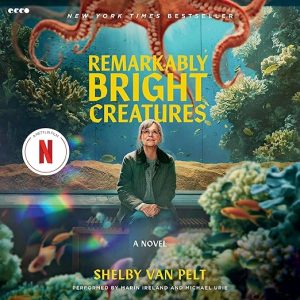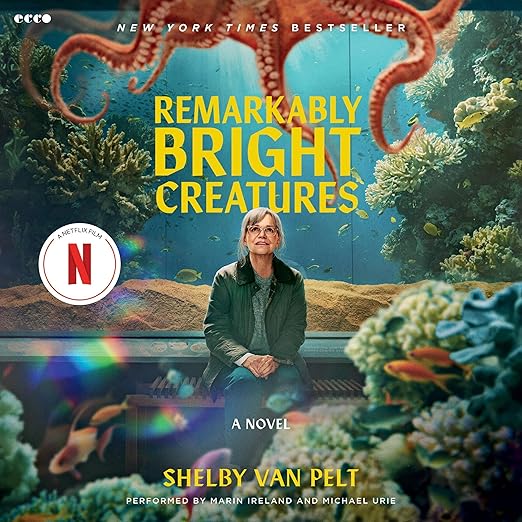
An octopus shares the billing on this audiobook, though the credit line does not admit it. The metadata names Marin Ireland alone. The first line of the description says the edition is read by Marin Ireland and Michael Urie as Marcellus, and Marcellus is a giant Pacific octopus who narrates in the first person, holds his keepers in low regard, and has already worked out what happened to a boy who vanished thirty years ago. Eleven hours and sixteen minutes of Puget Sound grief, routed through a cephalopod.
Tova Sullivan works the night shift at the Sowell Bay Aquarium, mopping floors and tidying up, a widow who has kept herself occupied since her eighteen-year-old son Erik vanished from a boat in Puget Sound. Cameron, a thirty-something who has just landed from California, turns up as her temporary replacement while looking for the father he never knew. Marcellus watches both of them from his tank. Shelby Van Pelt rotates the three of them, and the octopus chapters are the ones people repeat to each other.
The gambit could have curdled. What keeps it upright is that Van Pelt gives Marcellus real limits: an old invertebrate body, a shrinking amount of time, and no way at all to tell the one person who needs to know. He is a detective with the solution and no language for it. Van Pelt keeps him funny as well, which buys a great deal of patience. That constraint does more narrative work than the novelty of an octopus point of view, and it is the reason the sentimental machinery underneath does not pull the whole thing over.
A five-star posted on February 21, 2026 reports that a book club picked this as its favorite of the year, and praises characters that account calls relatable and flawed. That is a fair description of the register. The same response is impatient for the adaptation, which the description confirms is heading to Netflix. If you want the novel behind you before the film lands, eleven hours is not a heavy commitment for a story this unhurried.
Two Narrators, Two Species, One Real Argument
Two readers, two species, and that is the argument for the recording over the page. Marcellus does not simply get a new chapter heading here; he gets a different human being, which turns the alternation into something you hear rather than something you register visually. The publisher's copy claims a finalist placing for Audiobook of the Year. A trade notice reproduced at the top of the listing names both readers and credits each by role, and that notice, rather than the customer pool, is where the page's comment on the performances comes from.
The animal-narrator device has company, and a January 2024 five-star reaches for the nearest neighbor, saying no debut had hit that reader so hard since Hollow Kingdom, another book that unfolds through an animal's eyes. Take the comparison as a warning label as much as a recommendation. If a novel narrated by a creature has always struck you as twee, eleven hours will not change your mind, and the sections in Tova's and Cameron's voices are conventional enough that they will not carry you on their own.
The listing's closing line calls the novel a gentle reminder that a hard look at the past can uncover a future that once felt impossible. Gentle is right. The stakes are domestic, the reveals arrive on a schedule most listeners will anticipate, and the pleasure is in watching Tova reach a place the audience got to first. Audio suits that shape. A book you are ahead of is easier to enjoy at a pace somebody else is setting.
Trade Notice and Summary Disagree on the Son
The four-star from January 2026 puts a finger on the weak seam. That response enjoyed the flow and the odd choice of an octopus witness, then balked at Cameron's sudden improvement in work ethic once he lands in Sowell Bay, asking whether it was the job, the place, or something else. I had the same hesitation. Cameron is plot machinery more often than he is a person, and the novel needs him to change on a timetable the character has not earned.
The listing itself is assembled rather than written. A trade review sits above the plot summary, a stray angle bracket has survived into the first line of that summary, and the two blocks disagree with each other: the trade notice says Tova's teenage son died under mysterious circumstances, while the publisher's summary describes an eighteen-year-old who mysteriously vanished at sea three decades ago. Read the full page before pressing play and you will hold the novel's emotional architecture in advance.
One practical consequence of the thin credit line: a listener browsing by narrator will not see Michael Urie attached to this title at all, and a second voice is a real part of what the money buys. The five visible responses run five, five, four, five and five against an aggregate of 4.6 across 134 ratings, and the only assessment of the reading anywhere on the page comes from the trade magazine, not from a customer.
Come for the Octopus and the Natural History
Come to this one for the aquarium and the octopus rather than for the crime. A March 2026 five-star says the author depicts the behaviors and skills of the octopus accurately and concludes she did her research, and that is the layer with the most texture: what a captive animal can reach, open and get away with, and how little time he has left to do it. The natural history holds the novel up, and it is plainly the material Van Pelt enjoyed writing most.
Skip it if you need a puzzle to behave like a puzzle. This is a domestic story with a mystery inside it, not a mystery with a domestic setting, and the resolution is soft by design. Worth knowing before you start: a child's disappearance and a parent's decades-long grief sit at the center, and the book keeps returning to both rather than clearing them early. Listeners after a fast crime plot with an animal attached will find the pacing slow.
For the right listener this is a comfortable, sad, faintly ridiculous eleven hours with a genuine ache underneath, and the two-voice production is the version worth buying. Buy it knowing the page undersells what you get. A second reader, a trade citation and an award shortlist all sit behind this recording, and none of the three appears where a browsing listener would look first. The octopus deserved a better page.
Frequently Asked Questions
Who reads the Marcellus chapters in the Remarkably Bright Creatures audiobook?
The narrator credit names Marin Ireland only. Michael Urie voices Marcellus, a fact the publisher's own summary supplies and the credit does not, so the octopus sections come from a second reader. Anyone paying for a split cast should confirm it there, because Urie's name appears nowhere in the listing metadata.
Should I hear the audiobook before the Netflix adaptation arrives?
The description confirms a film is coming. Eleven hours and sixteen minutes is a manageable run for a novel this unhurried, and the recording has already solved the problem the adaptation will have to solve: giving a first-person octopus a body and a voice. Hearing Urie's Marcellus first gives you a benchmark.