Quick Take
- Narration: Tanya Eby handles the dual-POV structure between Morgan and Clara with clear differentiation, maintaining emotional credibility through the most difficult passages.
- Themes: Grief after sudden loss, mother-daughter estrangement, secrets that fracture families
- Mood: Emotionally raw, at times quietly devastating, with a final act that earns its resolution
- Verdict: Colleen Hoover working in a register that suits her strengths, and Tanya Eby’s narration is exactly the right match for this kind of domestic tragedy.
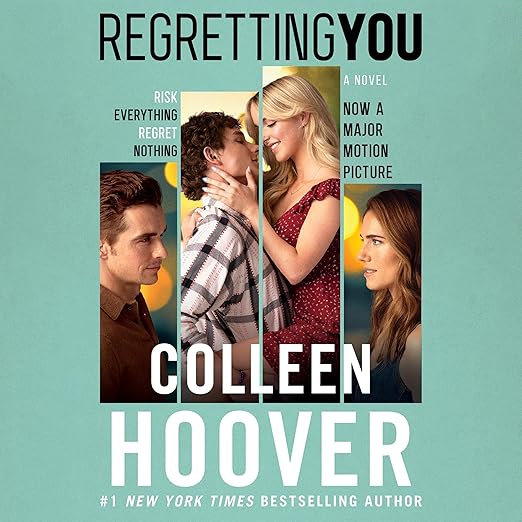
I listened to Regretting You on a Sunday when I had the house to myself, which turned out to be the right conditions for it. Colleen Hoover’s novels tend to require some emotional bandwidth, and this one in particular earns its reputation for landing hard in ways you are not entirely prepared for. The premise is deceptively contained: Morgan Grant, who gave up her own plans to start a family young, and her sixteen-year-old daughter Clara, who resents her mother’s caution as much as Morgan fears Clara repeating her choices. Then Chris, husband and father and the person who keeps them from each other’s throats, is killed in a car accident under circumstances that are not what they first appear to be.
Tanya Eby narrates the dual-POV structure, alternating between Morgan’s and Clara’s perspectives, and she does it well. The two voices are distinct without being exaggerated, which is the technical challenge of this kind of split narration. Eby keeps both women grounded and human, which matters especially in the second half, when both characters are behaving in ways that are recognizably self-destructive and not always easy to sympathize with.
Our Take on Regretting You
Hoover is working in familiar territory here, domestic grief, family secrets, romantic entanglements that emerge in the worst possible context, but she handles the mechanics of it with more care than some of her more compressed novels allow. The relationship between Morgan and Clara is the real engine of the book, and it is drawn with enough specificity that the misunderstandings between them feel earned rather than contrived. One listener described it as “messy and painful and painfully real,” which captures something true about how Hoover renders the silence between people who love each other and cannot say so.
The romantic subplot, Morgan finding comfort with Jonah, a man connected to Chris, has divided readers. One reviewer called the outcome predictable, which is fair. It is not a mystery where that relationship ends up. But Hoover seems less interested in surprise than in the texture of the approach, the guilt, the argument with herself, the way attraction surfaces in grief. Whether that satisfies will depend on your patience for the internal debate.
Why Listen to Regretting You
The audiobook format works particularly well for this novel because so much of the emotional content is embedded in unspoken tension, in what Morgan and Clara cannot bring themselves to say to each other. Having two voices in your ears narrating from their respective positions of misunderstanding creates a kind of dramatic irony that is heightened in audio. You know what each woman is withholding from the other, and Eby’s narration keeps both perspectives genuinely felt rather than letting one become unsympathetic.
The book has since been adapted into a film starring Mckenna Grace, Mason Thames, Allison Williams, and Dave Franco, which may bring new listeners to it after watching the movie. Those listeners will find the audiobook expands considerably on the interior experience of both characters in ways that film adaptation necessarily compresses.
What to Watch For in Regretting You
The pacing in the middle section is slower than the opening, and some listeners who came expecting Hoover’s more propulsive recent work may find the domestic register requires more patience. The novel is fundamentally about two people learning to grieve in parallel without being able to help each other, and that kind of story moves at the speed of emotional thaw, which is not always fast.
The revelation about Chris and its implications is handled without the full weight a reader might hope for, and at least one reviewer noted that the final chapters feel summarized rather than fully dramatized. Hoover resolves her characters with intention but a little quickly, and in a story this invested in emotional complexity, the closure can feel premature.
Who Should Listen to Regretting You
This audiobook is well-suited to listeners who respond to Hoover’s emotional directness and want something with more domestic and familial substance than her purely romantic novels. It is also a strong recommendation for anyone who enjoyed dual-POV family dramas by authors like Lisa Jewell or Liane Moriarty, where the focus is on what families hide from each other and the cost of those silences. Listeners who need their grief narratives to stay at a safe emotional distance should probably look elsewhere.
Frequently Asked Questions
Does Tanya Eby make the dual-POV structure work, or does it get confusing?
Eby differentiates Morgan and Clara clearly enough that the transitions between perspectives are rarely disorienting. The two voices carry different emotional registers, with Morgan’s carrying more resignation and Clara’s more volatility, and Eby sustains that distinction throughout the eleven-hour runtime.
How does this compare to other Colleen Hoover audiobooks in terms of tone?
Regretting You is more family-focused and less purely romantic than books like Verity or November 9. The emotional stakes are domestic rather than thriller-driven, and the tone is closer to literary fiction in its treatment of grief, even if the plot mechanics are genre-standard.
Is the film adaptation faithful to the book, and should I listen to this before or after watching the movie?
The audiobook expands considerably on the interior experience of both Morgan and Clara in ways the film cannot fully replicate. Listening first gives you the full emotional foundation; listening after the film gives you more depth on scenes that were necessarily compressed in adaptation.
The synopsis mentions a questionable accident involving Chris. How much of a mystery element does the book carry?
The accident and its circumstances form the central rupture of the story, but the book is not structured as a thriller or mystery. The revelations about what really happened emerge through domestic detail and character disclosure rather than investigation, and the focus remains on how the truth affects Morgan and Clara’s relationship rather than on solving what occurred.