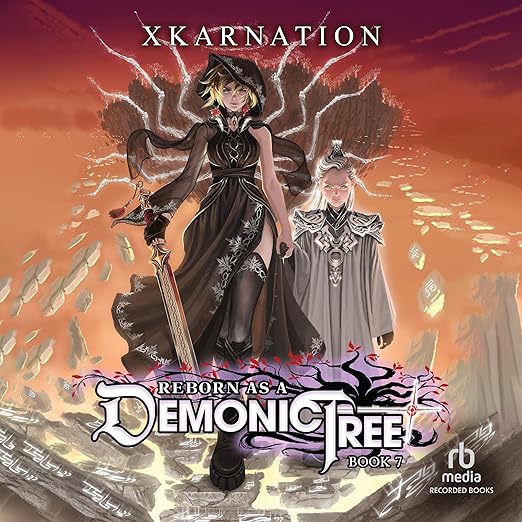
By the time a series reaches its seventh volume, the reviewer's job changes. You are no longer evaluating whether the premise works - that question was settled books ago for anyone still here. What you are asking instead is whether the series is maintaining integrity at scale, whether the world is deepening or merely expanding, and whether the author is still interested in the questions that made it worth reading in the first place. Reborn as a Demonic Tree 7 answers all three of those questions well.
I came to this series relatively recently, catching up on volumes 1 through 6 over the course of two months, which meant I arrived at volume 7 with the whole arc fresh in mind. The premise - a consciousness inhabiting a demonic tree within a cultivation world, slowly accumulating power, alliances, and something like a family - is one of the more genuinely inventive entry points in the LitRPG fantasy genre. XKarnation has been careful not to let the demonic tree high concept become a gimmick; by volume 7, Ashlock's immobility is a political and philosophical condition as much as a physical one.
What Kind of Ruler Ashlock Wants to Be
The central tension of this volume follows directly from the destruction of the Blood Lotus Sect. Victory at that scale leaves a power vacuum, and XKarnation is serious about the messy aftermath. Millions of mortals died during what the narrative calls the Night of Reckoning, and the survivors are not simply grateful - they are scared, displaced, and watching Ashlock's new order with suspicion. The question of what kind of ruler Ashlock wants to be is not rhetorical. It shapes every major decision in the book.
This is where the series distinguishes itself from cultivation fiction that is primarily power-scaling dressed in political clothes. Ashlock does not have clean answers. The Ashfallen Sect's relationship with the All-Seeing Eye complicates public trust. The approaching beast tide creates urgency that forecloses some of the deliberative options. And the supporting characters - Rhyker, Kaida, Stella - each carry their own agendas and growth arcs that do not always align neatly with Ashlock's preferred resolution. One reviewer noted especially good attention to developing the supporting cast this entry, with real character growth rather than just power scaling, which captures something real about how XKarnation is pacing volume 7.
Kaida's Evolution and the Rescue of Rhyker's Mother
The series rewards patient readers who want cultivation fiction with genuine philosophical texture. The Night of Reckoning aftermath is handled with more moral seriousness than most genre entries would bother with. There is a funeral sequence early in this volume that several reviewers cite, and it earns its weight - the deaths that preceded it were not consequence-free, and XKarnation does not pretend otherwise. The creation of an afterlife, the dialogue with the World Tree, and the subjugation of the Silverspire family are all significant plot beats that feel like they matter in the larger arc rather than being filler installments.
Kaida's latest evolution is a particular highlight for readers invested in the companion characters, and the rescue of Rhyker's mother adds a personal dimension to what could have been purely strategic combat. The series has always been good at making its battles mean something beyond the stat increases they generate.
A Missing Narrator Credit Worth Checking
Listeners who have not read the prior six volumes should start at the beginning without question. Volume 7 does not recap enough for new readers to orient themselves, and the emotional weight of the character developments depends entirely on accumulated context. This is not a criticism - long-running series earn the right to assume familiarity - but it is worth stating plainly.
The narrator information is missing from the available metadata for this Recorded Books release. Given the series has had consistent narration in prior volumes, this may simply be a data gap, but it is worth verifying before purchasing the audiobook specifically. One reviewer's question about Ashlock's stage progression after defeating Vincent Nightrose suggests some readers track the power-scaling closely alongside the narrative, and those expecting a major cultivation breakthrough in this volume may find the pacing more character-focused than they anticipated.
Satisfying for Fans Current Through Volume Six
Fans of the Reborn as a Demonic Tree series who are current through volume 6 will find this a satisfying continuation - one that takes the aftermath of the previous arc seriously and sets up the next chapter of Ashlock's rule with genuine consequence. Readers new to cultivation LitRPG who are intrigued by the concept should start at volume 1. Those who primarily want power-scaling action with minimal political and philosophical weight may find this installment more measured in pace than they prefer, though the action sequences remain present and well-executed.
Common Questions
Is this volume more focused on political aftermath or on action and combat?
Both are present, but this volume leans more heavily into the political and philosophical consequences of Ashlock's victory over the Blood Lotus Sect. There is meaningful action, but reviewers note the emphasis is on governance and character development rather than pure power-scaling.
Does Kaida have significant screen time in volume 7?
Yes - Kaida's latest evolution is specifically mentioned by reviewers as a highlight, and the supporting cast receives more development here than in some prior volumes.
Is there a confirmed narrator listed for the audiobook version?
The narrator field is not populated in the available metadata for this Recorded Books release. It is worth checking the Audible listing directly before purchasing to confirm narration details.