Quick Take
- Narration: Emily Sutton-Smith brings genuine emotional investment to Katherine’s chapters, though the dual-perspective structure requires some adjustment from listeners accustomed to single-POV alien romance.
- Themes: Cosmic devotion and possession, survival across unfamiliar worlds, love as an act of will across impossible distances
- Mood: Intense and melodramatic, with genuine emotional peaks and an AI character who steals scenes
- Verdict: A sprawling alien romance entry that rewards series readers more than newcomers, with some prose roughness that enthusiasts overlook and critics do not.
I should tell you upfront that RaZ is the fourth book in the Darverius, House of DaR series, and that entering at book four without the prior context is, as one series reader put it bluntly, a struggle even for people who have read everything before it. I came to this one cold, and I will be honest about what that experience was like alongside what I can identify about what works for the audience this book is genuinely made for.
The setup operates on a scale that alien romance as a genre tends to favor: RaZ has crossed galaxies, traveled for years, to find Katherine, a woman who has lost everything she loved and is, as the book opens, lost in an in-between state, drawn back to the living by a heartbeat and a whisper. The dueling first-person chapters alternate between Katherine’s grief-saturated perspective and RaZ’s absolute certainty about what she is to him, that bone-deep alien conviction that makes this subgenre work when it works: the sense that you are reading about love as a fundamental force rather than a romantic preference. The alternation takes a few chapters to settle into, but once it does, the structure serves the emotional dynamic well.
The Scale of What Jennifer Julie Miller Is Building
One of the things that becomes clear even as a newcomer is that Miller is working at the ambitious end of alien romance world-building. The House of DaR is not a simple alien-meets-human setup. There is a ship with an AI named the Traveler that one reviewer described as loaded with personality, and later a second AI named ANDI who gets introduced with considerable narrative weight. There is also an origin series, the Forsaken series, that apparently precedes the DaR continuity and that existing readers may want to locate before going further. The sheer complexity of the universe Miller has constructed is both one of the series’ strengths and a genuine barrier to entry at book four. Arriving cold means navigating a large cast of characters and narrative threads without the foundation that the earlier books provide, and that is a real cost.
Emily Sutton-Smith handles Katherine’s chapters with emotional consistency that grounds the more melodramatic elements of the narrative. Katherine’s grief is the book’s most honestly rendered content, and Sutton-Smith finds the right register for it, neither over-performed nor flatly clinical. RaZ’s chapters have a different challenge: the intensity of his devotion and possession-framing is the genre’s central pleasure for its readership and the genre’s central difficulty for critics. Sutton-Smith navigates it without adding irony that is not on the page, which is the correct approach even if listeners outside the genre’s core audience will find the possessive language jarring.
What Works and What Strains
The prose in RaZ has roughness that several reviewers have noticed, including some apparent dialect or phrasing inconsistencies that one reader flagged specifically: uses of ain’t and reckon that felt inconsistent with Katherine’s established voice, and some phrasing that reads as potentially translated from another language. These are genuine editing issues, and they affect the audio experience more than they would in print because Sutton-Smith has to voice the inconsistencies rather than a reader’s eye passing over them. For invested series readers this is apparently a manageable limitation. For newcomers it is more noticeable.
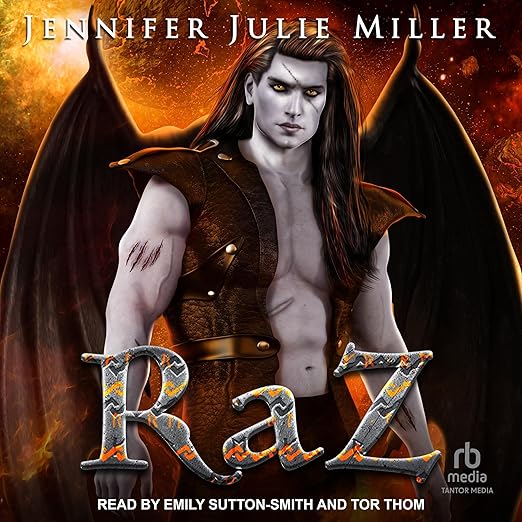
What the book does well is sustained emotional intensity and the specific pleasure of an alien male lead who is categorically unlike human romantic options. RaZ is described by one reviewer as tall, dark, and handsome with wings and red eyes, which has particular appeal to readers of the genre that is not dismissible as superficial. The book’s action elements arrive unexpectedly and effectively, with multiple readers noting moments that made them want to back up and re-listen.
The AI Characters and Why They Matter
Multiple reviewers single out the AI characters in the House of DaR series as distinctive pleasures, and in RaZ they are among the highlights. The Traveler, the ship’s AI, functions throughout as both a practical plot element and a source of genuine personality and humor. Later in the book, ANDI, described as the original AI, gets introduced with significant narrative weight that clearly sets up future installments. These characters represent something unusual in alien romance: genuinely interesting non-human perspectives that are neither purely functional nor purely comic. They add texture to the universe that the romantic central plot cannot provide alone, and Sutton-Smith’s handling of them is one of the narration’s consistent strengths.
Where to Start and Whether to Start Here
Start at the beginning of the series rather than here. This is the consistent advice from readers who love the books, and it is good advice. For existing series readers, RaZ delivers what the series does best: cosmic-scale devotion, well-developed secondary characters, and emotional sequences that hit with real force. Listeners for whom prose consistency matters significantly, or who find alien possession-framing in romance unappealing, will want to look elsewhere. Within its genre and for its core audience, the series has clearly built something durable. A note on access: unlike some earlier entries in this series, RaZ is available through standard audiobook purchase rather than as a free audiobook, which is worth factoring into your decision about where to start if you are new to Jennifer Julie Miller’s work. The House of DaR series has clearly found a committed readership, and the consistency of the praise across multiple installments suggests that Miller is delivering reliably on what that readership wants. For listeners who are already part of that readership, RaZ maintains the series’ strengths and advances its mythology in ways that will keep them engaged. The cosmic scope, the genuine emotional investment in the characters, and the AI companions who add unexpected humor and warmth to a genre that can take itself too seriously: these are reasons to stay, for the readers who already know them.
Frequently Asked Questions
Can RaZ be listened to as a standalone entry in the series?
Technically yes, but even dedicated series readers describe book four as challenging to follow without the prior context. The cast of characters is large and the world-building is accumulated across four books. Starting from the beginning of the House of DaR series, or even the preceding Forsaken series, will significantly improve the experience.
What makes the alien romance in RaZ different from more conventional human romantic leads?
RaZ combines physical distinctiveness, described by reviewers as winged and red-eyed, with a conviction about Katherine that operates at a species-deep level rather than as a choice or preference. The possessive dynamic this creates is the genre’s central pleasure for its core readership, and Miller commits to it fully rather than softening it for a broader audience.
How does Emily Sutton-Smith’s narration handle the dual-perspective structure between Katherine and RaZ?
She maintains emotional consistency across both Katherine’s grief-driven chapters and RaZ’s intensely devotional perspective without overplaying either. Katherine’s chapters are particularly well-handled. The prose inconsistencies that exist in the text are more noticeable in audio than in print, which is a limitation of the source material rather than the narration.
The AI characters in the book get praised by reviewers. How significant are they in this installment?
The Traveler, the ship’s AI, appears throughout and functions as both a practical plot element and a source of genuine personality and humor. ANDI, the original AI, is introduced later in the book with significant narrative weight. Both characters are highlights that multiple reviewers single out specifically.