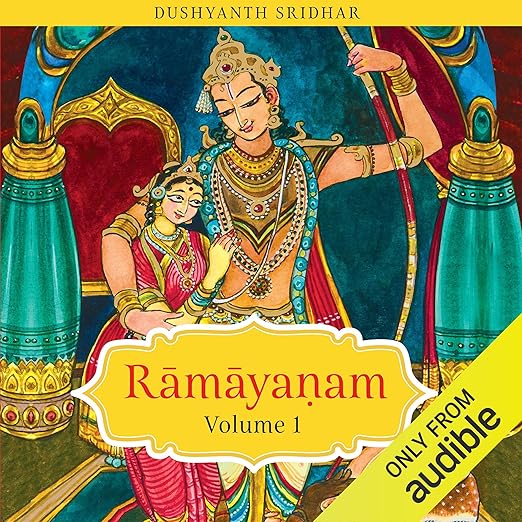
I came to Ramayanam Volume 1 as a reader with more familiarity with Western classical epic than Indic, which meant I was listening partly as a student. Dushyant Sridhar, a noted Vedic scholar, frames this retelling as a conversation between Valmiki and Narada, a structural choice that immediately signals what kind of text this is. This is not a novelization or a popular retelling aimed at stripping the epic down to its narrative bones. It is a scholar's transmission, attentive to the commentarial tradition and the theological dimensions that centuries of acaryas have identified as essential.
At eleven hours and nineteen minutes, Volume 1 covers considerable ground, and Vijayan Menon's narration maintains the ceremonial quality the material asks for throughout.
Sridhar Frames the Epic as Sacred History
The Ramayanam is described in the text itself as adi kavya, the first poem, composed by Valmiki during Rama's time and ratified by Rama himself. That claim situates the epic not as literature in the Western sense but as sacred historical record, and Sridhar's retelling honors that framing rather than translating around it. The layers of philosophy and theology are not decorative additions to a basically straightforward story; they are, in this tradition, the point. Sridhar draws on both well-known and lesser-known commentarial works to illuminate dimensions that a more popular retelling would set aside.
One reviewer appreciated the depth of pre-historic context before Rama's story begins, describing it as giving a lot of information about pre-historic events in an easy and joyful way. Another found the content diluted compared to other versions they had read. This divergence reflects the challenge of any retelling: it will inevitably satisfy some readers' expectations for the original more than others'.
Menon's Recitative Style Suits a Sacred Text
Vijayan Menon's narration is the primary reason to choose the audio format over print for this material. His delivery has a quality that is best described as recitative rather than dramatic, which is appropriate for a text that sits at the intersection of scripture, epic, and living tradition. The Valmiki-Narada framing that Sridhar uses gives Menon's narration the quality of a teacher transmitting wisdom to a student, and that frame holds throughout the eleven-hour first volume.
The audio format also allows the philosophical and theological commentary to unfold at a pace that reading might rush. Sridhar's explication of multiple layers of meaning in individual episodes is best absorbed through listening that allows reflection, and the audiobook format suits this if you are willing to pause and return rather than pushing through continuously.
Sanskrit Terms and a Mid-Story Ending Await
Listeners approaching this without background in Vedic tradition, Sanskrit terminology, or the major schools of Hindu philosophy may find certain passages demanding. Sridhar is not writing for complete newcomers to the tradition, and while the English is accessible, the conceptual framework assumes some familiarity with the categories he's working within: dharma, the nature of avatara, the significance of the itihasa genre as distinct from purana. This is not a failing of the book but a characteristic that listeners should factor into their expectations.
The volume ends mid-narrative by design, as this is a two-volume presentation. Listeners who want a complete narrative arc within a single listening session should be aware that Volume 1 covers the early portions of the epic and sets up the events that will develop in Volume 2.
Existing Ramayana Fans Get a Scholarly Retelling
Listeners with existing familiarity with the Ramayana tradition who want a scholarly English retelling that engages seriously with the commentarial literature will find this among the more substantive options available in audio. Those interested in Vedic literature more broadly who want an English-language entry point to the adi kavya will find Sridhar's framing approach enriching rather than simplifying. Skip it if you're looking for a fast-paced narrative adaptation in the style of Valmiki retold for popular audiences, or if the two-volume structure and scholarly register create a commitment barrier. This is a devotional and intellectual undertaking as much as it is a literary one.
Key Details
- Read by: Vijayan Menon brings a ceremonial gravity to the material that suits the Vedic scholar's retelling. His voice has the quality of someone performing a text with reverence rather than simply reading it.
- At its heart: Dharma and devotion, cosmic narrative, the adi kavya as living tradition
- Vibe: Stately and immersive, with layers of mythology and theology woven through the storytelling
- Short version: Dushyant Sridhar's retelling of the Ramayanam in English is a substantial contribution to the tradition's accessibility, though those expecting a simplified popular adaptation may find the scholarly framing more demanding than anticipated.