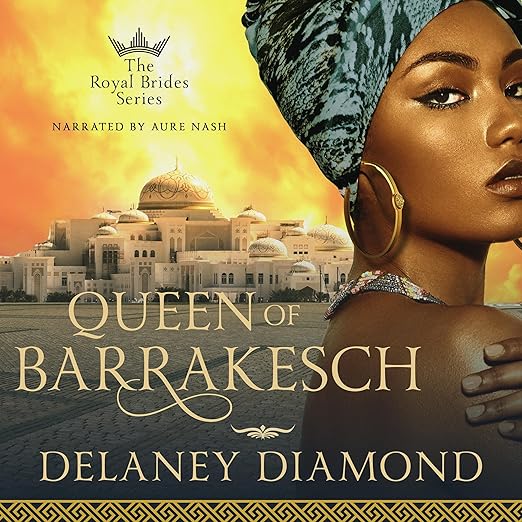
Quick Take
- Narration: Aure Nash delivers the warmth and tension that a fake-engagement-to-real-marriage romance requires, emotionally present, pacing the slow-burn revelation that Imani has been in love all along.
- Themes: Fake relationships that become real, self-determination within constraint, friendship crossing into love
- Mood: Warm and romantic with genuine stakes, light suspense elements alongside the central relationship
- Verdict: A satisfying close to the Royal Brides trilogy, rich in Black royalty representation and executed with the emotional intelligence that Delaney Diamond’s romance readers return for.
I read Queen of Barrakesch in one sitting on a Saturday afternoon, which is not something I do often with romance fiction and which says something about the pacing. Delaney Diamond does not let the setup, fake engagement between two friends, one of whom has been secretly in love with the other for longer than she will admit, slide into the comfortable predictability that the premise could easily become. There is genuine tension here. Not because we don’t know where it ends, but because Diamond makes us feel the cost of the secret Imani has been carrying.
This is the third and final book in the Royal Brides series. Imani Karunzika and Crown Prince Wasim al-Hassan of Barrakesch have been friends long enough that the proposal of a fake engagement feels practical to both of them, she escapes the loveless arranged marriage her parents are pushing, he secures his claim to the throne against the condition that he must marry. The fake engagement becomes real, the marriage proceeds, and Imani finds herself not just a queen but the wife of the man she has been in love with in secret. Her greatest struggle, as Diamond puts it, is keeping that secret inside a palace where everything is observed.
Our Take on Queen of Barrakesch
The friends-to-lovers setup is one of the harder romance structures to execute well because it requires an explanation for why these two people, who clearly belong together, have not acted on it. Diamond handles this by grounding the delay in Imani’s fierce independence and her wariness of being swallowed by a dynamic where the power differential is real and growing. Wasim is a king. His authority is absolute within his country. Imani’s struggle is not to resist him but to avoid disappearing into the role of queen at the expense of the self she has spent her life protecting. That internal conflict gives the romance a dimension beyond the will-they-won’t-they surface.
One reviewer specifically highlighted the representation: this is a Black royal love story, and the emotional resonance that produces for readers who have rarely seen themselves in this fictional tradition is worth acknowledging. Another reviewer offered praise for Diamond’s ability to write “sexy sex scenes” with the same breath as praising the storyline’s suspension and drama, which is probably the most honest summary of what Diamond’s readers come for and receive: emotional intelligence and heat in the same package.
Why Listen to Queen of Barrakesch
Aure Nash is an effective narrator for this material. The challenge of narrating a romance where one character is actively concealing their feelings from the other, and from themselves, requires a narrator who can convey interiority without tipping into the confession before the story is ready to make it. Nash manages the balance, keeping Imani’s emotional suppression audible in the performance without making it heavy-handed. The five-and-a-half-hour runtime is appropriate for the novella-length story, though some readers who have enjoyed Diamond’s longer works may find it slightly compressed.
This is published by Garden Avenue Press, Diamond’s own imprint, and benefits from the production consistency that comes with an author invested in her own catalog’s quality.
What to Watch For in Queen of Barrakesch
A minority reviewer noted some dissonance in the faith identity of the characters, Imani is identified as Christian, Wasim is Muslim, and the reviewer felt their faith expressions were inconsistent with how the characters actually behaved in the narrative. This is a fair critique that may or may not register depending on how closely you read faith representation in fiction. It does not derail the romance, but it is a real observation rather than a quibble.
As the third book in the Royal Brides trilogy, this works best read in sequence. The first two books establish the world and the tone, and some of the emotional payoff here depends on investment in the series’ consistency. That said, the central relationship is established clearly enough within this volume that the book functions as a satisfying standalone if you are comfortable missing the earlier context.
Who Should Listen to Queen of Barrakesch
Essential for readers who have followed the Royal Brides series through the first two books, and a strong entry point for romance listeners drawn specifically to friends-to-lovers narratives with royal settings and Black protagonists. Recommended for fans of Alyssa Cole’s royal romance work and readers who want warmth and heat in equal measure. Skip it if the fake-relationship-to-real-love setup is a trope you have exhausted, or if faith representation inconsistency in fiction is something that interrupts your engagement with a narrative.
Frequently Asked Questions
Is Queen of Barrakesch the end of the Royal Brides series, and can it be listened to without the earlier books?
Yes, this is the third and final book in the Royal Brides series. It functions reasonably as a standalone since the central relationship is established within the book, but it works best read in sequence as the series’ emotional payoff. Starting here without the earlier books means missing some world-building context.
How does the power imbalance between Imani and Wasim, she becomes queen in a country where his authority is absolute, affect the romance dynamic?
This imbalance is central to the novel’s tension rather than minimized. Imani’s internal struggle is explicitly about maintaining her identity and self-determination within a role that could subsume her. Diamond treats the power differential seriously rather than glossing over it, which gives the romance more substance than the fake-engagement premise alone would generate.
Does Aure Nash’s narration capture the internal conflict of a character actively hiding her feelings from her new husband?
Nash handles Imani’s emotional suppression with enough subtlety that the internal conflict registers without being telegraphed prematurely. The narration conveys interiority in the quiet scenes, particularly the moments when Imani nearly breaks her own resolve, without spoiling the arc the story is building toward.
Is the romantic content in Queen of Barrakesch explicit, and is that consistent with the rest of the Royal Brides series?
The romantic content is warm and includes scenes that readers have described as notably sensual. Multiple reviewers flagged this as a feature rather than a concern. The level of heat is consistent with the series’ tone throughout.