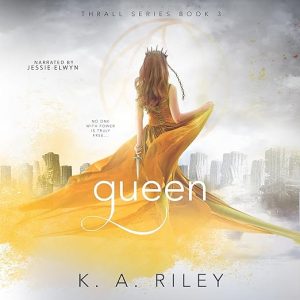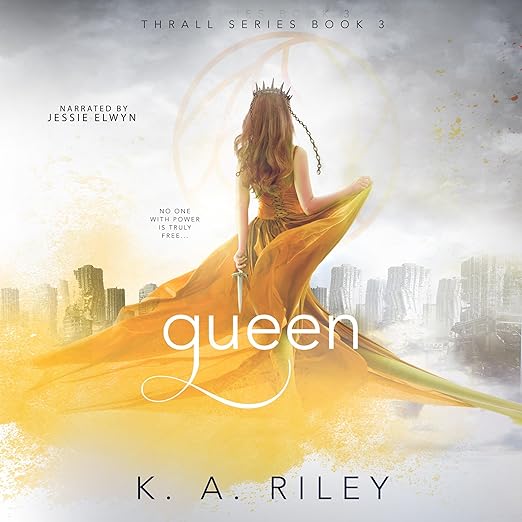
I picked up Queen at the end of what had been a long week, the kind of week where you want something that demands your full attention and then delivers on that demand. The Thrall series by K.A. Riley operates in the romantic fantasy space, and this third book closes out the central arc of Shara and Thorne's relationship against a backdrop of political upheaval in the realm of Kravan. What reviewers describe as a series full of plot twists that leave you putting the book down to collect yourself is exactly the kind of reading experience that makes fantasy romance compelling when it works.
The story picks up with Shara separated from her tethered mate Thorne and navigating underground tunnels to find him, forging new alliances and meeting new enemies in the process. When she is finally reunited with Thorne, there is a moment of what sounds like genuine reprieve: freedom, the ability to love openly without punishment, a sense that Kravan might finally reform. Riley is experienced enough to know that apparent resolution in the middle of a book is the setup for the second half's complications, and the cryptic messages appearing on the Capitol's walls signal that the real confrontation is still coming.
The series's emotional architecture is built on a tension that romantic fantasy readers will recognize: Shara has learned, through direct and painful experience, not to trust anyone. Her tethered bond with Thorne is the exception, and the series derives its stakes from testing whether even that bond can hold against the forces around them. In the third book, that testing takes the form of secrets that emerge from people close to Shara, which forces a choice that multiple reviewers describe as genuinely heartbreaking.
The plot twists are apparently significant enough that reviewers are still reacting to them months after reading. One notes being shaken by specific character deaths involving characters who had been prominent throughout the series. Another describes having to put the book down multiple times to recover. That level of emotional engagement with a genre fiction finale is a genuine achievement, and it suggests Riley has spent two books earning the kind of attachment that makes those moments land.
What Works
Jessie Elwyn narrates across all three books, which matters for a series where the listener's relationship to Shara's interior voice is the primary vehicle for emotional investment. A narrator who is consistent across a trilogy becomes part of how readers understand the character, and Elwyn has clearly established that relationship by the time this third book arrives. The performance in Queen carries the weight of everything that has been built before it, and reviewers who are enthusiastic about the finale are not distinguishing the narration from the story, which is exactly what you want from this kind of performance.
At eleven and a half hours, this is the longest entry in the trilogy, and the extra length accommodates both the political resolution and the romantic culmination. For series readers who have invested in Shara and Thorne across the previous two books, that length feels appropriate rather than padded.
Weak Spots in Queen
The honest critical tension in this book's reviews is around pacing and content. One reviewer describes the plot as too choppy compared to the first two books, and another was frustrated by what they felt was a predictable structure in the middle section. More significantly, multiple reviewers flag the frequency and explicitness of the intimate scenes as a point of friction, with at least one noting that the scenes feel disconnected from the plot rather than serving it. This is not a minor caveat for listeners who choose fantasy romance for its worldbuilding and character dynamics: if intimate content is extensive and not well-integrated, it can interrupt narrative momentum in ways that are genuinely distracting over eleven hours.
Another reviewer found Shara's focus on Thorne exhausting, which is a character critique worth taking seriously. When a protagonist's interiority is dominated by a single relationship to the exclusion of other concerns, it can make what should be a character's defining choices feel reactive rather than agentic. Whether Riley navigates this successfully in the final book is something readers divide on.
Who It's For
This is exclusively for series readers who have completed books one and two of the Thrall trilogy. Starting here would be structurally baffling and emotionally empty, because all of the stakes are accumulated rather than established in this volume. For those listeners, particularly those who responded to the first two books' combination of political fantasy and intense romantic pairing, this delivers the emotional finale the series promises. Readers who prefer fantasy romance with less explicit intimate content or who found Shara's relationship focus frustrating in earlier books will likely find those tensions amplified rather than resolved here.
Is Queen a complete ending to Shara and Thorne's story, or does the series continue after this?
One reviewer describes Queen as wrapping up the central story arc and notes there is a subsequent book that begins a new story arc. That reviewer chose to stop after Queen, treating it as the series finale. The primary Thrall storyline appears to conclude here.
How explicit are the intimate scenes in Queen compared to the earlier books in the Thrall series?
Multiple reviewers describe the intimate scenes as frequent and explicit, and some felt they were excessive and insufficiently tied to plot development. This appears to be more pronounced in Queen than in earlier volumes. Listeners who prefer low-heat or mid-heat fantasy romance should factor this in.
Can someone who loved the first two Thrall books trust that this finale delivers emotionally?
Most series fans appear satisfied, with the plot twists and character resolutions landing hard for readers who were invested. Some felt the middle section's pacing sagged compared to the earlier books, but the emotional finale reads as effective for the majority of engaged series readers.
Does Jessie Elwyn's narration handle the darker and more political sections of Queen as well as the romantic content?
Elwyn narrates across the full trilogy and reviewers who comment on the narration do so favorably. The political and action sequences in Queen require a broader range than some earlier installments, and no reviewer has flagged her performance as a limitation.