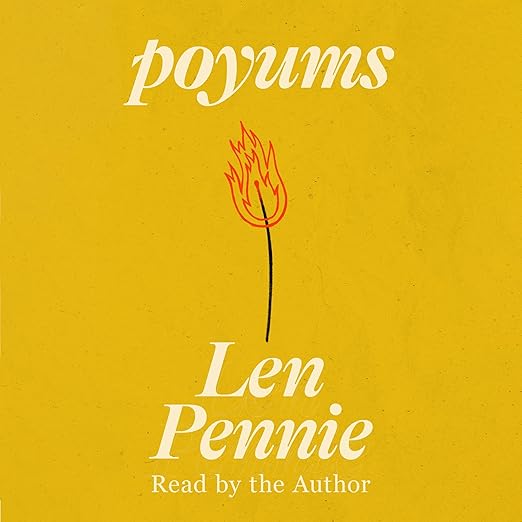
Quick Take
- Narration: Len Pennie reads her own work, which makes this an entirely different experience than a third-party performance, her voice carries the emotional architecture of each poem directly.
- Themes: Feminist advocacy, trauma recovery, language and identity, self-authorship
- Mood: Bold, tender, and occasionally devastating
- Verdict: A short but resonant collection that benefits enormously from Pennie’s own voice, hear it in audio if you hear it at all.
Poetry in audio is a particular proposition. A skilled narrator can bring a poem to life, but there’s something else that happens when the poet reads their own work, a quality of authority over the line breaks, the pauses, the exact weight given to each word that no amount of interpretive skill can fully substitute for. Len Pennie reading poyums is one of the clearest examples I’ve encountered of why this distinction matters. At under two hours, it’s one of the shortest audiobooks I’ve covered on this site. I listened to it in a single sitting on a Tuesday morning, which turned out to be exactly the right context: a quiet space with nowhere immediately pressing to be.
Pennie came to wider attention through her social media presence, specifically her Scots word of the day videos, which managed the rare trick of making language preservation feel joyful rather than dutiful. poyums, her debut collection, draws on that bilingual sensibility, moving between English and Scots in ways that are never decorative. The Scots language in these poems does specific work: it carries particular emotional registers, specific regional and cultural histories, that English alone cannot replicate.
Our Take on poyums
The collection covers substantial ground in its brief runtime. Pennie writes letters to her younger self. She advocates for women’s rights with directness that has no patience for softening. She adapts fairy tales to process the experience of an abusive relationship, a move that might sound precious but lands with unexpected force because Pennie’s handling of inherited narrative forms is sophisticated. She uses the fairy-tale structure’s logic of transformation and rescue and subverts it, which is more interesting than simply rejecting it.
The fiercely feminist dimension of the collection is apparent from the opening poem, which the synopsis partially excerpts: I have done more than just simply get by, so much more than escape or survive. This is not a collection interested in the survivor-as-victim framing. Pennie’s speakers are in the process of claiming their own narratives, demanding authorship over stories that have been told about them or happened to them. The line This story is mine from the cover to spine and the narrative I will control functions as both personal statement and poetic manifesto.
Why Listen to poyums
One reviewer noted that the themes can be difficult to read at times, and that’s honest. Trigger warnings flagged by other listeners include assault and eating disorders. These are not peripheral subjects in the collection; they are central to Pennie’s project of writing directly about the experiences that shape and sometimes damage women’s lives. The collection’s power comes partly from its refusal to keep these subjects at an aesthetic distance, and listeners should know that going in.
What makes this emotionally sustainable rather than simply difficult is the humor. Pennie is genuinely funny in ways that surprise you, and the collection moves between registers with assurance. The funny poems are actually funny, not self-deprecating in the way that sometimes functions as another form of self-erasure, but sharp and fully inhabited. This tonal range is one of the marks of a poet with real control over her material.
What to Watch For in the Scots Language Poems
For listeners unfamiliar with Scots, the bilingual poems may require some adjustment. One reviewer described the experience as encouraging them to learn more about the language, which is perhaps the ideal response. Pennie doesn’t translate or gloss the Scots passages, they stand on their own, and the emotional meaning generally comes through even when specific words are unfamiliar. Several listeners without any Scots background found that this unfamiliarity added to rather than subtracted from the experience, because the texture of a language you don’t quite know communicates something about cultural particularity that a translation would smooth over.
The author’s own reading gives these passages their full weight. Pennie knows exactly how each Scots word sounds in context, where to place the emphasis, how to handle the phonology that English speakers might stumble over. This is the primary argument for the audiobook format for this collection, you get not just the poems but Pennie’s own sense of how they should land.
Who Should Listen to poyums
This collection is for listeners who want contemporary feminist poetry that doesn’t soften its edges, and who are open to a bilingual experience that treats Scots as a living and meaningful linguistic tradition rather than a quaint regionalism. Fans of poets like Warsan Shire or Hollie McNish, writers who bring biographical directness to feminist subject matter, will likely respond strongly to Pennie.
The under-two-hour runtime makes this accessible to listeners who don’t regularly engage with poetry in audio form. The brevity is a feature, not a limitation: Pennie has selected and arranged these poems with care, and the collection feels complete rather than truncated. It is one of those listening experiences that is proportionally much larger than its duration suggests, which is exactly what the best poetry collections do.
Frequently Asked Questions
Is it necessary to understand Scots to appreciate the collection?
No. Pennie’s reading carries the emotional meaning of the Scots-language poems even for listeners without prior familiarity, and the English poems are immediately accessible. Several reviewers without any Scots background found that the unfamiliar language added texture and particularity rather than creating a barrier.
Are there content warnings listeners should know about before starting poyums?
Yes. The collection addresses assault, eating disorders, abusive relationships, and mental health directly and without softening. These are central to Pennie’s project rather than incidental, so listeners who need to approach this material carefully should plan accordingly. The collection is not relentlessly heavy, the humor is genuine, but the difficult subjects are fully present.
Does hearing Pennie read her own poems make a significant difference compared to a standard audiobook narration?
Substantially. Pennie’s reading carries a quality of authority over pacing, emphasis, and tonal range that third-party narration rarely achieves with poetry. Multiple reviewers who encountered her work on social media first describe the audiobook as extending and deepening what made those performances compelling. This is one case where the author-read format is the natural choice for the material.
How does poyums relate to Pennie’s social media presence and her Scots word of the day series?
The collection grows from the same sensibility, a commitment to Scots as a living language and to direct, personal writing about women’s experience. But poyums is more sustained and more formally ambitious than social media posts. Fans who found her online presence compelling will discover she has significantly more range as a poet than short-form content allows her to show.