Quick Take
- Narration: Mark Moseley reads with declaratory confidence that suits Whitman’s bardic register, though the collection’s length demands sustained listening stamina.
- Themes: Democratic selfhood, the body and mortality, America as ongoing project
- Mood: Expansive and elemental, like a long walk along a river you can’t quite see the other side of
- Verdict: An 8-hour Whitman collection is an ambitious listen, but Moseley’s reading and the range of selections, from Leaves of Grass through Drum Taps, make it genuinely rewarding for patient listeners.
I first read Whitman properly in graduate school, in a seminar on 19th-century American literature that spent three weeks on Leaves of Grass alone. I remember the professor saying that Whitman demands to be heard, not just read, that the poems are written for the voice, for breath, for physical delivery. I thought of that seminar constantly while listening to this collection on a long drive through upstate New York, watching the landscape shift from suburb to farmland to something genuinely open, and realizing the professor was right.
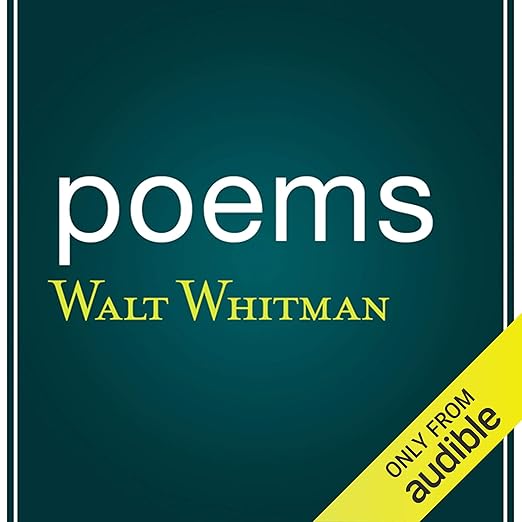
This Audible collection gathers selections from Leaves of Grass, Drum Taps, and Songs of Parting, spanning Whitman’s major phases and preoccupations. It’s a generous selection, 8 hours of poetry is a significant commitment, and the breadth means listeners encounter Whitman in his many registers: the cosmic cataloguer of Song of Myself, the intimate elegist of Drum Taps, the mortality-haunted singer of the final poems.
Why Whitman Works on Audio
There’s a reason Whitman’s poetry has always been recited at public occasions, inaugurations, funerals, moments of national reckoning. The verse is built on breath and accumulation, the long cadences that roll forward clause by clause until the line becomes almost overwhelming with its own expansiveness. Reading Whitman silently is one experience; hearing him read aloud by a voice committed to the performance is another, and the audio format reveals dimensions of the poems that the page can obscure.
Mark Moseley reads with declaratory confidence that suits Whitman’s bardic register. He doesn’t try to domesticate the poems or make them conversational; he lets them be public and large. Song of Myself, Crossing Brooklyn Ferry, the Civil War poems of Drum Taps, these require a voice willing to make their claims, and Moseley is willing. The pacing can occasionally feel relentless, particularly over 8 hours, but that relentlessness is arguably part of Whitman’s point: the poems insist on being experienced at full intensity rather than sampled.
What the Collection Covers and What It Leaves Out
The selection is strong, the most famous poems are present, and the inclusion of Drum Taps gives the collection real historical texture, since those Civil War poems are among the most moving things Whitman wrote and the most consistently underread. The Songs of Parting section, which closes the collection, sits well at the end: those late poems have an elegiac quality that functions as a natural conclusion.
What this collection doesn’t provide is scholarly apparatus, no introductions to individual poems, no contextual notes, no biographical framing. Listeners who know Whitman well won’t miss this; listeners coming to him for the first time might occasionally wonder what they’re inside of. One reviewer who encountered Whitman for the first time through this collection at age 48 described feeling embarrassed about the delay, which tells you something about the poems’ power even without academic scaffolding, but some listeners may benefit from a brief background read before starting, particularly for Drum Taps.
Whitman as Essential American Listening
One reviewer stated that you cannot understand America without Walt Whitman, and while that’s the kind of claim that invites skepticism, it’s not entirely wrong. Leaves of Grass attempted something genuinely strange: to build, in verse, an American selfhood capacious enough to contain multitudes, democratic, physical, contradictory, unfinished. That project is still ongoing, and returning to Whitman with fresh ears in an audio format reminds you how contemporary his questions remain.
The audio format, stripped of typographic conventions, also equalizes the poems in interesting ways. Without line breaks visible on the page, Whitman’s long-lined verse sounds more like intensified speech than like conventional poetry, which is closer to what he intended. Moseley’s reading honors that intention.
The experience of listening to Whitman also raises a question I didn’t fully expect: how does it feel to hear poetry specifically about America listened to while moving through American landscapes? I found that Whitman’s catalogues, of rivers, occupations, bodies, machines, migrations, landed differently on audio than they do on the page, partly because the listening context itself kept shifting. A poem about the Potomac heard while crossing a bridge has a different resonance than the same poem read in a quiet room. Whitman wrote for exactly this kind of contextual encounter, his poetry was designed to be read aloud in public, to be encountered in motion. Mark Moseley’s performance respects that mobility. He doesn’t confine the poems to the interior space of careful literary attention; he projects them outward, which is where they were always meant to land. Whether you’re listening on a commute, a walk, or a long drive, the poems find their occasions. That responsiveness to context is one of Whitman’s most underappreciated qualities, and one that the audio format reveals more vividly than the page.
Who This Audiobook Is For
Poetry listeners who have always meant to spend serious time with Whitman will find this a well-curated entry point. The selection covers his range without requiring the reader to navigate the full, overwhelming length of Leaves of Grass. Listeners who come to audio primarily for narrative will struggle, these are poems, not stories, and the 8-hour runtime rewards attentive listening over passive consumption.
If you’re looking for a scholarly or contextualized edition with introductory notes and critical apparatus, this isn’t it. But for a pure audio experience of the poems themselves, read by a narrator who understands what they require, this is a valuable recording of some of the most important verse in the American tradition.
Frequently Asked Questions
Is 8 hours of Whitman poetry a reasonable listen for someone who doesn’t read much poetry?
It depends on your tolerance for sustained attention to verse. Whitman is more accessible than many poets, his language is direct and his subjects are large, but 8 hours requires genuine engagement. Casual listeners may prefer to sample individual poems first.
Does the collection include Song of Myself?
Yes, selections from Leaves of Grass are included, and Song of Myself is among them. The collection also covers Drum Taps and Songs of Parting, giving listeners a sense of Whitman’s range across his career.
How does Mark Moseley’s reading approach differ from more conversational narration?
Moseley reads with declaratory public confidence, he treats the poems as bardic performance rather than intimate conversation, which suits Whitman’s rhetorical register but may feel grand to listeners accustomed to quieter narration.
Is there any contextual introduction or scholarly framing in this audiobook?
No. The collection presents the poems without introductory apparatus or critical notes. Listeners unfamiliar with Whitman’s historical context may want to do a brief background read before starting, particularly for the Civil War-era Drum Taps poems.