Quick Take
- Narration: Stina Nielsen gives a clean, unhurried performance that suits the Amish setting and the dual-timeline structure without drawing attention to itself.
- Themes: Faith and community, family inheritance, grief and second chances
- Mood: Quietly warm with an underlying current of suspense
- Verdict: A well-constructed Christian mystery-romance that uses its dual timeline to genuine thematic effect.
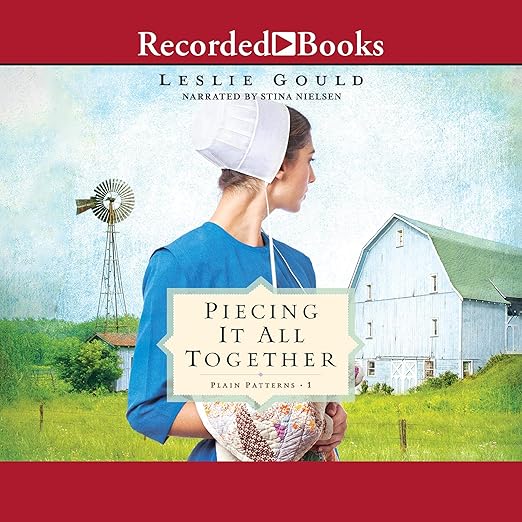
I came to Piecing It All Together on a slow winter afternoon, curious about how Leslie Gould would balance three things that do not always coexist comfortably: a missing-persons mystery, a romance built on old friendship, and the kind of faith-centered reflection that defines Christian fiction at its best. Eleven hours and four minutes later, I had my answer: with more craft than the setup might suggest.
The premise moves quickly. Savannah Mast's fiance dumps her a week before their wedding. She flees to her Amish grandmother's farm in Indiana, which is exactly the kind of retreat that might seem contrived in lesser hands. But Gould complicates things almost immediately: an Amish girl goes missing, a childhood friend named Tommy Yoder is implicated as a suspect, and a local historian begins telling a story from the 1840s that mirrors the present in ways that feel earned rather than mechanical. The historical thread, involving a disappearance from the 19th century, is where Gould does some of her most interesting structural work.
Our Take on Piecing It All Together
The dual-timeline structure is Gould's strongest structural choice in this book. The 19th-century story, relayed through quilt shop owner and historian Jane Berger, provides a parallel that the present-day characters can only partially see. It gives the novel texture without overloading the contemporary plot. One reviewer noted some initial difficulty switching between timelines but found that the connections became clear and resonant by the end. That is an honest description of the reading experience: the payoff requires patience in the middle chapters, and Gould earns it through careful construction rather than dramatic revelation.
Why Listen to Piecing It All Together
Stina Nielsen's narration is well matched to the material. The Amish setting requires a particular tonal register: unhurried, grounded, respectful of silence. Nielsen does not rush through the quieter scenes, and that pacing decision works in the book's favor. Savannah's emotional arc, from devastation through distraction into genuine reckoning with her faith and her family's history, is handled with care. The romance thread involving Tommy Yoder is not the dominant story, which is a choice that some listeners will appreciate and others may find frustrating depending on what drew them to the book. Gould is more interested in legacy and belonging than in the romantic resolution.
What to Watch For in Piecing It All Together
The novel's central question, whether Savannah returns to California and the fiance who abandoned her or stays and builds something new, is less interesting than the question underneath it, which is about what it means to belong to a tradition you did not choose. Savannah's mother served as an Amish midwife; that connection gives her a history with the community that is neither fully insider nor fully outsider. Gould develops that ambiguity with some delicacy. The mystery thread is functional rather than thrilling, but it drives the plot forward at a consistent pace and gives the novel a sense of stakes that purely character-driven Christian fiction sometimes lacks.
Who Should Listen to Piecing It All Together
The primary audience is readers who enjoy Amish fiction with a Christian faith dimension and who appreciate a dual-timeline structure that uses historical narrative to illuminate the present. Fans of authors like Wanda Brunstetter or Beverly Lewis will find familiar pleasures here alongside Gould's particular interest in family heritage and inherited faith. Listeners who came primarily for mystery will find the suspense present but secondary to the character and thematic work. As the opening book in the Plain Patterns series, this also functions as a strong introduction to Gould's recurring concerns if you are new to her work, and the series is worth following if this one lands for you.
One reviewer described Gould's ability to piece together a family's heritage across time periods as the defining quality of the Plain Patterns series, and that ambition is evident here even in the first volume. The quilt shop as a setting is not incidental; quilts as objects that carry history forward provide the novel's central metaphor, and Gould uses it with enough restraint that it never becomes heavy-handed. The 1840s storyline follows a woman named Emma whose situation echoes Savannah's present-day crisis in ways that reward patient listeners who stay with both threads.
Frequently Asked Questions
Does this book need to be read as part of the Plain Patterns series, or does it work as a standalone?
It works as a standalone. The Plain Patterns series follows different characters across books, and Piecing It All Together introduces the world and themes without requiring prior knowledge of other Gould books.
How prominently does Christian faith appear in the narrative?
It is present throughout and shapes how characters make decisions, but Gould does not approach it with a heavy hand. The faith dimension is woven into the community and characters rather than delivered as explicit message.
Is the dual timeline difficult to follow in audio format?
Stina Nielsen's narration helps differentiate the timelines through tone and pacing. Some listeners noted initial adjustment, but the structure becomes clear quickly and the connections between past and present develop naturally.
How does the missing-persons mystery compare to the romance as a story driver?
The mystery drives the plot's external action while the romance provides the emotional arc. Neither dominates entirely, which gives the novel a dual engine. Listeners who want a fast-paced thriller will find the balance weighted toward character and faith themes.