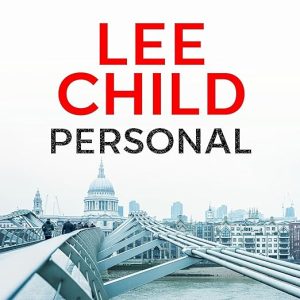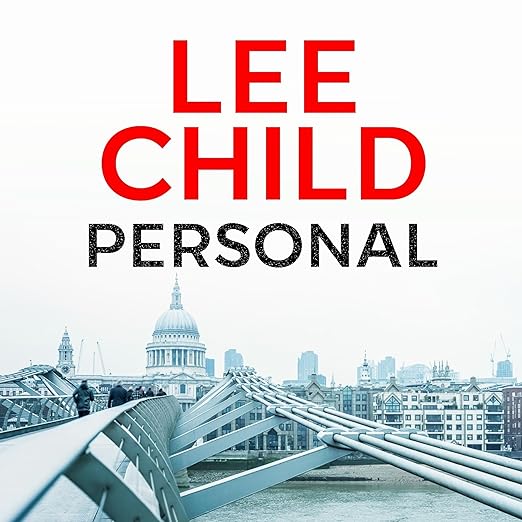
- Read by: Gabriel Cichi delivers a capable thriller narration that keeps the pacing taut, though the recording may be a non-English language version given the available synopsis.
- At its heart: Pursuit and personal stakes, international espionage, the lone operative against institutional pressure
- Vibe: Propulsive and spare, classic thriller cadence
- Short version: Core Reacher formula executed with Lee Child's characteristic efficiency, a reliable entry point for fans of the series and a solid thriller for newcomers to Jack Reacher.
Personal is the nineteenth Jack Reacher novel, and if you have spent any time with this series you already have a specific kind of audiobook listening in mind: economical prose, action that moves like machinery, a protagonist who solves every problem with a combination of tactical intelligence and physical force that borders on myth. Lee Child delivers exactly that, as he almost always does, and the pleasure of the Reacher novels in audio has always been that the stripped-down style translates to the format better than most comparable thriller series. There is very little in these books that depends on the kind of visual architecture that gets lost in the transition to listening.
The premise of Personal has a kind of satisfying elegance that stands out even within a series built on satisfying premises. Someone has taken a shot at the President of France during a G8 summit in London. The shot was fired from over a mile away, which narrows the field of possible shooters dramatically. One name surfaces: a man who was trained by Reacher himself, a former military sniper who Reacher once sent to prison, and who has apparently been working as a contract killer since his release. The CIA wants Reacher to find him. Reacher, characteristically, has his own reasons for wanting to close this particular case.
What Lee Child Delivers
One of the distinguishing features of Personal within the broader Reacher series is its movement between Paris and London, giving Child the opportunity to use European settings that he handles more specifically than most American thriller writers who wander onto that terrain. Paris in particular gets the kind of attention that suggests genuine familiarity; the street-level geography that Child deploys in the Paris sequences has a texture that distinguishes it from the anonymous international thriller locations that populate the genre.
Casey Nice, the CIA agent assigned as Reacher's partner for this operation, is one of the stronger supporting characters in the recent series installments. Child resists the temptation to make her simply a capability delivery system, instead giving her enough psychological interiority that the dynamic between her and Reacher functions as actual character tension rather than just logistical pairing. The Guardian's observation that Child works with a limited set of factors to consistently fresh effect captures something real: he has been working the same essential materials for two decades, and the craft that makes each book feel distinct despite the formula is a legitimate achievement.
What Makes Personal Worth Hearing
There is a particular reason the Reacher novels work as well in audio as they do, beyond the obvious appeal of their genre. Child writes in extremely short sentences and paragraphs, a style that can feel almost telegraphic on the page but that becomes deeply satisfying when spoken aloud. The brevity creates rhythm; the rhythm creates momentum; the momentum carries you through ten hours of story with very little friction. The audiobook format essentially perfects the reading experience for this material, delivering Child's prose in the form it most naturally wants to be received.
Gabriel Cichi's narration matches that economy. He reads Child's prose at the speed it was written to be received, which is faster than most narrative nonfiction but slower than frantic thriller narration. The action sequences benefit from his restraint; he trusts Child's sentence structure to generate tension rather than adding vocal urgency on top of it. The result is a performance that serves the material efficiently, which is exactly what these books require. The pacing across all ten hours is one of the recording's most reliable qualities.
Things to Know Before Starting Personal
Personal is nineteenth in the series, but the Reacher novels are deliberately structured to be readable in any order. Reacher carries no accumulated obligations to previous plots; his characterization is stable across all entries; and Child provides whatever minimal context is needed within each book. New listeners will not be lost starting here, and returning readers will find the familiar pleasures operating at their usual level of reliability.
The series has a few peaks, notably books like Killing Floor, The Enemy, and Nothing to Lose, where Child brings additional ambition to the formula. Personal sits solidly in the upper middle tier: a book that does everything expected of it and occasionally more. At just over ten hours, it is an ideal length for this kind of listen, long enough to build real investment in the set-piece confrontations, short enough that it never tests your patience. The combination of the transatlantic setting, the strong Casey Nice dynamic, and the personal backstory connecting Reacher to his quarry makes this one of the stronger entries in the series' later installments.
Who Should Pick Up Personal
Listeners who enjoy efficient, character-driven thriller writing with a protagonist defined by absolute physical and tactical competence will find everything they are looking for here. The transatlantic setting adds variety for those who have found the American settings of earlier Reacher novels somewhat interchangeable. Fans of the franchise film adaptations will find Child's written Reacher a considerably more interesting proposition: less visually spectacular, considerably more interior, and operating in a moral universe more nuanced than the films typically suggest.
Those seeking psychological complexity or ambiguity about their protagonist will not find it here. Reacher is Reacher. The pleasures on offer are of a different, more immediate kind: clarity of purpose, economy of language, and action sequences that unfold with the satisfying precision of a well-maintained mechanism. For those pleasures, Personal delivers reliably.
Good to Know
How does the Paris and London setting affect the story compared to Reacher's more typical American settings?
Child uses the European settings with more geographical specificity than many American thriller writers bring to international locations. Paris in particular is rendered with genuine street-level detail. The transatlantic structure also adds a political dimension, involving the CIA and State Department, that gives Personal a slightly broader canvas than the more isolated American scenarios in earlier books.
How does Gabriel Cichi's narration compare to other Reacher narrators like Dick Hill?
Cichi's delivery is efficient and well-paced, matching Child's economical prose style. Listeners accustomed to Dick Hill's long-running tenure with the series may find the adjustment takes a chapter or two, but Cichi serves the material competently. The Reacher formula is robust enough to translate across different narrators without losing its essential character.