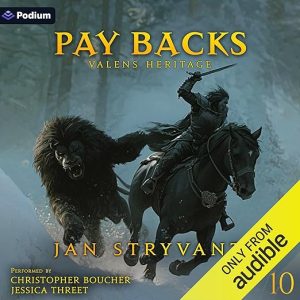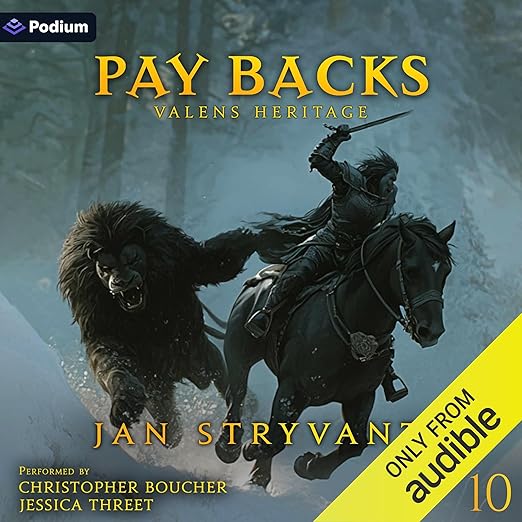
Pay Backs is the audiobook that caps the Valens Heritage series at its tenth and final installment, and the question any series finale must answer is not whether the plot resolves but whether it earns the emotional weight of everything that preceded it. Jan Stryvant's conclusion to the Valens Heritage saga answers that question at a 4.8 rating across more than 600 listeners, which is a meaningful signal for a paranormal romance series with a large and opinionated readership.
The premise of this concluding volume involves the lions heading to Nighthome to help Sawyer take the goblin crown, a succession process that the synopsis accurately describes as more hostile corporate takeover and counting coup than conventional warfare. Alongside that, there is the matter of House Uunregarten being brought to account for offenses against House Valens, Sean's wife Cali, their children, and the broader lion pride. Ten thousand of Sean's best friends make a compelling argument. The humor in that framing is characteristic of what the series has done throughout: keep the power fantasy grounded in relationship loyalty and darkly comic logistics rather than pure spectacle.
What stands out in the listener response to this final volume is not praise for the action sequences but for the character work. One reviewer, identifying herself as an "old white widow woman who loves cats of all sizes" and explicitly outside the target demographic, noted that she had read all the novels and short stories across both the Valens Legacy and Valens Heritage series multiple times, "not so much for the sex but for the love expressed." That is the thing Stryvant has consistently done well: built relationships that readers care about independent of genre fulfillment, so that by book ten, the stakes of the farewell feel genuine.
The duet-style narration that Stryvant specifies in the synopsis is executed by Christopher Boucher in a way that serves the material. At just under seven hours, this is a relatively compact finale for a sprawling series, and Boucher keeps the energy moving without sacrificing the emotional beats that returning listeners will have been anticipating across multiple volumes. The pacing is confident, which is what you want in a closer: no wheel-spinning, no false sentiment, a story that knows where it is going and delivers.
The Strengths
The audiobook format has been particularly well-suited to the Valens Heritage series throughout its run, and Pay Backs is no exception. The large cast of characters, the interlocking political obligations, the various species and factions that populate Sean's world, all of this lands more cleanly in audio when a narrator can differentiate voices and maintain consistent characterization across a six-hour listen than it might on the page, where readers are responsible for tracking the same material themselves. Boucher has been the voice of this world, and there is a cumulative quality to hearing a series conclude in the same voice that introduced it. The specific mechanics of goblin succession, which Stryvant has clearly thought through in considerable detail, are among the more original elements in what is otherwise a fairly conventional paranormal romance landscape. The hostile-corporate-takeover framing for a goblin crown is the kind of conceptual joke that earns its place in the narrative rather than just sitting there as world-building decoration. Boucher delivers the comedic register of these sequences with the light touch they require, making the political sequences feel like a genuine part of the story rather than an obstacle to get through before the emotional beats.
The farewell note from Stryvant embedded in the synopsis, thanking readers while also noting that no amount of begging will change his mind about ending the series (though large sums of money might), is characteristic of the author's sense of humor and the community relationship he has built with his readership. It is also worth noting as a signal to newcomers: this is the final book in a completed series, and the author is explicit that it is a genuine conclusion rather than a pause.
What to Watch For in Pay Backs
This is book ten of ten in the Valens Heritage series, which itself follows the Valens Legacy series. Anyone picking this up without that background will find the character relationships opaque and the political stakes impossible to follow. The synopsis assumes complete familiarity with Sean, Cali, Sawyer, Mihalis, Troy, and the broader world Stryvant has constructed across hundreds of hours of prior audio. This is not a point of entry; it is a reward for investment.
The paranormal romance genre conventions of the series are well established by this point, and Pay Backs does not significantly depart from them. Listeners who have found the spice level or harem elements of prior volumes frustrating will not find resolution here; the book is consistent with what came before. Conversely, listeners who loved those elements should find the finale delivers on the emotional and romantic threads in ways that feel genuinely satisfying rather than perfunctory.
Recommended For
This audiobook is for readers who have followed the Valens Heritage series from the beginning and want a finale that closes the major character arcs with care and humor. It is not appropriate as a standalone or a series sampler. If you are new to Stryvant's work, the place to start is Valens Legacy book one, which sets up the world and characters that Pay Backs brings to a close. For dedicated series listeners, this is the conclusion the investment deserves: warm, funny, and genuinely affectionate toward the characters it says goodbye to.
Is this audiobook a complete series conclusion, or does it leave threads open for future books?
Stryvant explicitly states in the book itself that this is the final Valens Heritage novel. The synopsis confirms it, and listener reviews describe it as a genuine, satisfying conclusion to the major character arcs rather than a cliffhanger or soft ending.
How does Christopher Boucher's narration handle the large ensemble cast in the finale?
Boucher handles the returning cast with the consistency that comes from narrating a long series, maintaining distinct vocal profiles across characters and keeping the tonal balance between action, humor, and emotional closure intact throughout.
What spice level should listeners expect from this audiobook?
Consistent with the series overall, Pay Backs is a paranormal romance with mature content. One reviewer noted she read the series primarily for the emotional relationships rather than explicit content, suggesting the book works on both levels, but newcomers should know the series operates in adult paranormal romance territory.