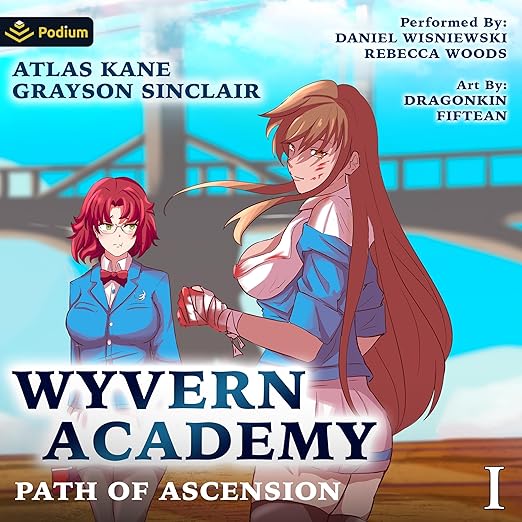
Quick Take
- Narration: Daniel Wisniewski maintains the energetic pace that wuxia-influenced cultivation fiction requires, handling the battle academy sequences with reliable clarity.
- Themes: Ki cultivation and progression, battle academy competition, harem dynamics and male camaraderie
- Mood: Action-oriented and fast, with genre-specific romance woven into the competitive framework
- Verdict: A solid first entry in an anime-influenced cultivation series with genuine worldbuilding ambition, though the harem elements and some pacing issues will determine whether this is your genre or not.
I spent a Tuesday morning with Path of Ascension while catching up on some domestic chores, which is probably not the listening context Atlas Kane envisioned for his battle academy cultivation novel, but the format worked well enough. This is genre fiction with clearly established conventions and a specific audience: readers who enjoy the progression fantasy elements of LitRPG and cultivation novels alongside anime-style battle academy stories, with the addition of harem romance content and explicit adult material. Knowing that going in matters, because the book does not apologize for what it is, and listener satisfaction will track closely with alignment to those well-defined genre expectations.
The premise is efficiently constructed. Demons have invaded from another plane of existence, conventional weapons are useless against them, and humanity has responded by cultivating Ki in specific individuals called Heroes of Ascension. The two protagonists, J and Alex, begin their training at Wyvern Academy, described as one of the world’s top battle academies. The series is explicitly inspired by Japanese light novels and anime, and that lineage is visible in both the worldbuilding logic and the social dynamics between characters throughout the first volume.
The Cultivation System and Its Internal Logic
The strongest element of Path of Ascension is the care Kane has taken with the worldbuilding framework. One reviewer noted the specific invention of giving humanity a concrete reason to cultivate and develop heroes, calling this a more satisfying motivation than the typical power-for-power’s-sake progression fantasy setup. The demon portal invasion creates genuine stakes for the training sequences: competence at Wyvern Academy is not merely about personal status or institutional prestige. It is about functional survival in a world that faces an ongoing existential threat from demons who cannot be stopped by conventional military means.
One reviewer with detailed worldbuilding concerns raised a specific structural objection worth acknowledging: given a world-ending threat, the number of training academies seemed implausibly limited, and the absence of institutional urgency felt inconsistent with the stakes as described. This is a fair criticism of a book that is primarily interested in the academy experience rather than the macro geopolitics of demon containment. Listeners who think carefully about worldbuilding consistency will notice these gaps; listeners who are primarily engaged in following J and Alex through their competitive training arc will find them less disruptive to their enjoyment.
The Harem Structure and Its Execution
The harem elements are explicit in both the synopsis and the content itself. Kane notes directly that the series contains unconventional relationships and explicit adult content, and the romantic dynamics are woven throughout rather than contained to specific sections. One reviewer observed that the romance felt a little too heavy with J specifically, noting that the various girls remained somewhat undifferentiated as characters whose names and appearances became a blur. This is a recognized challenge in harem fiction: the protagonist’s relationships are central, but the narrative space to develop each romantic interest as a fully realized individual is structurally limited in a single volume.
Another reviewer appreciated the treatment of harem elements as better than average for the genre, describing the explicit scenes as well written and graphic without being vulgar. These are essentially genre calibration notes: Path of Ascension is working within established conventions and executing them with more care than many comparable titles, without transcending the conventions themselves. Whether that level of execution is sufficient will depend entirely on what the listener brings to this specific genre.
Alex, J, and the Dual Protagonist Challenge
The dual protagonist structure is interesting and underutilized in the first volume. Alex, who has been rejected by the top academy due to heritage bias and is fighting to prove himself at Wyvern, has a compelling underdog narrative that one reviewer felt was consistently undercut by the story’s refusal to give him a clean victory: even when he achieved something, it was unjustly stolen from him. The frustration with Alex’s lack of a satisfying win reflects the kind of narrative withholding that cultivation fiction sometimes uses to sustain tension, but it can produce diminishing returns when applied without relief across an entire first book.
Daniel Wisniewski’s narration keeps the energy level appropriate for the battle academy format throughout. The action sequences are clear and the character differentiation between J and Alex is sufficient to track across the full runtime. At just over eight hours, the book moves quickly enough that pacing issues in the worldbuilding do not create prolonged drag. Listeners already embedded in the cultivation and LitRPG space will find Path of Ascension a competent and enjoyable entry into this specific series. Those who have not yet determined whether the genre suits them would do well to sample the first chapter before committing to the full listen, because the conventions it operates within are very specific and deliberately so.
Genre Fit and Series Commitment
Path of Ascension carries a 4.5 rating across 883 listeners, which is strong for a debut series entry in a niche genre and suggests that the audience most likely to respond to wuxia-influenced cultivation fiction is finding and enjoying it. The Wyvern Academy series has continued beyond this first volume, which means listeners who connect with the world and want to see the demon portal stakes develop across the larger narrative have material to continue with. The eight-hour runtime for the first book is modest enough that it functions as a genuine test case: if the cultivation mechanics, the battle academy social dynamics, and the harem elements click for you within the first two hours, the series will likely hold you through its subsequent entries. If any of those three elements are fundamental obstacles, the later books will not resolve them.
Frequently Asked Questions
How explicit is the adult content in Path of Ascension, and is it consistent throughout the book?
The synopsis flags explicit adult content and unconventional relationships directly. The adult content is integrated throughout rather than confined to specific sections, and at least one reviewer described the romantic scenes as graphic but not vulgar. Listeners sensitive to this content should consider the warning before starting.
Is Path of Ascension book one a satisfying standalone or does it end on a major cliffhanger?
The book establishes characters and world without resolving all narrative threads, as expected for a first entry in an ongoing series. Reviewers do not flag a traumatic cliffhanger, but listeners who prefer complete narrative arcs in each volume should know this is a series entry rather than a self-contained story.
How does Path of Ascension compare to Japanese light novel cultivation stories it cites as influences?
The author explicitly positions the series as influenced by Japanese light novels and anime. Reviewers who are familiar with that tradition describe it as a genuine genre entry rather than a superficial imitation, with cultivation mechanics and battle academy social dynamics that reflect the source material’s DNA clearly.
Does Daniel Wisniewski’s narration differentiate between J and Alex effectively across 8 hours?
Yes. The dual protagonist structure requires audible character differentiation, and Wisniewski maintains consistent voice characterization for both leads. The action sequences, which require clarity rather than performance, are handled straightforwardly and remain followable throughout the runtime.