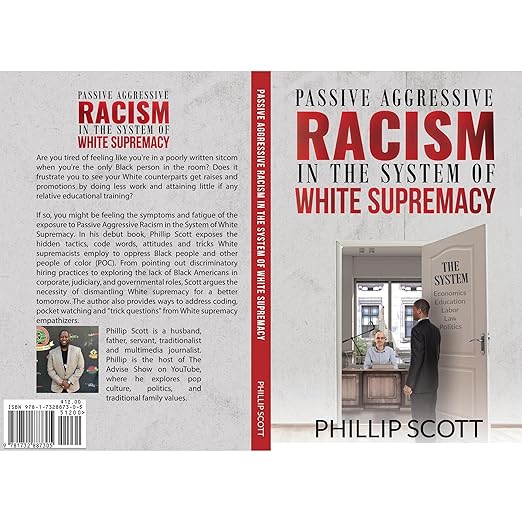
Quick Take
- Narration: Virtual Voice (AI-generated) handles the material functionally but lacks the rhetorical urgency this subject demands from a human narrator.
- Themes: Systemic racism, workplace discrimination, code-switching and survival tactics
- Mood: Direct and instructional, with an activist undercurrent
- Verdict: A compact primer for listeners new to the structural analysis of white supremacy, though more rigorous sources exist for those ready to go deeper.
I was on a train from Paris to Lyon when I queued this one up, partly because the title was doing exactly what a title should do: announcing its argument without hedging. Phillip Scott’s debut book does not traffic in ambiguity. It knows what it wants to say, and it gets there quickly. At one hour and thirty-six minutes, it’s closer to an extended essay than a book in the traditional sense, and that brevity turns out to be both its clearest asset and its most significant constraint.
The subject matter is one where I think audiobook format actually matters quite a lot. A text you read in private can be annotated, paused, argued with in the margins. Listening while moving, on a commute, during a walk, puts you in a more receptive mode, and for a book designed less for academic debate than for practical orientation, that receptivity is probably useful. Scott is writing, according to the reviews, as an informative podcaster translating spoken-word directness to prose, and that lineage comes through in the material’s accessible register.
Our Take on Passive Aggressive Racism
Scott’s central argument is that white supremacy does not announce itself with burning crosses. It operates through what he calls passive aggressive tactics: discriminatory hiring signals, the systematic absence of Black Americans from corporate, judiciary, and governmental roles, and what he identifies as coded “trick questions” deployed by white supremacy empathizers. The book frames itself not merely as an analysis but as a manual, it provides readers with specific ways to address these tactics, including how to recognize and respond to pocket watching and coding in professional environments.
That manual quality is what separates this from a lot of academic writing on the same subject. Scott is not primarily interested in constructing a theory of white supremacy for scholarly consumption. He’s interested in telling Black readers and other readers of color what to look for and what to do. One reviewer called it a good introduction for beginners just dipping a toe into the subject, with the honest caveat that more thoroughly researched sources exist for those ready to go further. That seems like an accurate characterization: this is an entry-level orientation, not a comprehensive academic text.
Why Listen to Passive Aggressive Racism
The 4.8 average rating across 376 reviews is striking for a debut book from a self-published author. It suggests Scott has reached an audience that finds real value in the directness of his approach. Several reviewers describe it as truth-telling, a word that appears repeatedly and means something specific in this context. When the institutional framing of racism tends toward euphemism and procedural language, a book that names tactics plainly and without apology fills a particular gap in the conversation.
The short runtime also makes it an approachable first listen for someone who has heard the term white supremacy used primarily in its most extreme, visible forms and wants to understand what the phrase means in a more structural, everyday context. Scott is doing a kind of community education work here, and that has its own value distinct from scholarly rigor.
What to Watch For in Passive Aggressive Racism
The most significant limitation of this audiobook is the narration. Virtual Voice, Amazon’s AI text-to-speech technology, handles the words adequately, but rhetoric is not just about words. It’s about emphasis, rhythm, and the particular energy a human speaker brings to material they care about. Scott is described by reviewers as a gifted podcaster, which means he presumably has that energy. It’s a genuine loss that it’s absent here. The content deserves the conviction of a human voice, especially when the argument escalates in its second half toward the structural and political.
A second consideration: one honest review flagged the need for editing, describing the text as a good introduction for beginners but noting it lacks the research depth of other available sources. Listeners expecting the analytical rigor of, say, Isabel Wilkerson’s Caste or Ibram X. Kendi’s How to Be an Antiracist will find this a different kind of book, useful, direct, community-oriented, but not operating at that level of evidentiary density.
Who Should Listen to Passive Aggressive Racism
This works best for listeners who are relatively new to structural racism as a framework and want a compact, plainspoken introduction to how discrimination operates beneath the surface of everyday institutional life. It is also a useful listen for anyone in Scott’s stated target community, Black readers and readers of color navigating professional environments where the tactics he describes are a lived reality. Listeners looking for academic depth or extensive citation should pair this with more rigorously researched texts on systemic racism.
Frequently Asked Questions
Is this audiobook narrated by a human voice or AI?
It uses Virtual Voice, Amazon’s AI text-to-speech system. The narration is functional but lacks the rhetorical energy you’d expect from a human narrator, which is a notable limitation for material this charged.
How does this book differ from academic texts on systemic racism?
It functions more as a practical manual than an academic analysis. Scott focuses on naming specific tactics and providing ways to respond to them, rather than building a comprehensive evidentiary argument. Think of it as an orientation guide rather than a scholarly study.
Who is Phillip Scott, and what’s his background?
Scott is described by reviewers as an informative podcaster as well as an author. This is his debut book, and the audiobook format reflects his roots in spoken-word commentary, direct, community-oriented, and accessible rather than academic.
At under two hours, is this long enough to cover the topic adequately?
It covers the topic at an introductory level, and the short runtime is by design, this is a primer, not an exhaustive treatment. One reviewer described it accurately as ‘a good introduction for beginners,’ with the honest note that more thoroughly researched sources exist for those ready to go deeper.