Quick Take
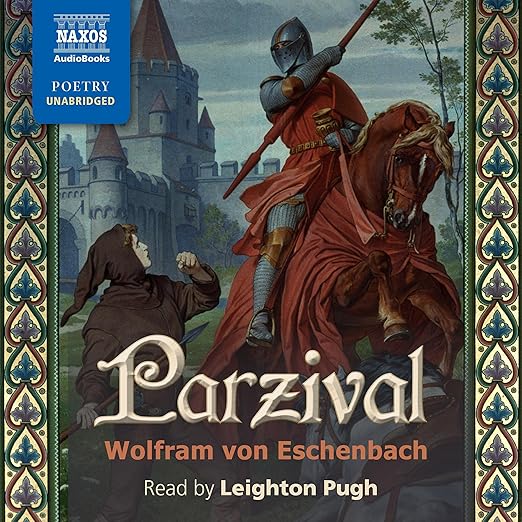
- Narration: Leighton Pugh brings the right gravity and fluency to a medieval epic that requires a narrator capable of moving between courtly refinement and battlefield intensity without losing the listener.
- Themes: Chivalric quest and moral failure, the Grail as spiritual destination, love and loyalty in conflict with duty
- Mood: Epic and ceremonious, with flashes of dark comedy and genuine emotional weight
- Verdict: For listeners willing to meet the medieval world on its own terms, a rich eighteen-hour journey through one of the great narrative poems of European literature.
I remember the first time I encountered Wolfram von Eschenbach in a seminar on medieval German literature during my graduate studies. The professor, who had a gift for provocative framings, described “Parzival” as the Arthurian tradition’s most sophisticated attempt to think through what it actually means to fail and then to be redeemed, not through heroics but through something closer to spiritual readiness. That reading never fully left me, and returning to the text in audio format, in Cyril Edwards’ modern prose translation, was both an act of nostalgia and a genuine critical rediscovery.
Written in the early thirteenth century, “Parzival” follows an Arthurian knight through tournaments, sieges, love affairs, and moral crises in pursuit of the Holy Grail, or more accurately, in pursuit of the right question to ask in the Grail castle. The poem’s central incident, Parzival’s failure to ask the Fisher King why he suffers, and the years of wandering and shame that follow before he earns a second chance, gives the narrative a psychological depth unusual in medieval romance. It is not simply a story of brave deeds but of emotional and moral growth under pressure.
Our Take on Parzival
The Edwards translation used for this recording is well-regarded among medievalists. One reviewer notes that Wolfram’s poem is more coherent and better structured than the Nibelungenlied and more courtly than the Icelandic sagas of the same period, which is accurate and useful context for listeners new to medieval German literature. The poem’s influence on Wagner’s opera of the same name, and through that on a significant strand of European cultural imagination, gives it a relevance beyond academic interest. Naxos AudioBooks has a strong track record with classical and medieval texts, and this production maintains that standard with an eighteen-hour runtime that does not feel padded.
Why Listen to Parzival
Leighton Pugh is one of the better voices in classical and medieval audiobooks. He handles the narrative’s tonal range without flattening it: the comic passages (and there are more of them than first-time readers expect from a medieval epic) land differently from the tragic ones, and the romantic interludes have a tenderness that avoids melodrama. At eighteen hours, this is a substantial commitment, and Pugh’s consistency across that runtime is impressive. Listeners who approached medieval literature through prose translations on the page and found the experience dry often report that audio brings the oral tradition dimension of the material back to life in ways print cannot replicate. The poem was meant to be heard, and this production honors that origin.
What to Watch For in the Text
First-time listeners to medieval romance should approach “Parzival” knowing that the narrative structure is not modern. Digressions, inserted narratives, and authorial commentary appear throughout, and the pacing is episodic rather than driven by a single continuous momentum. Wolfram is also notoriously dense: reviewers note that the poem has attracted both straightforward literary admirers and readers interested in its occult and esoteric dimensions, including connections to Grail mysticism and the historical roots of freemasonry. The text supports multiple readings, which is part of its enduring interest, but also means listeners will likely find different layers depending on what they bring to it.
Who Should Listen to Parzival
This audiobook is right for listeners with genuine curiosity about medieval European literature who are not intimidated by pre-modern narrative conventions. It works for those already familiar with the Arthurian tradition through Malory or Chretien de Troyes, and it is particularly rewarding for anyone interested in Wagner’s operas who wants to encounter the source material. Academic readers and Arthurian enthusiasts will find the Edwards translation and Pugh’s narration a strong combination. Listeners who have struggled with the pacing of medieval texts in the past may find audio the better medium for this one specifically.
One reviewer makes the observation that the poem contains clues and layers that have attracted readers well beyond the purely literary, including those interested in the historical circumstances of the Grail legend, connections to the Cathar tradition in southern France, and the possible influence of Eastern or alchemical symbolism in Wolfram’s use of the Grail as a stone rather than a cup. This is not the primary register in which most listeners will encounter the poem, but it reflects the genuine density of the text and the reason scholars return to it across centuries. Pugh’s performance does not foreground these interpretive possibilities, nor should it, but the poem rewards attentive listening in ways that exceed its surface narrative.
Frequently Asked Questions
Which translation of Parzival does this audiobook use, and is it reliable?
This recording uses Cyril Edwards’ modern prose translation. Reviewers with academic backgrounds in medieval literature praise it as a reliable and accessible rendering that preserves the poem’s narrative qualities without being overly literal.
How does Parzival differ from other Arthurian texts like Le Morte d’Arthur?
Wolfram’s poem is earlier, more psychologically complex, and more explicitly concerned with the inner moral life of its protagonist. Where Malory’s compilation is episodic and focused on chivalric deed, Parzival treats the failure and redemption arc as the central interest with a more coherent underlying structure.
Is there much action in Parzival, or is it primarily philosophical?
Both. The narrative includes tournaments, battles, and chivalric encounters throughout, but these are woven into a larger framework of moral and spiritual development. The poem is not austere or purely contemplative; it has genuine narrative momentum and a strong cast of secondary characters.
Does Leighton Pugh handle the full eighteen-hour runtime consistently?
Yes, and this is one of the production’s real strengths. Pugh maintains energy and tonal range across the full length without the flatness that can afflict long single-narrator recordings. He is particularly effective with the poem’s comic and romantic passages.