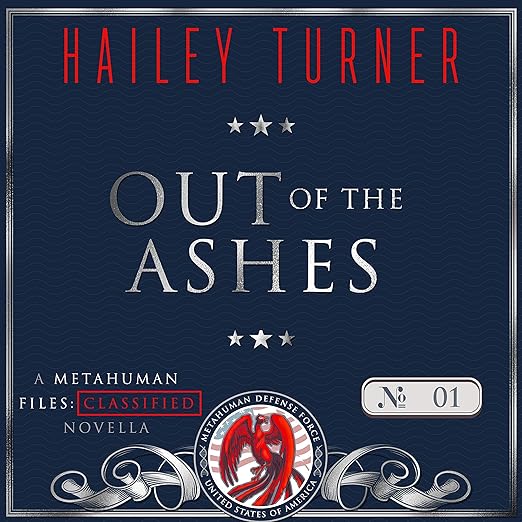
Quick Take
- Narration: Greg Boudreaux handles both Sean and Alexei with emotional precision, and his work in the quieter, more vulnerable scenes is where the novella’s real weight lands.
- Themes: PTSD and trauma recovery in a relationship, guilt vs. self-forgiveness, the distance that shared suffering can create between people who love each other
- Mood: Intimate and emotionally careful, more internal than action-driven
- Verdict: A PTSD recovery novella that takes the aftermath of trauma more seriously than most romance fiction dares, delivered in under three hours with real emotional impact.
I listened to Out of the Ashes on a quiet weeknight, which turned out to be the right setting for it. This is not an action novella. It is something closer to a character study of two men trying to find their way back to each other after events that broke something between them. Hailey Turner is working in the M/M military romance space with the Metahuman Files series, but Out of the Ashes is lighter on action and heavier on psychological interiority than its setting might suggest. That is a deliberate choice, and it pays off.
Staff Sergeant Alexei Dvorkin and Agent Sean Delaney were together before the events chronicled in the preceding novel In the Blood. What happened there, specifically Alexei’s time as a prisoner of war and the trauma both men carry from that period, has frayed what existed between them. Sean blames himself for what Alexei suffered. Alexei wants his partner back but cannot reach him. Turner is honest about the mechanics of PTSD: the therapy sessions, the nightmares, the way trauma creates distance even between people who desperately want proximity, the gap between identifying what you are experiencing and actually overcoming it. For a novella of under three hours, the emotional work she accomplishes is substantial.
Our Take on Out of the Ashes
The series context is important to flag before you begin. One reviewer explicitly noted that despite being labeled book one in the Metahuman Files: Classified series, Out of the Ashes functions as book 4.5 in the main Metahuman Files sequence. This means that the emotional resonance, particularly the aftermath of In the Blood’s events, arrives with full force only for listeners who have the prior context. Coming in without it, you will understand what is happening, but the grief and relief that the best moments in this novella generate depend on knowing what Sean and Alexei had before it was damaged. Turner does not recap; she trusts her returning readers.
Why Listen to Out of the Ashes
Greg Boudreaux’s narration is well-suited to this material. M/M romance audiobooks succeed or fail on the narrator’s ability to differentiate male characters and sustain emotional credibility through vulnerable scenes without retreating into irony. Boudreaux does both. He is most effective in the slower, more interior passages where Sean is processing his guilt and Alexei is navigating the space between what he wants and what he can ask for. The mission that catalyzes Sean’s breaking point is handled with appropriate urgency, but it is the conversations that follow that demonstrate what Boudreaux does best. Reviewers consistently describe the emotional authenticity of the relationship dynamics as the book’s primary draw, and the narration honors that.
What to Watch For in Out of the Ashes
At two hours and thirty-eight minutes, Out of the Ashes is a novella in length and scope. It is not designed to function as an introduction to these characters or this world: it is an interlude, an opportunity to spend time inside the heads of Sean and Alexei as they heal, rather than a full arc with beginning, middle, and end. Readers expecting the plot momentum of an action novel will find the pacing deliberate. The romance resolution feels earned rather than rushed, but it arrives within the compact frame of a story that is primarily interested in interior state rather than external event. The supernatural elements of the Metahuman Files world are present in the background but do not drive the novella’s action.
Who Should Listen to Out of the Ashes
The ideal listener has already completed at least In the Blood and ideally the broader Metahuman Files series. For those readers, this is a deeply satisfying companion piece that does justice to two characters whose trauma was depicted in unflinching terms in the prior book. M/M romance readers who appreciate PTSD representation handled with psychological accuracy will find Turner’s approach thoughtful rather than exploitative. Listeners who are new to the series should begin with the main Metahuman Files sequence, where Sean and Alexei’s relationship is established, before arriving here.
Frequently Asked Questions
Do I need to read the Metahuman Files series before listening to Out of the Ashes?
Yes, strongly recommended. Despite being labeled book one in the Classified subseries, Out of the Ashes is book 4.5 in the main Metahuman Files sequence and assumes full knowledge of what Sean and Alexei experienced in In the Blood. Beginning here without that context will provide a coherent story but significantly diminish the emotional impact.
How does Out of the Ashes handle PTSD? Is the portrayal accurate or romanticized?
Multiple reviewers with personal familiarity with trauma recovery described Turner’s portrayal as accurate and serious. She covers therapy, the non-linear nature of healing, the way guilt and trauma create distance between people who want connection, and the gap between understanding what you are experiencing and overcoming it. The treatment is neither romanticized nor exploitative.
Is Out of the Ashes primarily a romance or primarily a PTSD recovery story?
It is both, with the recovery arc serving as the central structure and the romantic relationship as the stakes and destination. The novella is interested in whether Sean and Alexei can find their way back to each other, which means the healing has to happen before the romance can be restored. It reads as character study more than conventional romance.
How does Greg Boudreaux’s narration handle the dual male protagonists and the emotional demands of the material?
Boudreaux differentiates Sean and Alexei clearly and handles the more vulnerable, interior passages with emotional credibility rather than clinical distance. He is particularly effective in the scenes where the emotional content requires restraint rather than expression, which suits a story about two people who are struggling to articulate what they feel.