Quick Take
- Narration: Paul Michael delivers the Langdon formula competently, clear, propulsive, never scene-stealing, which suits Brown’s architectural thriller style.
- Themes: Science versus religion, artificial intelligence and human identity, the ethics of revelation
- Mood: Kinetic and cerebral, set against the backdrop of modernist architecture
- Verdict: Brown’s most philosophically ambitious Langdon novel, carried by a genuinely interesting central question even when the plot machinery creaks.
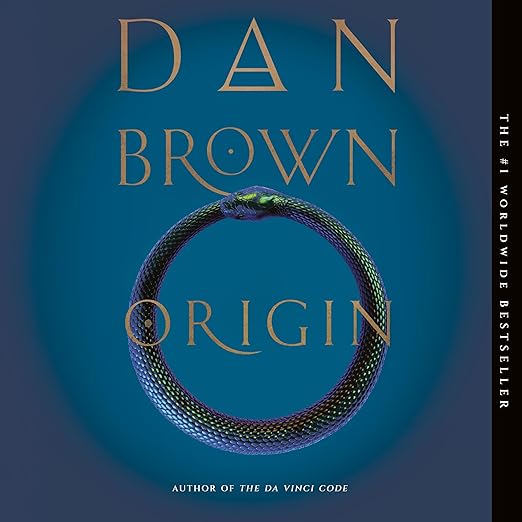
I finished Origin on a long overnight flight from Paris, somewhere over the Atlantic at an altitude where philosophical questions about human origins feel less abstract than usual. The cabin was dark, most passengers were asleep, and Paul Michael was walking me through the Guggenheim Bilbao at a pace that made the hours disappear. Whatever you think of Dan Brown’s prose style, and the criticisms are well-documented, he writes audiobooks that function almost like films. Origin is the fifth Robert Langdon novel, and it is the one where Brown seems most interested in what he actually wants to say.
The setup is familiar: Langdon is invited to witness a major public revelation by a former student, the flamboyant tech billionaire and futurist Edmond Kirsch. The revelation is interrupted violently before it can be made. Langdon, paired with museum director Ambra Vidal, spends the next eighteen hours racing across Spain, from the Guggenheim Bilbao to the Sagrada Familia in Barcelona to the Royal Palace in Madrid, trying to locate a password that will unlock and broadcast Kirsch’s discovery. The discovery, in case the synopsis is being coy about it, concerns the origin of life and what comes next for humanity.
Our Take on Origin
Reviewer Yaj from the UAE put it precisely: Brown departs from the comfort zone of a conventional techno-thriller and delivers something far more ambitious, a meditation on intelligence, belief, and the future trajectory of the human species. That framing is accurate. The central question Kirsch has answered is not a MacGuffin. Brown actually engages with it, and the final revelation, while not scientifically rigorous, is more thoughtful than the book’s thriller packaging suggests. The artificial intelligence element, an AI named Winston who assists Langdon and Ambra throughout the novel, adds a layer of irony to the book’s conclusions that Brown handles with more subtlety than he typically allows himself.
Reviewer Heather Jones-Lancto noted the art references are factual, which matters. The architecture of the Guggenheim Bilbao, the symbolism embedded in the Sagrada Familia, the paintings Kirsch curated for his event, Brown has done his research, and Michael’s narration lets these sequences breathe rather than rushing through them. At 18 hours, Origin is the longest of the Langdon novels, and the architectural interludes earn their runtime.
Why Listen to Origin
The audiobook format suits Origin particularly well because Michael maintains a clean, authoritative voice that never mugs for effect. The Langdon series has always depended on the listener accepting that a Harvard professor of symbology is somehow constantly in the middle of global conspiracies, and Michael’s steady delivery papers over the absurdity without drawing attention to it. He is not giving a performance in the theatrical sense, he is serving the story’s momentum, which is what Brown’s pacing demands. Reviewer John Johnson, who read every Brown novel and considers this the best, specifically notes the book’s ability to sustain multiple storylines simultaneously, and Michael handles the gear changes between Langdon’s perspective and the antagonist threads with clarity.
What to Watch For in Origin
The villain’s identity is telegraphed earlier than Brown likely intends, and listeners with any experience of the Langdon formula will probably identify the key revelation before it arrives. This is a structural problem that has followed the series since The Da Vinci Code, and Origin does not solve it. The romantic pairing between Langdon and Ambra feels obligatory rather than organic, and the pacing in the middle third, during the extended Barcelona sequence, slows noticeably. Brown is stretching to reach his page count and some of that stretch is audible even in audio form.
What saves Origin from these familiar problems is the sincerity of its central argument. Brown is genuinely interested in the question of whether scientific discovery can coexist with religious belief, or whether it must necessarily displace it. The answer he arrives at is more nuanced than the thriller frame suggests, and it gives Origin a lasting quality that Angels and Demons, for all its Roman spectacle, does not quite have.
Who Should Listen to Origin
Langdon series veterans who have followed Brown through The Da Vinci Code, Angels and Demons, The Lost Symbol, and Inferno will find the most satisfying return on investment here, Origin rewards familiarity with Langdon’s recurring structural patterns and subverts several of them in ways that feel intentional. First-time Brown listeners can enter here; the book is largely self-contained. Readers who cannot forgive clunky expository prose or convenient coincidences will continue to find Brown frustrating. Those who want a thriller that actually has something to say about artificial intelligence, the future of religion, and where human civilization might be heading will find that Origin delivers on that ambition more fully than its marketing suggests.
Frequently Asked Questions
Does Origin work as a standalone listen or do I need to have heard the earlier Langdon novels?
Origin works as a standalone. Brown recaps Langdon’s background lightly enough that new listeners will not feel lost, and the plot does not require knowledge of previous entries. That said, Langdon series veterans will catch callbacks and appreciate the evolution of the character’s recurring patterns.
How does Paul Michael’s narration of Origin compare to other Langdon audiobook narrators?
Paul Michael has narrated the entire Robert Langdon series and has settled into a consistent interpretation of the character, measured, academic, and capable of urgent delivery during action sequences. His approach is less theatrical than some thriller narrators, which suits Brown’s architecturally dense set pieces.
Is the science in Origin accurate enough that a listener with a science background will find it credible?
The science is speculative and simplified for a general audience. Brown engages seriously with abiogenesis and evolutionary theory but extrapolates dramatically beyond current scientific consensus. The ideas are interesting as philosophical provocations rather than as scientific claims, and that framing is more honest than many popular science thrillers manage.
At 18 hours, does Origin justify its runtime or does it feel padded compared to earlier Langdon novels?
Origin is the longest of the Langdon novels and does have a slower middle section. The architectural and art history sequences add genuine texture rather than just padding, and listeners who enjoy Brown’s location work in Spain will find the length justified. Those who primarily want plot mechanics may find the extended Sagrada Familia passages slow.