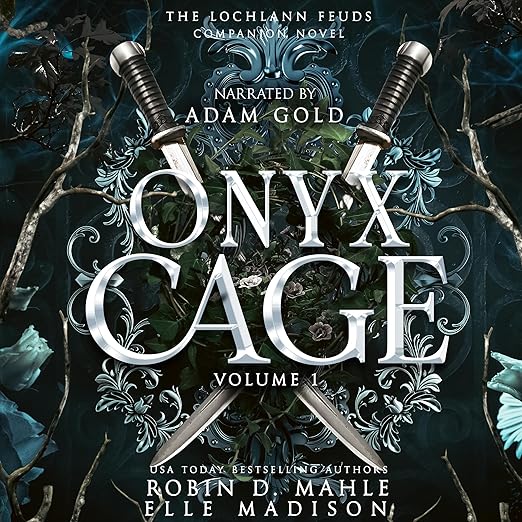
Quick Take
- Narration: Adam Gold is not just well-cast; reviewers describe his voice as the definitive sound of Evander, the male lead. His performance is the main reason to choose audio over print for this companion novel.
- Themes: Tactical self-control undone by unexpected love, perspective recontextualization, the cost of duty
- Mood: Intense and emotionally layered, with the particular pleasure of watching a story you know refract through a new lens
- Verdict: Essential for Lochlann Feuds fans; genuinely pointless if you have not read the main series first.
I have a complicated relationship with companion novels. The best ones, the ones that justify their existence, do not just repeat what you already know from the protagonist’s perspective; they retroactively change your understanding of events you thought you had fully processed. Onyx Cage: Volume I does that. I listened to it on a Friday evening after a long week, expecting to coast, and found myself genuinely unsettled by around chapter four in a way that surprised me. Robin D. Mahle has made a calculated creative decision here that pays off.
The premise: this is books one and two of the Lochlann Feuds series retold entirely from Evander’s perspective. Evander is the male lead, the clan tactician whose identity is built on meticulous preparation and emotional control. The opening line of the synopsis captures his character precisely: he has spent years carefully, meticulously assessing each situation and weighing the best potential outcome, knowing that his clansmen live and die on his ability to do it well. And then she arrives at the Summit and none of that preparation matters. That collision between a strategist’s identity and an encounter he cannot strategize around is the engine that drives everything that follows.
Our Take on Onyx Cage: Volume I
What the companion perspective reveals, and what Mahle clearly understood would be the most interesting consequence of the exercise, is that Rowan, the original protagonist, reads very differently through Evander’s eyes than through her own. Several reviewers describe feeling strong negative reactions to Rowan in this book: her immaturity, her selfishness, the gap between what Evander is dealing with externally and what he returns home to. One reviewer said it affected their day. That is not a failure of Mahle’s writing; it is the point. Seeing a beloved character as someone else sees her, honestly rather than sympathetically, is destabilizing in exactly the productive way that the best character work produces.
Why Listen to Onyx Cage: Volume I
Adam Gold’s narration is the version-defining element here. Multiple reviewers with strong opinions about the series state flatly that his voice is Evander’s voice, that they cannot imagine the character sounding any other way. That degree of casting success is rare enough to be worth noting. The 11-hour runtime covers two full books of story from the new perspective, which is substantial but not padded; the material earned its length through the accumulated weight of the Lochlann Feuds world. The fantasy romance setting, characterized by clan dynamics, high-stakes political maneuvering, and a remote, storm-edged geography, is rendered with specific texture rather than generic world-building.
What to Watch For in Onyx Cage: Volume I
The disclaimer in the synopsis is genuine and not merely a formality: this audiobook is strongly encouraged for listeners who have already completed the Lochlann Feuds series. The companion structure requires prior investment to pay off emotionally. Without knowing who Rowan is, without caring about her arc, the experience of watching Evander’s patience with her early behavior will land as characterization rather than revelation. The series fandom is passionate enough that one reviewer described the Lochlann Feuds as their Roman Empire, which gives you a sense of the emotional stakes involved. This is a text for insiders, which is both its limitation and its particular pleasure.
Who Should Listen to Onyx Cage: Volume I
Lochlann Feuds readers who have completed at least the first two books are the clear audience. For them, this is essential listening rather than optional supplementary material; the depth it adds to Evander as a character and the retroactive complexity it creates in Rowan’s arc are significant. Newcomers should go read the main series first. Those who are generally skeptical of companion novels may find their skepticism tested by the quality of Mahle’s execution, but entering without the series context is setting up the experience to fail. Adam Gold’s performance is available nowhere else in the series in this form, which is itself a compelling reason to choose audio over print for existing fans.
Frequently Asked Questions
Is Onyx Cage: Volume I a retelling of the entire Lochlann Feuds series, or just the first two books?
It covers the events of the first two books in the Lochlann Feuds series from Evander’s perspective. A Volume II is anticipated, presumably covering the subsequent books in the series.
Does Adam Gold voice the entire audiobook, or does the narration shift between characters?
Gold voices the entire audiobook, which is consistent with it being Evander’s first-person companion narrative. His narration is single-perspective throughout, which reviewers describe as the correct creative decision for this material.
I read Lochlann Feuds in print rather than as an audiobook. Is the audio version of Onyx Cage still worth it?
Yes. Adam Gold’s performance is singled out by reviewers as the defining vocal interpretation of Evander, and several listeners describe the audio as enhancing the emotional experience even for those who consumed the source material in text form.
Reviewers mention disliking Rowan in this book. Does that affect enjoyment of the companion novel or the original series retroactively?
It complicates them, which appears to be intentional. Mahle is showing Rowan’s early behavior as Evander experiences it rather than as Rowan narrates it. Reviewers who felt strong negative emotions about Rowan in this context generally describe that reaction as adding depth to the series rather than diminishing it.