Quick Take
- Narration: Scaachi Koul reading her own essays is the only way this collection should exist; her father’s vocal interjections, noted by Library Journal, add a dimension no other narrator could replicate.
- Themes: First-generation immigrant identity, gender and body politics, family dynamics
- Mood: Biting and self-aware, with a melancholy undertow
- Verdict: An essay collection that works best when its humor and its grief share the same sentence, which is more often than you might expect.
I had heard Scaachi Koul in interviews before I listened to her essays, and I had the experience of finding her funnier and more precise in conversation than most writers are on the page. That set an expectation that the audiobook either had to meet or fall short of. It mostly meets it, and in a few places exceeds it, because what Koul can do on the page she can also do with her voice: hold contradictory things in suspension without forcing a resolution that the material does not actually support.
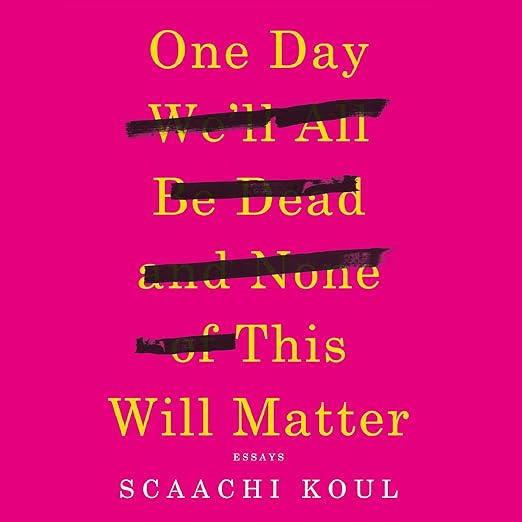
One Day We’ll All Be Dead and None of This Will Matter is not quite a humor essay collection, though it has been sold that way. It is a book about being a specific kind of woman in a specific kind of situation, the daughter of Indian immigrants navigating Western culture with her own ambitions and her own body and her own history of being looked at, and Koul’s humor is the instrument she uses to make the weight of that situation bearable for herself and readable for others. When the humor works, it does real structural work rather than decorating the argument.
The Father as Recurring Figure and Voice
Library Journal singled out the father’s vocal interjections as a particular virtue of the audiobook, and this is worth dwelling on. Koul’s father appears throughout the essays as a character, alternately exasperating and deeply affecting, and his actual presence in the recording adds a layer that does not exist in the print version. The interjections are brief but they shift the register of the listening experience in ways that feel earned rather than gimmicky. You are not simply hearing Scaachi describe her family dynamic; you are briefly inside it.
Several essays focus directly on the parent-child relationship and what gets transmitted across immigration and cultural difference. The fears her parents carry, the protectiveness that can read as control, the gap between what they left and what they arrived into, these are handled with more tenderness than the book’s title or its comic marketing might suggest. The collection’s emotional center is not the internet trolls or the bikini waxer, though both make memorable appearances. It is the family.
Where the Razor Sharpness Cuts Both Ways
Not every essay in the collection works equally well, and one reviewer’s description of the humor as jarring relative to the seriousness of some subjects is a fair assessment of at least a few pieces. Koul’s comic mode is biting and self-aware, and at its best that combination produces writing that disarms readers into confronting something they would otherwise defend themselves against. At its less successful moments the biting quality crowds out the other tones she is capable of, and the essay loses some of its purchase.
The essays on casual racism, body image, and navigating Western beauty standards alongside Indian family expectations are the ones where the humor-and-gravity balance works most consistently. These are also the essays that most clearly show why Koul was considered an important new voice in cultural criticism. She is not simply venting experience. She is examining how systems produce individual feeling, and she does it while being very funny about a bikini waxer appointment.
What Author Narration Offers This Particular Collection
The decision to have Koul narrate is not just commercially logical; it is aesthetically necessary. These essays require the narrator to modulate between self-deprecating humor, real anger, and genuine vulnerability across relatively short spans. A professional narrator working from inference would likely smooth those transitions into something more consistent and considerably less interesting. Koul’s own voice carries the register shifts because she knows when she is being funny about something serious and when she is being serious about something she normally treats as funny. The difference matters, and only she can deliver it with the authority the material requires.
The Five and a Half Hours and How to Use Them
At five and a half hours, the collection is a satisfying single-day listen or a companionable week of commutes. It does not demand completion in one sitting, and some essays reward sitting with their argument before moving to the next one. Listeners who come expecting pure comedy may need to recalibrate toward the more layered experience the book actually delivers. Those who find the biting mode too relentless in places will find that the essays about her parents provide real relief and real emotion alongside it. The range is the point.
Frequently Asked Questions
What role does Scaachi Koul’s father play in the audiobook beyond being a character in the essays?
Library Journal noted that the audiobook includes actual vocal interjections from her father. He functions as a recurring presence in the recording itself, adding a dimension that exists only in the audio version.
Is this collection primarily funny, or is it more serious than its title suggests?
Both, in proportions that shift from essay to essay. The humor is real and sometimes genuinely laugh-out-loud, but several essays are primarily about grief, family pressure, and the experience of racism. Readers expecting pure comedy may need to adjust.
Does Koul’s Indian-Canadian background need to be familiar territory for a listener to connect with the essays?
No. Multiple reviewers from different backgrounds describe connecting with the collection’s themes of cultural in-betweenness, family expectation, and being a woman whose appearance is publicly available for critique. The specificity makes the essays vivid, not less accessible.
How does this collection compare to other immigrant-daughter essay collections?
It sits alongside books like Roxane Gay’s Bad Feminist in its mode of personal essay with cultural commentary, but Koul’s tone is more caustic and her family material is more central. It is its own distinct thing rather than a template entry in an established form.