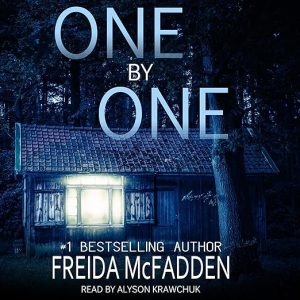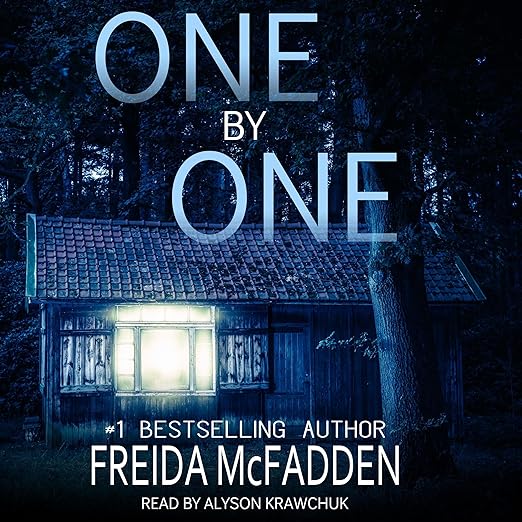
Freida McFadden has built a reputation on domestic thrillers that feel plausible right up to the moment they don't, and this audiobook represents a deliberate pivot from her usual kitchen-sink psychology. One by One drops the suburban floorplan and relocates the dread into actual wilderness, which changes everything about the pacing and the stakes. I came to it after working through several of her other titles back to back, and the shift in setting registered immediately. The familiar ingredients are still present: a marriage under pressure, secrets among friends, a narrator we're not entirely sure we can trust. But this time the forest becomes a character in its own right, and Alyson Krawchuk's narration leans into that atmospheric weight in ways that are genuinely difficult to shake. Claire Matchett's failed vacation is the kind of setup McFadden executes better than almost anyone else working in this genre right now.
Our Take on One by One
McFadden opens with Claire, whose idea of a restorative vacation turns catastrophic when the minivan breaks down on a lonely dirt road with no cell reception. What follows is less a whodunit and more a survival thriller that slowly reveals itself to be both at once. The genius of the setup is how McFadden uses the isolation not just as a practical problem but as a psychological pressure cooker. The woods don't care that these adults have accumulated years of relationship baggage. The woods don't care that trust has already been eroded before the first night falls. The narrative chapters alternate between "Then" and "Now" timelines, a structure McFadden has deployed before but which works especially well here because the reader is constantly recalibrating what they know about the survivors before the story catches up to the aftermath. One reviewer noted that the "why" behind the events was particularly chilling, and I agree that the motive, when fully revealed, recontextualizes everything that came before in uncomfortable ways. McFadden has always been good at builds toward revelations that are not merely surprising but that reframe the entire emotional architecture of the story retroactively. That instinct is sharp here.
Why Listen to One by One
Alyson Krawchuk handles Claire's first-person narration with a measured unease that never tips into hysteria. She's the kind of narrator who keeps you slightly off-balance, giving emotional detail to Claire's internal life while keeping the surface voice controlled enough that you can never quite determine whether her fear is straightforward or whether it serves a purpose. For a story where perception and unreliability are doing heavy structural work, that tonal discipline is essential. Krawchuk also manages the "Then" and "Now" splits clearly, using subtle vocal texture shifts that help orient the listener without requiring clunky transitional signals. At just under seven hours, the production moves briskly. McFadden's prose in audio works better than on the page for many listeners because the stripped-back sentences benefit from being heard rather than scanned; Krawchuk adds weight to lines that might read as perfunctory in print and makes them land with genuine unease. The experience of listening to a survival thriller with headphones in the dark adds a dimension that the page can't fully replicate.
What to Watch For in One by One
McFadden's fans who come from her more character-driven domestic work may notice that the survivalist mechanics occupy more real estate here than the interpersonal psychology. The relationship repairs and ruptures feel slightly compressed compared to something like The Housemaid, where character is the engine and plot is almost secondary. That is a tradeoff, not a failure of craft, but it's worth knowing going in. One reviewer noted that as someone who actually hikes, the wilderness navigation felt slightly unrealistic, and that observation rings true for anyone who has spent time in backcountry terrain. McFadden is working toward maximum tension rather than documentary accuracy, and the woods here are more symbolic than geographic. Readers who need their thrillers grounded in procedural detail will chafe at some of the choices. Those who enjoy a horror-inflected pace, where the irrationality of the situation is itself part of the atmosphere, will find this well constructed. The rating of 4.2 from 131 listeners reflects a book that divides between those who love the twists unconditionally and those who prefer her earlier, more claustrophobic work.
McFadden also uses the couple dynamic more strategically than the synopsis suggests. Claire's marriage is fraying before the trip begins, and the stress of survival strips away the social performances that kept the cracks hidden. The wilderness plot and the marriage plot inform each other rather than running parallel without connection, which elevates One by One above more mechanical survival fiction. That structural choice is what makes the final reveal land with the specific kind of discomfort it does.
Who Should Listen to One by One
Listeners who enjoy survival-scenario thrillers with a psychological undertow will find this delivers on both fronts. Fans of McFadden's previous audiobooks, particularly those who appreciated her handling of unreliable narration, will recognize her instincts even in the unfamiliar setting. The "Then" and "Now" structure rewards listeners who enjoy assembling information from fragments rather than receiving it chronologically, and Krawchuk's narration makes that assembly feel earned rather than merely clever. If you want fully realized nature writing alongside your suspense, look elsewhere. But if you want a fast, well-narrated six-and-a-half hour audiobook that earns its last-chapter reveal and leaves you recalibrating who you trusted from the beginning, McFadden and Krawchuk deliver exactly that. Skip it if you need your thrillers to stay close to what's psychologically or practically realistic rather than atmospherically effective.
A Few Questions About One by One
Does Alyson Krawchuk's narration work for the dual-timeline structure in this audiobook?
Yes. Krawchuk differentiates between the 'Then' and 'Now' chapters using subtle vocal shifts that help orient listeners without calling too much attention to the technique. The controlled unease in her voice suits Claire's unreliable perspective well throughout the nearly seven-hour runtime.
At under seven hours, does this audiobook feel rushed or properly developed?
The brevity suits the pace McFadden is aiming for. The 'Then' and 'Now' structure carries a lot of narrative weight efficiently. Some listeners feel the character relationships could have used more time, but the thriller mechanics land cleanly within the runtime without feeling truncated or underserved.