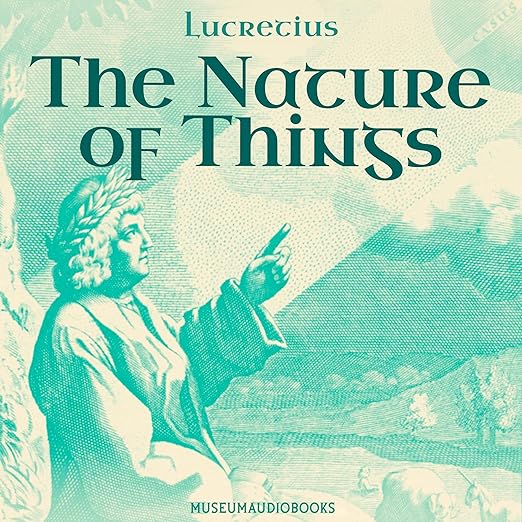
Quick Take
- Narration: Andrea Giordani reads with care and rhythmic intelligence, giving the verse its proper weight without turning it into performance poetry.
- Themes: atomic materialism, the absence of divine intervention in nature, Epicurean ethics and the pursuit of peace
- Mood: Dense and austere, punctuated by passages of startling beauty, the intellectual equivalent of a long mountain walk
- Verdict: An essential work of Western philosophy rendered in listenable form; patience is required, but what Lucretius offers in return is extraordinary.
I encountered Lucretius properly for the first time during my postgraduate work on ancient literature, where De Rerum Natura occupied a strange position: everyone acknowledged it as one of the foundational texts of Western thought, and almost no one read it in full. It was always the poem excerpted in anthologies, the one Greenblatt would later write about in The Swerve, the one whose rediscovery in the fifteenth century is credited with nudging Europe toward the scientific revolution. I had read sections in translation. I had never listened to it all the way through until this audiobook version from MuseumAudiobooks.com landed on my queue, and the experience of hearing the whole arc of Lucretius’s argument, uninterrupted, was something I wasn’t fully prepared for.
Written in the first century BC, On the Nature of Things is a didactic poem in six books that sets out to explain the Epicurean account of the universe: everything is composed of atoms moving through void, there is no divine intervention in human affairs, death is simply the dissolution of atomic arrangement and therefore nothing to fear, and the good life consists of pursuing pleasure in its deepest sense – tranquility, friendship, intellectual clarity – and avoiding the suffering caused by superstition and the fear of punishment after death. By any measure, this is a radical document. That it survived at all is something close to a miracle of manuscript transmission.
Our Take on On the Nature of Things
What makes Lucretius remarkable as a thinker, and what this audiobook conveys well, is that his arguments anticipate modern science in ways that continue to be striking. His insistence that matter cannot be created or destroyed prefigures conservation laws. His account of atoms – indivisible, constantly in motion, combining in infinite configurations – is recognizable as a poetic version of what later became atomic theory. His treatment of evolution, though not identical to Darwin’s, engages with similar questions about how living forms develop and why some survive and others don’t. One Amazon reviewer noted the pleasure of watching Lucretius try to deduce physics from first principles, making funny mistakes along the way, like arguing the earth must be flat because otherwise upside-down antipodeans would be absurd. These moments of charming error alongside genuine insight are part of what makes the poem human and alive rather than merely historically significant.
The translation used here is in verse, which is the right choice for a work that Lucretius conceived as poetry. Verse translations of ancient didactic poetry are a contested territory – some listeners will prefer a more literal prose rendering, others will want the music – but this one reads well, as one reviewer confirms, noting that it works as poetry in its own right. The six-book structure is not subtle about its ambitions: Lucretius builds his argument methodically, and the poem rewards sustained attention across its full arc rather than dipping in at intervals.
Why Listen to On the Nature of Things
Andrea Giordani’s narration is thoughtful and measured. He reads the verse with attention to its rhythm without turning the performance into something theatrical, which is the right approach for a philosophical poem. Some listeners may find the pace slow, particularly through the more technical passages where Lucretius is working through arguments about atomic physics or the nature of sensation. But this is content that benefits from being heard at a contemplative pace rather than rushed. The eight hours and fifty-one minutes feel appropriate for the scope of what’s being attempted.
The audiobook format is a genuinely interesting way to encounter ancient verse. Reading silently, it’s easy to skip past passages that feel dense; listening, you have to stay with the argument, which is actually closer to how ancient audiences would have received poetry in performance. For that reason, this is one of those rare cases where audio may be a better medium than silent reading for first encounters with the text.
What to Watch For in On the Nature of Things
Patience is not optional. Books four and five, which deal with perception, sensation, and the development of civilization, are the densest sections and the ones where the verse translation is under the most strain. One reviewer specifically objected to the rhyme and rhythm of the translation, noting they found it forced. That’s a fair response to a genuine challenge: no translation of Lucretius is going to satisfy everyone, and listeners with a strong investment in either strict literalism or a particular poetic aesthetic will have opinions about the choices made here. It’s worth noting that the synopsis for this audiobook is minimal – just two sentences – which means new listeners should come with some prior context. Reading Greenblatt’s The Swerve beforehand, as several reviewers suggest, provides an ideal introduction to both the text and its extraordinary history.
Who Should Listen to On the Nature of Things
This is for readers who have an appetite for ancient philosophy in its full difficulty, for those who are curious about the Epicurean tradition and its influence on later thought, and for anyone who has encountered references to Lucretius and wants finally to hear what the fuss is about. It’s not for casual listeners looking for accessible nonfiction or for something to half-listen to during other tasks. Lucretius demands your full attention, and what he offers in return is remarkable: a window into a mind grappling with the nature of reality two thousand years ago, reaching conclusions that the twenty-first century is still working through.
Frequently Asked Questions
Should I read anything before listening to On the Nature of Things?
Stephen Greenblatt’s The Swerve: How the World Became Modern provides an excellent introduction to Lucretius and the extraordinary story of the poem’s rediscovery. Several reviewers recommend it as preparation, and it significantly enriches the listening experience.
Is a verse translation the right choice for this audiobook?
It depends on your priorities. Verse preserves the musical quality Lucretius intended and reads as poetry in its own right, which some listeners find essential. Others prefer more literal prose translations for philosophical clarity. Both have merit; this audiobook commits to verse throughout.
How does Lucretius’s ancient science hold up, is it frustrating to hear him get things wrong?
Less frustrating than illuminating. Lucretius’s errors are often as interesting as his insights, because they show a remarkable mind reasoning from first principles without the benefit of modern instrumentation. The moments of near-correct deduction alongside charming mistakes are part of what makes the poem alive rather than merely historical.
Is this audiobook suitable for someone new to ancient philosophy?
It’s accessible but not easy. Some prior familiarity with Epicurean philosophy or ancient thought in general will help you follow the argument. The poem doesn’t provide much scaffolding, Lucretius assumes you’re committed to following him through a sustained argument across six books.