Quick Take
- Narration: Ric Jerrom brings Seneca’s aphoristic prose to life with steady authority; his voice suits the philosophical weight of the material without adding unnecessary drama.
- Themes: Stoic ethics, the shortness of life, virtue versus fortune
- Mood: Measured and quietly demanding
- Verdict: A fourteen-hour immersion in Stoic thought that rewards attentive listening; Jerrom’s narration makes the dense material consistently engaging.
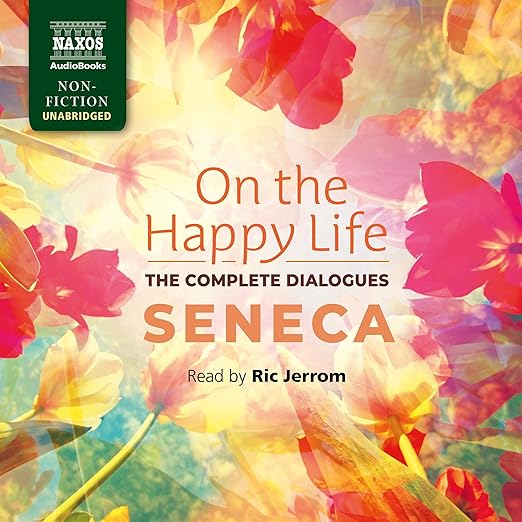
I returned to Seneca this winter after a long stretch of reading contemporary fiction, and I was reminded of something I had almost forgotten: that philosophical prose from antiquity, when translated well and delivered by a thoughtful narrator, has a way of cutting through the noise of the present in ways that nothing written in the last decade can quite replicate. On the Happy Life: The Complete Dialogues, narrated by Ric Jerrom for Naxos AudioBooks, gave me fourteen hours of that experience.
Seneca wrote these dialogues during his years as tutor to the young emperor Nero, a biographical context that adds a particular irony to his discussions of moral integrity and right living. A man advising one of history’s more notorious rulers on how to be a good person produced some of the most practical and penetrating ethical writing in the Western tradition. The dialogues cover a remarkable range: the shortness of life, tranquility of mind, anger, mercy, happiness, and grief at the loss of a loved one. The breadth is one of the collection’s genuine strengths.
Our Take on On the Happy Life
What distinguishes Seneca from his Stoic contemporaries, and what makes him particularly well-suited to the audio format, is his style. As the synopsis notes, his writing is accessible and aphoristic. He does not build elaborate logical structures that require you to hold multiple premises in mind simultaneously. He delivers precise, penetrating observations that can stand alone and accumulate over the course of a dialogue into something larger. That quality transfers beautifully to listening. Reviewer Herman Kaljo noted that he ended up highlighting almost the whole book due to so many brilliant words of wisdom, and that experience of encountering one quotable insight after another is what Stoic listening feels like at its best.
The dialogues are also, as reviewer Em Love observed, remarkably relevant to modern life without trying to be. Seneca is writing about how to live under circumstances where much is beyond your control, how to treat fortune as something borrowed rather than owned, how to maintain equanimity in the face of grief. These are not historical concerns. The grappling with vice versus virtue and the question of how to remain unfazed by life’s tragedies that reviewer Herman Kaljo identifies feel as immediate now as they did in the first century.
Why Listen to On the Happy Life
Ric Jerrom’s narration through Naxos AudioBooks is well-calibrated for this material. Naxos has a long reputation for matching narrators to classical and philosophical texts, and Jerrom reads with the paced authority that Seneca’s prose requires. The aphoristic quality of the writing could easily become monotonous in a lesser performance, but Jerrom varies his register enough to keep the fourteen hours moving without imposing emotional readings that the text does not support. One reviewer described finding the reading difficult to follow at times, which is an honest observation: Seneca can be dense, and some of the longer dialogues require sustained attention. Jerrom helps but cannot fully compensate for the inherent demands of the material.
This is listed under literature and fiction by genre classification, but it functions primarily as philosophy. Listeners approaching it as a narrative will be disappointed. Approached as a long engagement with a first-century thinker whose concerns remain startlingly current, it is one of the most consistently rewarding classics in the audiobook catalog.
What to Watch For in On the Happy Life
At fourteen and a half hours, this is a significant time commitment. The dialogues vary in accessibility, and some, particularly the extended treatments of anger and the shortness of life, are more immediately engaging than others. If you are new to Seneca, starting with his Letters (the Epistulae Morales) before tackling the full dialogues may be a more gradual entry point. Reviewer John Alam noted that familiarity with Seneca’s letters makes the dialogues easier to navigate quickly, which is sound practical advice.
The translation quality also matters significantly with classical texts in audio form, and this production benefits from a translation that captures the aphoristic quality without becoming artificially colloquial. Listeners with strong opinions about specific Seneca translations may want to verify which version is used before committing to the full runtime.
Who Should Listen to On the Happy Life
This audiobook will reward listeners who have some existing interest in philosophy, classical literature, or Stoic thought, and who are willing to bring sustained attention to a fourteen-hour engagement with a demanding thinker. It is an excellent choice for listeners who have explored Marcus Aurelius or Epictetus and want to complete their Stoic reading, or for those who find contemporary self-help insufficiently rigorous and want something with genuine philosophical weight behind its counsel. Casual listeners hoping for accessible wisdom in small doses may find the complete dialogues format more demanding than they want; the Letters would serve them better as an introduction.
Frequently Asked Questions
Do I need a background in philosophy to enjoy this audiobook?
Some familiarity with basic Stoic concepts helps but is not strictly required. Seneca’s style is more accessible than many ancient philosophers because he writes in an aphoristic, practical register rather than building dense logical arguments. Listeners who have read Marcus Aurelius will find the transition natural. Complete newcomers to philosophy may find some dialogues challenging.
How does this compare to Seneca’s Letters as an entry point to his work?
The Letters, or Epistulae Morales, are generally considered a more accessible introduction because they are shorter, more focused, and accumulate gradually over many installments. The Complete Dialogues are broader in scope and some are more demanding. One reviewer specifically noted that familiarity with the Letters helps you move through the Dialogues more quickly.
Is the fourteen-hour runtime manageable or does the material become repetitive?
The dialogues cover enough distinct territory, from anger and grief to mercy and the shortness of life, that repetition is not a major issue. The challenge is sustained attention rather than monotony. Listeners who engage in focused sessions of thirty to sixty minutes will likely find the runtime more rewarding than those who try to listen passively for hours at a stretch.
Who narrates this version and is Ric Jerrom a good fit for the material?
Ric Jerrom narrates for Naxos AudioBooks, which has a strong track record with classical and philosophical texts. His delivery is steady and authoritative without being theatrical, which suits Seneca’s measured prose well. Listeners comfortable with British narration of classical texts will find this production to a high standard.