Quick Take
- Narration: Robert Petkoff handles Wallace’s dense, footnote-heavy prose with intelligence and patience, maintaining the essay’s intellectual energy without losing the warmth underneath.
- Themes: Athletic greatness and its philosophical implications, the body as argument, writing as attention
- Mood: Intellectually alive, occasionally overwhelming, always worth the effort
- Verdict: This is not a book about tennis scores; it is a book about what it means to watch something done perfectly, and Robert Petkoff makes the five-hour experience feel necessary.
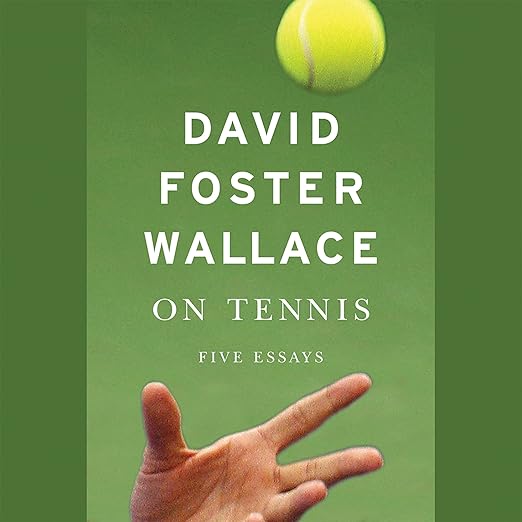
I came to this collection the way most people come to David Foster Wallace: sideways. I had read the Federer essay years earlier in a magazine, printed it out, and kept it in a folder with a handful of other pieces I return to when I need to remember why writing matters. When I found out the full collection had been released as an audiobook with Robert Petkoff narrating, I listened to it on a Tuesday afternoon walk and did not come home until nearly six hours later.
On Tennis collects five essays Wallace published between 1990 and 2006, and they span the full range of his preoccupations: memoir, cultural criticism, celebrity biography, and pure philosophical digression. He was a regionally ranked junior tennis player, and that background gives his observations about the game a specificity that is rare in literary sports writing. He is not romanticizing something he watched from the stands. He is writing about a world he partially inhabited, which makes the sense of loss and wonder that runs through these essays feel earned rather than performed.
Our Take on On Tennis
The five essays here are not of uniform quality, and part of what makes this collection valuable is that the gaps between them reveal something about Wallace’s own development as a writer. The opening essay, about growing up playing tennis in the flat, windy Midwest and how the geography shaped his game, is a piece of memoir as precise and strange as anything he wrote. The Federer essay, the final piece, is almost certainly one of the greatest pieces of sports writing in American literature, and hearing it read aloud adds a dimension that silent reading does not quite reach.
The middle essays are more variable. The piece on Tracy Austin’s memoir is a brilliant critical provocation about why athletes cannot write, and it has a self-aware irony given that Wallace himself was doing exactly what he claimed athletes could not do. The US Open essay and the Michael Joyce profile are both substantial but occasionally sprawl in ways that the other pieces do not. None of them are bad. A few of them are exceptional.
Why Listen to On Tennis
Wallace’s prose is legendary for its footnotes and its subordinate clauses and its willingness to follow a thought somewhere most writers would not go. On the page, that can occasionally feel like architecture. In Petkoff’s narration, the sentences flow in a way that makes the complexity feel more conversational and less designed. One reviewer noted that Wallace had a command of the English language that was pretty well staggering, and Petkoff seems to understand that his job is to carry that command without performing it. He reads with intelligence and a certain steadiness that keeps the longer sentences from collapsing under their own weight.
The footnotes are integrated by Petkoff in a way that preserves their function without breaking the rhythm entirely. In any Wallace audiobook, the footnote question is real, and Petkoff handles it better than most narrators manage with similarly demanding material.
What to Watch For in On Tennis
Listeners who know nothing about tennis will find more here than they expect, as one reviewer who did not play at all noted that the writing dragged them in anyway. But the Michael Joyce essay in particular assumes some familiarity with the professional tennis world of the mid-1990s and the tour’s internal economics, and those details will land with less resonance for listeners who have no frame of reference. That essay is also the longest and most digressive of the five, and it is the one most likely to test patience.
Wallace’s style is not for everyone, and the audiobook does not dilute it. The sentences are long, the footnotes are many, and the intellectual frame occasionally outpaces the subject. Listeners who have not encountered his prose before should consider this a reasonable introduction, but it is not a gentle one.
Who Should Listen to On Tennis
This collection is essential listening for Wallace readers who have not yet encountered his sports writing, and equally essential for tennis fans who want to understand why the game can sustain this kind of philosophical attention. It works well for fans of literary essays generally, particularly those who appreciate writing where the form and the subject are in genuine conversation. It is a harder sell for listeners who approach sports writing expecting primarily statistics, narrative momentum, or match reporting. The five hours are largely spent inside Wallace’s mind, which is a specific and unusual place to be, and the audiobook makes that experience both more intimate and more demanding than the page version.
Frequently Asked Questions
Do I need to know tennis well to appreciate On Tennis?
No, but some familiarity helps with the Michael Joyce profile and certain references in the Federer essay. Multiple reviewers with minimal tennis backgrounds report that the quality of the writing was sufficient to carry them through. The essays are ultimately about attention, greatness, and what it means to do something extraordinary, and those subjects do not require a scorecard.
How does Robert Petkoff handle Wallace’s footnotes in the audiobook?
Petkoff integrates the footnotes into the narration in a way that preserves their function without completely disrupting the rhythm. Footnote handling is always the central technical challenge in any Wallace audiobook, and Petkoff manages it more gracefully than many narrators working with similarly dense material.
Is the Federer essay the best piece in the collection?
Most readers and reviewers would say yes, and it is frequently cited as one of the finest pieces of sports writing published in English. The opening Midwest memoir essay is also exceptional. The collection is uneven, but its peaks are genuinely extraordinary, and the Federer essay in particular gains something from being heard aloud.
Is On Tennis appropriate for listeners who are new to David Foster Wallace?
It is a reasonable entry point, though not a gentle one. The essays are shorter and more accessible than Infinite Jest, and the sports framing gives the dense prose a concrete anchor. Listeners who find his style impenetrable on the page should not expect the audiobook to fully resolve that, but Petkoff’s pacing does make the sentences more navigable than silent reading sometimes allows.