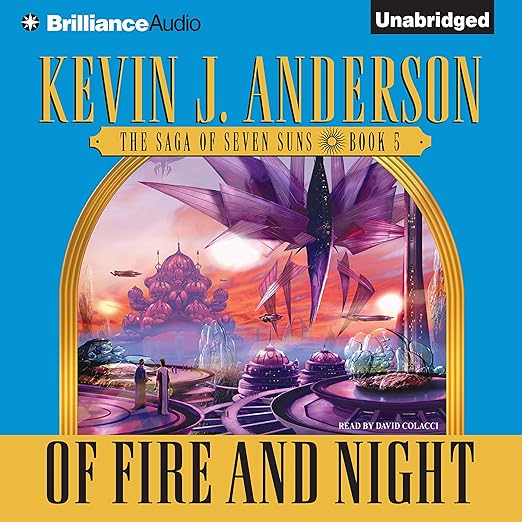
Quick Take
- Narration: David Colacci maintains coherence across an enormous cast of characters and species, a necessary skill for space opera of this complexity, and does so with stamina across eighteen-plus hours.
- Themes: Fractured alliances under existential threat, political corruption enabling catastrophe, unlikely coalitions as humanity’s last hope
- Mood: Propulsive and maximalist, with the satisfying convergence of a long-running series hitting its penultimate peak
- Verdict: The point where the Saga of Seven Suns pays off the most of its accumulated investment, best experienced after books one through four.
There is a specific pleasure that comes from arriving at the fifth book in a space opera series and discovering that the author has actually been building toward something the whole time. Not all series deliver that. Kevin J. Anderson delivers it in Of Fire and Night with an enthusiasm that I found genuinely infectious, despite arriving at the Saga of Seven Suns with some skepticism rooted in Anderson’s work on the Dune prequels, a skepticism that the series has steadily eroded over its course.
I finished book four late on a Thursday evening and started Of Fire and Night on Friday morning, which is the best endorsement I can offer. The book picks up in full crisis: Basil Wenceslas, the increasingly irrational chairman of the Hansa, has managed to alienate every potential ally humanity possesses. The Roamers, the Ildirans under Mage-Imperator Jora’h, the colonists on Theroc, all have been pushed away or actively antagonized. Meanwhile, the soldier compies, the robotic soldier class that Wenceslas has over-deployed, are revolting and slaughtering the military from within. And the hydrogues, the series’ primary alien threat, are still present and still catastrophically dangerous.
Our Take on Of Fire and Night
Anderson’s great skill in this series is the management of scale. He is telling the story of an interstellar civilization at war, with a cast of characters and factions that would defeat a less disciplined writer. One reviewer compares the experience to "Star Wars prequels without the kiddie elements and other flaws," which captures something real: this is sweeping, sincere space opera that trusts its readers to track a lot of simultaneous plot threads without hand-holding. By book five, those threads are converging, and the convergence is satisfying in the way that good series architecture always is when it pays off.
The Theroc sections, involving the worldforest intelligence and its thorny tree battleships, are among the most distinctive material in the series. Anderson’s worldbuilding extends beyond the standard space opera toolkit, and the biological and ecological dimensions of the conflict give it a texture that pure military SF sometimes lacks. The wental storyline, tracking the water entities being seeded across planets to challenge the hydrogues, is similarly inventive.
Why Listen to Of Fire and Night
David Colacci has narrated the Saga of Seven Suns from the beginning, and his familiarity with the material is evident by book five. The cast of major characters runs into the dozens, spanning multiple species, political factions, and narrative timelines, and Colacci keeps them distinct with consistent voice differentiation that does not tip into caricature. At eighteen hours, the audiobook demands stamina, but the narrative pacing is brisk enough that the runtime rarely feels burdensome. Anderson writes in short chapters that shift perspective frequently, which translates well to audio listening in segments.
What to Watch For in Of Fire and Night
The book is, as multiple reviewers note, not a standalone work or a series conclusion. It resolves a great deal of what has been building since book one, but it also leaves enough open for the sixth and final volume. Readers who picked up this book without the preceding four will be comprehensively lost; the entire value of the payoff depends on accumulated investment in the characters and factions. The political subplot involving Wenceslas and his internal antagonists is necessary but occasionally feels like it is marking time while the more exciting elements of the plot converge elsewhere.
Anderson is also not a prose stylist in the literary sense. His strengths are structural and inventive rather than sentence-level, and some passages read more like efficient plot delivery than distinctive writing. For this genre and this series, that is a trade-off most readers will make happily, but it is worth knowing going in.
Who Should Listen to Of Fire and Night
Readers who have followed the Saga of Seven Suns from Hidden Empire through book four are the natural audience, and for them this is essential. Do not start here. For those who enjoy large-scale military SF and space opera in the tradition of David Weber or Iain M. Banks, the series from the beginning is a worthwhile investment. Literary fiction readers looking for spare, precise prose will not find it. Those who want immersive world-building and plot momentum will.
Frequently Asked Questions
Can Of Fire and Night be listened to without reading the previous four Saga of Seven Suns books?
Not meaningfully. The book assumes complete familiarity with the factions, characters, and history established across four preceding volumes. Start with Hidden Empire.
Does Of Fire and Night resolve the hydrogue conflict, or does the main threat carry into book six?
The final battle with the hydrogues occurs in this book, but Anderson leaves significant threads and consequences open for the sixth volume. It is a penultimate climax rather than a series conclusion.
How does David Colacci manage the large cast of human and alien characters across 18+ hours?
Very effectively. By book five, Colacci has developed consistent vocal signatures for the major recurring characters, and the differentiation between species and factions is clear without being cartoonish. It is a technically demanding performance executed with real craft.
Is the Saga of Seven Suns appropriate for listeners skeptical of Anderson’s Dune prequel work?
Multiple reviewers note that the series represents Anderson at his best, free from the constraints of working in another author’s universe. The original worldbuilding here is considerably more inventive than the Dune prequel material, and the series has attracted genuine enthusiasm from listeners who went in skeptical.