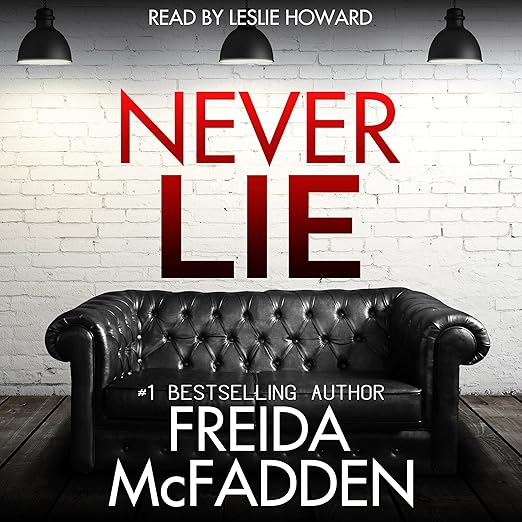
Freida McFadden's Never Lie sets its trap with unusual patience. Newlyweds Tricia and Ethan, snowbound in the remote manor that once belonged to a vanished psychiatrist named Adrienne Hale, is a familiar setup for the domestic thriller genre. The discovery of a secret room lined with cassette recordings of every patient session Dr. Hale ever conducted is the mechanism that drives everything forward. But what makes this audiobook particularly effective in the listening format is that Tricia's discovery of those tapes mirrors exactly what the listener is doing: absorbing information one session at a time, building a picture of a disappearance from incomplete and potentially unreliable fragments. At 7 hours and 20 minutes, narrated by Leslie Howard, the book uses that structural alignment between protagonist and listener to exceptional effect.
McFadden is best known for The Housemaid, and readers familiar with her work will recognize the signature: a narrative that keeps offering apparent solutions to its central mystery before pulling them aside to reveal something worse or stranger beneath. One reviewer described it as having that totally Freida way of convincing you it's all too obvious, only to pull the rug out from under you with an unexpected twist. That framing is accurate, and it explains why McFadden has cultivated such a loyal readership. The twist does not feel arbitrary after the fact. It was present in the structure the whole time, positioned just past where you were looking, which is the harder achievement.
Howard Voices Both the Present and the Tapes
The dual-timeline structure of Never Lie is one of its cleverest decisions. Present-day Tricia listening to recordings from Adrienne Hale's past means the reader is always inhabiting two timeframes simultaneously, and McFadden controls the release of information from each with precision. The cassette-tape conceit is not just atmospheric window dressing: it is a structural device that justifies why the backstory unfolds at exactly the pace and order that serves the plot. The information Tricia receives is mediated, sequential, and incomplete, which is also true of what the listener receives. The effect is deeply satisfying once the final tape is played and the picture fully assembles, because the assembly was being prepared across every preceding chapter.
Leslie Howard's narration serves this structure well. The challenge with a book that switches between a contemporary first-person voice and the recorded voices from decades-old therapy sessions is maintaining clarity without sacrificing atmosphere. Howard's handling of Tricia's present-day perspective is warm and slightly anxious, and the shift into the cassette-tape segments carries enough tonal differentiation to orient the listener without interrupting the flow. This is the kind of book where a less attentive narration could undermine the plot mechanics, and Howard does not allow that to happen across the full runtime.
Eavesdropping Deepens When You're the Listener
The audiobook format specifically enhances the cassette-tape conceit in a way that print cannot fully replicate. When Tricia listens to Adrienne Hale's patient recordings, you are also listening. The material reality of the audio medium collapses the distance between protagonist and listener. The sense of eavesdropping, of receiving information that was never intended for you, is genuinely intensified by the audio delivery. This is one of those relatively rare cases where a book's central structural device and the audiobook format align so neatly that listening is arguably the best version of the story. A reader following the same content on a page is doing something slightly different and slightly more removed from the psychological mechanism the book is exploiting.
The pacing is brisk without feeling rushed. At just over 7 hours, Never Lie does not indulge atmosphere at the expense of plot movement. The tension escalates consistently, and the reveals are distributed across the second half with care. Reviewers who described the book as completely addictive and as quick, fun, easy, and light with a twisty punch at the finish are not describing a shallow thriller: they are describing a book that has solved the pacing problem with precision. You feel propelled rather than processed, which is the more demanding and the more pleasurable version of the thriller experience.
Snowbound Manor Conventions, Used Knowingly
McFadden's books reward listeners who do not overthink the genre conventions but engage them as the deliberate instruments they are. Never Lie is firmly in the domestic psychological thriller tradition, and it uses those conventions with full awareness of the field it is operating in. The snowbound manor, the vanished woman with a secret life, the marriage that may be less solid than it appears: these are elements that McFadden deploys knowingly rather than innocently. Listeners who find the genre's conventions tired may discover this is more polished than they expected, but not a book that reinvents the form. Listeners who love the genre and want a technically accomplished example of it at its most controlled will be satisfied completely.
The ending, described by multiple reviewers as shocking and in one case as revealing the entire horrifying truth, holds up to the setup it has been building. The final cassette delivers precisely what the first half has promised, and the audiobook has the good sense to end promptly after that delivery rather than deflating the impact with extended resolution.
The Cassette Device Rewards Listeners Who Play Fair
Anyone who has enjoyed The Housemaid or other McFadden work should come to this audiobook without hesitation: it delivers the same pleasures with a different and particularly well-chosen structural innovation. Psychological thriller listeners who appreciate plots that play fair, where the solution is achievable in retrospect but not obvious in advance, will find the construction here particularly satisfying. The audio format is specifically worth seeking out for this title given how well the cassette-tape device translates to the listening medium. Listeners who prefer slow-burn literary fiction to plot-driven suspense should look elsewhere, but anyone happy in the thriller genre will find this a strong and tightly controlled example.
Questions Listeners Ask
Does the cassette-tape device in Never Lie work especially well as an audiobook?
Meaningfully so. The audio format collapses the distance between Tricia listening to the tapes and the listener receiving them. The eavesdropping quality of the recordings is more immediate in audio than in print, and it sharpens the unsettling effect of the dual-timeline structure throughout.
Is Never Lie a strong entry point for listeners new to Freida McFadden's work?
It is. The setup is self-contained, the structure is clear, and it demonstrates McFadden's signature twist mechanics effectively. Fans of The Housemaid will feel immediately at home; new readers will understand why she has such a devoted following after completing this audiobook.
How does Leslie Howard handle the switch between present-day narration and the cassette recordings in this audiobook?
With enough tonal differentiation to orient the listener immediately without disrupting the atmosphere. Tricia's present-day voice reads as warm and slightly anxious; the cassette-tape segments carry a distinct register. The transitions are clear without being jarring.