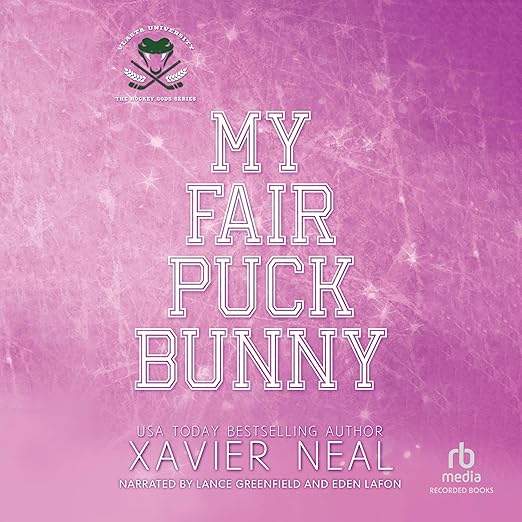
Quick Take
- Narration: Eden Lafon brings the light, quick-witted energy the story requires, handling the comedic rhythms and the more tender emotional beats between Tatum and Adrian with equal ease.
- Themes: Beauty standards and self-worth, the best-friend’s-brother setup, staged romance becoming real
- Mood: Playful and warm, with enough depth to earn its emotional moments
- Verdict: A college hockey romance that runs the familiar playbook but delivers it with enough character specificity and genuine humor to make the formula feel fresher than expected.
I was looking for something genuinely fun to listen to on a Saturday morning run, the kind of audiobook that keeps the pace up without requiring intense concentration. My Fair Puck Bunny landed in my queue from a reader recommendation and I expected something breezy and uncomplicated. What I got was mostly that, with a few more layers than the cover image suggested were coming.
Xavier Neal is a USA Today bestselling author whose work sits firmly in the college sports romance space, and The Hockey Gods Series is built on the familiar architecture of that genre: a campus setting, a team with outsized personality, and two people who should not work but demonstrably do. What distinguishes the second installment is the specific combination of Tatum, nicknamed Tater-tot, a math genius whose social world is considerably narrower than Adrian’s, and Adrian Stratton, the smooth-talking left wing whose reputation has become a liability. The fake-relationship premise that structures their year is not new, but the character dynamics underneath it carry enough specificity to make the predictable beats feel earned rather than automated.
Our Take on My Fair Puck Bunny
The book’s best quality is that it takes its female protagonist seriously without making her earnestness the object of comedy. Tatum’s intelligence and her social awkwardness coexist without either one being played for simple laughs or positioned as a flaw to be remedied by the romance. One reviewer noted that the story digs into beauty standards and gender roles with a bit more depth than Neal’s first Hockey Gods book, which is not nothing in a genre where those themes often get gestured toward without real engagement. Adrian’s journey from carefully constructed playboy persona to someone capable of genuine vulnerability is handled at a pace that feels plausible rather than perfunctory.
The Vlasta Vipers team dynamics add the specific texture that makes sports romance work when it does. The interactions between teammates, the particular culture of a competitive college hockey program, and the way athletic identity intersects with social identity on campus are all rendered with enough detail to feel like a genuine environment rather than a generic sports backdrop. Readers who know hockey culture, and several enthusiastic reviewers clearly do, will find the texture authentic enough to satisfy.
Why Listen to My Fair Puck Bunny
Eden Lafon’s narration is a significant part of the book’s appeal in audio form. The comedic material in particular, and there is a substantial amount of it, because Neal has real comic timing and knows how to write banter, requires a narrator who can carry the rhythm without over-emphasizing the jokes. Lafon does this consistently, letting the humor land without underlining it. The more emotionally direct sequences between Tatum and Adrian are handled with enough warmth to shift the register without breaking the overall tone of the book.
The pacing is well calibrated for audio. At just over nine hours, My Fair Puck Bunny is the right length for what it is, long enough to develop the central relationship past the initial premise, short enough that it doesn’t overstay its welcome or reach for complications the story doesn’t need. The spice level, which one reviewer gauged at around 3.5 out of 5, is present but not overwhelming, which suits the overall balance the book is trying to strike between comedy, romance, and a bit of genuine emotional weight.
What to Watch For in My Fair Puck Bunny
The writing style is distinctive and deliberately quirky in ways that not every reader will connect with. One reviewer noted starting and stopping the book more than once before committing, but ultimately found the book rewarding enough to go to five stars. The narrative voice has its particular rhythms, and if those rhythms don’t click for you immediately, patience will be required before the story finds its stride. A second reviewer raised a mild objection to the exaggerated treatment of a character’s intelligence, which is a fair observation, Tatum’s math-genius qualities occasionally tip into the kind of slightly idealized territory that the story otherwise tries to avoid.
This is also Book 2 in the Hockey Gods Series. The first book, which follows a different Vlasta Vipers couple, is referenced here and some of the team relationships carry forward. The book functions as a standalone romance, the central love story is complete and self-contained, but listeners who want the full team picture will get more out of starting from book one.
Who Should Listen to My Fair Puck Bunny
Listeners who enjoy college sports romance and are comfortable with the fake-relationship setup will find My Fair Puck Bunny a reliably entertaining execution of that premise. The multicultural cast and the attention to beauty standards and gender dynamics give the book slightly more to chew on than the average genre entry. Hockey fans who enjoy seeing the sport rendered with some authenticity will appreciate the team culture detail. Those who are new to Xavier Neal and want to evaluate the series before committing might start with book one; those willing to jump in at two will find the story fully accessible.
Frequently Asked Questions
Does My Fair Puck Bunny work as a standalone, or is reading the first Hockey Gods book recommended first?
It works as a standalone, the central romance between Tatum and Adrian is complete and self-contained. Some team relationships and returning characters will carry more weight if you’ve read book one, but the story does not require that prior investment to make sense.
How steamy is this book, and how explicit is Eden Lafon’s narration of those scenes?
Reviewers consistently describe the heat level at around 3.5 out of 5, present and deliberately included but not the dominant focus of the book. Lafon’s narration handles these sections with directness rather than coyness, which suits the overall tone of the book.
Is the writing style consistent throughout, or does the quirkiness that some reviewers mention smooth out over the course of the book?
The quirky narrative voice is consistent throughout rather than something the book grows out of. Reviewers who report starting and stopping before committing ultimately found the style rewarding, but listeners who do not click with the opening chapters should know that the register does not shift dramatically as the story develops.
Does the fake-relationship premise get subverted in any meaningful way, or does the book follow genre expectations closely?
It follows the familiar beats of the fake-relationship setup while adding character-specific complications, particularly Adrian’s reputation problem and Tatum’s genuine social awkwardness, that give the formula slightly more texture than a straight execution. One reviewer specifically noted that the book breaks some of its own established expectations in ways that feel earned rather than arbitrary.