Quick Take
- Narration: Patrick Zeller delivers a light, warm performance that suits the comedy-of-manners tone without overselling the romantic tension.
- Themes: class and transformation, belonging in an alien society, the limits of a social experiment
- Mood: Playful and warm, with steamy edges
- Verdict: A quick, enjoyable alien romance retelling that works best if you come for the fun premise rather than narrative depth.
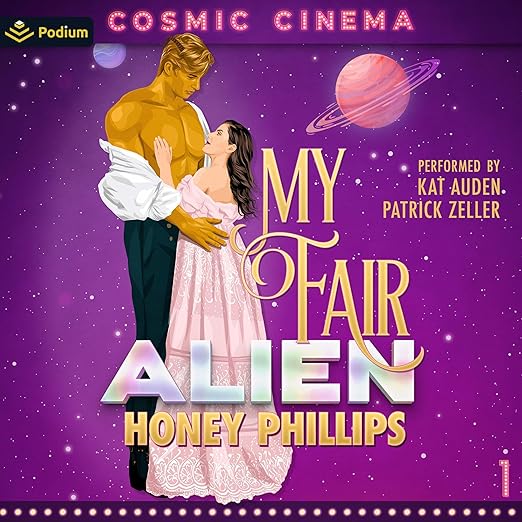
I finished My Fair Alien on a Sunday afternoon, sitting in the sun with nowhere to be. At four hours and forty-one minutes it is exactly the right length for that kind of listening: long enough to feel complete, short enough that the premise does not overstay its welcome. Honey Phillips has built her reputation on efficient, charming alien romance, and this entry in the Cosmic Cinema series delivers what her readers come for without pretending to be something else.
The setup is a clean transposition of the My Fair Lady story. Professor Harak H’gin is a linguistics scholar on the planet Plumeria, a society with strict social hierarchies and apparently little patience for the unrefined. He stumbles across Liza, a human woman scraping by selling flowers at the margins of Plumerian society. A colleague dares him to transform her into something their world would consider a proper member of polite company. Liza, who is desperate for any path upward, accepts the arrangement and moves into Harak’s home. The teacher-student dynamic, predictably and delightfully, complicates itself.
Our Take on My Fair Alien
What Honey Phillips does well is keep the emotional logic clean. The My Fair Lady source material has a built-in problem: in Shaw’s original, the professor is more interesting as a study in ego than as a romantic lead, and Eliza’s transformation raises uncomfortable questions about whose desires actually drive the story. Phillips sidesteps this by making Harak’s attraction genuine and increasingly difficult for him to rationalize, and by giving Liza more agency in the arrangement than Eliza traditionally gets. The bet is still there, but the power dynamic shifts as the story progresses rather than staying fixed.
Readers have noted that the world-building around Plumeria is specific enough to feel real, and I agree. The descriptions of locale came through vividly in the audio, and the social rigidity of Plumerian culture gives the romance its stakes. Liza’s position as an outsider who cannot quite fit the mold, even when she tries, resonates beyond the comedy-of-manners frame. The moment when Harak’s instincts override his carefully maintained detachment lands because Phillips has spent time establishing what those instincts cost him.
Why Listen to My Fair Alien
Patrick Zeller’s narration suits this material. He does not push too hard on the comedy or too hard on the heat, finding a register that keeps the story feeling light without undercutting the romantic tension when it arrives. The alien professor voice is distinguished without becoming a caricature, and Liza’s evolution across the runtime feels continuous rather than sudden. This is the kind of narrator-material fit where the production choices are mostly invisible, which is exactly right for a book that wants you to fall into the story rather than admire the craft from outside.
The standalone nature of the book is a genuine asset. This is part of the Cosmic Cinema series, but it does not require any prior reading. You can pick it up cold and the world is explained through action and dialogue rather than exposition dumps. For listeners who want alien romance but feel daunted by long series commitments, this is a clean entry point into Phillips’s work.
What to Watch For in My Fair Alien
At under five hours, the book moves quickly, and that means some of the secondary Plumerian world and supporting characters remain underdeveloped. If you come wanting a fully realized science fiction setting with cultural depth, you will find the edges are softer than they might be. The focus is on the central relationship, and the wider world is a backdrop rather than a subject.
The source material also sets certain expectations. If you have strong feelings about the My Fair Lady story, you should know that Phillips does not interrogate the problematic elements of the original so much as reroute around them. The retelling is warmer and more straightforwardly romantic than Shaw ever intended, which is both its appeal and its limitation depending on what you bring to it. One reviewer called it a much more satisfying ending than the source material, and that is probably accurate, though it is a different kind of satisfaction.
Who Should Listen to My Fair Alien
This audiobook is well-suited for readers who enjoy alien romance with a literary premise behind it, who want a complete story in under five hours, or who are already Honey Phillips fans looking for another entry in her catalog. It works as a gateway into the author’s style for curious newcomers. You may want to look elsewhere if you need extensive world-building, complex supporting casts, or a story that wrestles seriously with its source material’s tensions. The book knows what it is and delivers it with genuine warmth.
Frequently Asked Questions
Does My Fair Alien work as a standalone, or do I need to know the Cosmic Cinema series?
It works completely as a standalone. Phillips introduces the Plumerian world and its social rules through the story itself, and no prior series knowledge is required. This is a good entry point for new readers.
How closely does the story follow the My Fair Lady plot?
The structural beats are familiar: a bet, a teacher-student arrangement, a social transformation, and a romantic complication. But Phillips significantly reworks the power dynamics and gives the story a warmer, more genuinely mutual ending than the Shaw original. One reviewer called it a more satisfying conclusion.
Is the content appropriate for listeners who prefer less explicit romance?
The synopsis describes it as a sweet and steamy standalone intended for mature listeners. There is romantic and sexual content, but the overall tone leans playful rather than intensely explicit. If you have read Phillips before, you will know what to expect from her heat level.
How does Patrick Zeller differentiate the human and alien characters in narration?
Zeller’s approach is subtle rather than exaggerated. Harak reads as measured and slightly formal, consistent with a linguistics professor trying to maintain professional distance. He does not resort to a heavily accented or theatrical alien voice, which keeps the performance feeling grounded across the full runtime.