Quick Take
- Narration: Travis Macaulay narrates the six-minute lesson with a clear, child-friendly delivery that suits the ultra-short format, no time for development, but the audio is cleanly produced and directly targeted.
- Themes: Musical rhythm and time signatures, learning through play, neuroscience-based early music education
- Mood: Bright and encouraging, concise and purposeful
- Verdict: A six-minute bite-sized music lesson that makes most sense within the full Moosicology series context, purchased alone, it is too fragmentary to evaluate on its own terms, but as part of a systematic series, it serves a clear function.
Six minutes is a very particular kind of commitment. Not the kind you notice in your schedule. Not the kind that builds a habit on its own. Six minutes is the length of time it takes to unload the dishwasher, or to drive three miles, or to listen to one song. For a music education program aimed at children ages zero to seven, six minutes is also a choice, a deliberate structural decision about how much a very young child can absorb in a single sitting before the material needs to stop and be integrated before the next lesson begins.
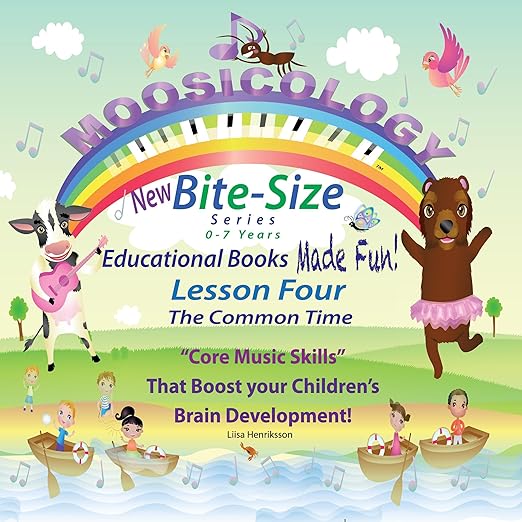
Moosicology Lesson Four: The Common Time is one entry in a sixteen-book series that works through music fundamentals from note introduction to tempo, each lesson bite-sized by design. This particular lesson addresses the 4/4 beat, common time, the rhythmic signature that underlies the vast majority of Western popular music, through a story about a girl who discovers rhythm in everyday objects: saucepans, pots, pans, wooden spoons. The premise is simple and good. Finding rhythm in household percussion before ever touching an instrument is how many musicians describe their earliest musical consciousness, and it is a starting point that any family can access regardless of whether they own instruments.
Neuroscience-Based Design and What It Actually Means Here
The Moosicology series claims a neuroscience-based method as its pedagogical foundation, and while the series does not elaborate on that claim within the audio itself, the structural design is consistent with what developmental music education research supports: short exposure, repetition across multiple lessons, integration of story and song, and progression through concrete concepts before abstract ones. Lesson Four sits at a specific point in that progression, it follows lessons on note introduction (Book One), time signature (Book Two), and the 4/4 Time (Book Three), and precedes lessons on note value, backbeat, syncopation, and shuffle note in subsequent books.
That sequential logic is important context for evaluating this individual lesson. The 4/4 time was introduced in Lesson Three as a concept; Lesson Four reinforces it through the lens of common time, the notation and cultural context that makes 4/4 the default rhythmic assumption in most music a child will encounter. Six minutes is sufficient to introduce that reinforcement if the groundwork is already in place from the prior lessons.
Travis Macaulay and the Ultra-Short Format
Travis Macaulay narrates with the kind of warm, direct delivery that early childhood audio requires. At six minutes, there is no room for extended characterization or tonal complexity, the lesson tells its story, models the rhythm concept, and ends. Macaulay keeps the energy consistent throughout, which is the appropriate goal for content of this length. Parents who are using the series systematically will find his narration blends comfortably across lessons.
The single-rating review sample means there is essentially no aggregated listener data to draw on here, which makes any claim about the lesson’s effectiveness for a specific child impossible. What is evaluable is the structural design: the lesson is coherent, purposeful, and consistent with the series’ stated methodology. Whether it works depends entirely on whether it is used as designed, as one component in a sequential sixteen-lesson program rather than as a standalone music education resource.
A Honest Assessment of the Format
Six minutes of audio at a standard audiobook price point is a format that requires honest upfront disclosure. A listener who purchases this lesson without having engaged with the series framework will find it brief to the point of feeling incomplete. The series is clearly designed as a curriculum delivered in small units, and the individual lessons reflect that design. Families who commit to the Moosicology series as a system will find each lesson serves its intended function. Those looking for a self-contained music education experience should consider whether the full sixteen-lesson arc fits their family’s listening practice before purchasing individual installments.
Frequently Asked Questions
Should Lesson Four be purchased before completing the earlier Moosicology lessons, or can it stand alone?
Lesson Four builds on the concepts introduced in Lessons One, Two, and Three. The 4/4 time signature is introduced in Lesson Three, and Lesson Four reinforces and contextualizes it. While the story can be heard independently, its full educational value depends on the framework established in earlier lessons. The series is designed to be followed sequentially.
What does “common time” mean, and why does it matter for ages 0-7?
Common time is another name for the 4/4 time signature, the rhythmic pattern that underlies most Western popular music, folk songs, and children’s songs. Teaching it at this age builds the foundational rhythmic awareness that makes later music learning, learning an instrument, reading music, singing with a group, significantly easier. Lesson Four introduces this concept through a story about finding rhythm in everyday household objects.
Is six minutes long enough to constitute a meaningful music lesson for a young child?
For children ages 0-7, six minutes is actually an appropriate length for a single focused concept introduction. The Moosicology series is explicitly designed as bite-sized lessons that accumulate across sixteen installments. The pedagogical design assumes that short, repeated exposure across multiple sessions is more effective for early childhood music learning than longer, infrequent lessons, which is consistent with what developmental music education research supports.
Does the audio lesson include actual music, or only spoken content?
The Moosicology series is described as using songs and stories designed to teach music skills, so the audio includes musical elements alongside the narrative. Lesson Four’s story about a girl finding rhythm in saucepans and wooden spoons incorporates rhythm demonstration as part of the lesson design, which is central to teaching the 4/4 common time concept rather than only describing it.