Quick Take
- Narration: Stella Bloom gives Nilah a consistent emotional register that captures the character’s mix of humor and genuine fear, a tricky balance in romantasy that Bloom handles well.
- Themes: Fae court politics, identity destabilization, loyalty tested by mystery
- Mood: Fast-moving and emotionally charged, with a wicked cliffhanger
- Verdict: Delivers on the romantic and political promises of book one with sharper stakes and a conclusion that will frustrate and compel in equal measure.
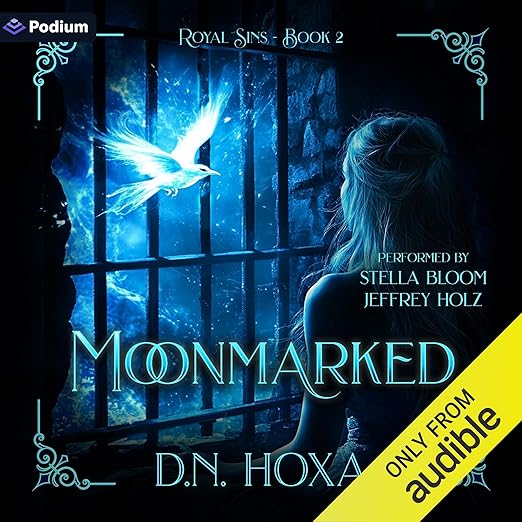
I finished book one of D.N. Hoxa’s Royal Sins series on a Friday night and immediately looked up when the second one was available. That particular kind of hunger is what this series is engineered to produce, and Moonmarked understands its own momentum well enough not to waste it. The second installment picks up where Nilah was left at the end of book one and proceeds to make her circumstances considerably worse before making them any better, which is the appropriate escalation for a middle-series entry that takes its own world-building seriously.
Stella Bloom narrates across just over fourteen hours with a handling of Nilah that captures both the character’s humor and her genuine fear. The synopsis gives you Nilah’s voice directly, including the parenthetical asides and the breathless catalog of problems, and Bloom keeps that register consistent without letting it tip into self-parody. Rune’s perspective chapters, which several reviewers mention as preferable to Nilah’s for different reasons, are handled with appropriately different emotional coloring.
Our Take on Moonmarked
Hoxa is working in a crowded genre, and what sets the Royal Sins series apart is the genuine density of its world-building. The Seelie Court, the Midnight fae, the sorcerers, the various courts and supernatural creatures including vampires, werewolves, incubi, succubi, giants, and dragons, all of these exist with enough internal consistency that the world feels populated rather than assembled from genre parts. Nilah’s situation in this second installment involves magic that is transforming her in uncontrolled ways, hunters after her for reasons she doesn’t fully understand, and a connection to the Ice Queen that reframes the entire series’ backstory. That is a lot of story to manage across fourteen hours, and Hoxa manages it without the plot feeling crowded.
Why Listen to Moonmarked
The chemistry between Nilah and Rune is what reviewers return to most consistently. One reader quoted directly from the book, including a line about the relationship between stars and darkness that lands as the kind of moment this genre is built around. What distinguishes Hoxa’s execution is that the romantic tension is woven into genuine political danger rather than substituted for it. The Seelie Court is not a safe backdrop for a love story; it is actively hostile, and the Queen’s palace operates with the kind of beautiful-and-lethal logic that makes fae court fiction satisfying when it works. One reviewer read both books in consecutive days without being able to stop, which is the most useful account of the experience available.
What to Watch For in Moonmarked
The cliffhanger is real and it is significant. Multiple reviewers respond to it with variations on genuine fury at having to wait, which is both a complaint and a testament to how invested they became. One reader describes finishing cover to cover in a single sitting and then being absolutely furious at the ending, a combination of reactions that tells you exactly what kind of reading experience this is. Listeners who cannot tolerate open endings should know this before starting book two. Additionally, one reviewer noted that Nilah’s voice and behavior can read as convincingly eighteen, which may be a feature or a friction point depending on your reading preferences. The series has strong enough world-building that this tends to be outweighed for most readers, but it is worth noting.
Who Should Listen to Moonmarked
Listeners who completed book one of the Royal Sins series will find this a natural continuation and a significant escalation. Readers who enjoy fae court romantasy with substantial supernatural complexity and genuine political stakes alongside the romantic arc will do well here. This is less suited to listeners who prefer self-contained stories, those who have already reached their limit with series cliffhangers, or readers who find younger-coded protagonists more frustrating than charming. The series as a whole rewards investment in its world, and Moonmarked is the installment where that investment begins to pay compound interest.
Frequently Asked Questions
Is Moonmarked a good entry point for the Royal Sins series, or do I need to start with book one?
Book one is essential context. The second installment opens exactly where the first ended, with no recap of prior events. Starting here without book one would mean missing the foundational relationships and world-building that give this installment its emotional weight.
How does Stella Bloom handle the dual POV chapters between Nilah and Rune?
Bloom differentiates the two perspectives clearly while keeping both voices consistent with the characters as established. Rune’s chapters are generally seen as carrying a more grounded emotional register, and Bloom captures that contrast without making either perspective feel underserved.
How dense is the supernatural world-building, and does it slow down the story?
The world-building is extensive, including multiple supernatural species and faction-based fae court politics, but Hoxa integrates it into the narrative rather than front-loading it as exposition. The pacing stays active throughout, and most readers find the complexity additive rather than obstructive.
Does the ending of Moonmarked genuinely resolve the central storyline?
No. The ending is an acknowledged cliffhanger that multiple readers describe with strong feeling. The main plot threads are escalated and complicated rather than resolved, and the final revelation in particular sets up the third installment significantly.