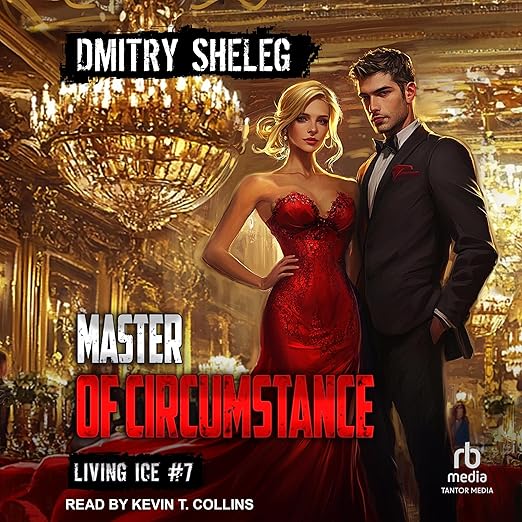
Quick Take
- Narration: Kevin T. Collins is a reliable presence for long-running series and handles the power-shift in Ivan’s characterization with convincing authority.
- Themes: Power and its corrupting pull, identity after survival, institutional resistance to individual will
- Mood: Propulsive and expansive, with a new complexity that comes from a protagonist who no longer needs to fight for survival
- Verdict: Seventh-book energy at its most confident, the series hasn’t lost momentum, though new listeners have no entry point here.
Seven books into a series, the narrative grammar has either calcified into formula or evolved into something more interesting. With Master of Circumstance, Dmitry Sheleg manages the latter, which is its own kind of achievement given that book seven is typically the point in a long-running series where readers either feel trapped by loyalty or genuinely compelled by what the story has become.
I should be upfront about the parameters of this review. The synopsis for Master of Circumstance is deliberately minimal, which is appropriate for a seventh installment: too much context risks spoiling the journey for new readers while saying nothing new to series veterans. What the brief summary does establish is a significant shift in Ivan Morozov’s position. Ten years have passed since the story began. Ivan is no longer reactive, no longer the prey responding to circumstances. He has become the shaper of them. That inversion is what gives this book its particular energy and, according to reviewers, its particular complication.
Our Take on Master of Circumstance
The Living Ice series has built its reputation on Sheleg’s willingness to genuinely develop his protagonist across volumes rather than resetting him to a comfortable baseline between entries. Ivan’s transformation from survival-mode fugitive to someone actively building power is the kind of progression that long-running genre fiction often promises and rarely delivers with consistency. The reviewer who described this installment as having a “different pace than the other books because Ivan doesn’t have to prove anything to anyone” has identified precisely what makes it work, and what makes it demand more from the writing.
When a protagonist no longer needs to establish himself, the narrative has to find other sources of tension. Sheleg finds two of them here: the introduction of genuine romance and the complication of institutional religion entering Ivan’s sphere of influence. The church element, introduced in this volume, appears to generate the kind of antagonism that resets the stakes without retreading earlier conflicts. One reviewer flagged it as the moment when things “got complicated again”, which is a fair summary of how long-running series maintain their energy by finding new categories of problem for protagonists who have solved the old ones.
Why Listen to Master of Circumstance
Kevin T. Collins is well-suited to this material. He has the vocal range for a story that has expanded significantly in scope, from the survival-focused early volumes to something closer to a political drama, and his handling of Ivan’s changed register (confident, deliberate, occasionally ruthless) is convincing without tipping into parody of the power-fantasy genre. At just under ten hours, the runtime is appropriate for the complexity of what Sheleg is managing.
The reviews from existing series readers are consistent in their enthusiasm and consistent in their assumption that anyone listening to book seven has followed the preceding six. That assumption is correct and correct to make. The world-building, character relationships, and political structures that this volume develops are built on foundations that cannot be quickly summarized. For series readers, the entry point here is precisely correct.
What to Watch For in Master of Circumstance
The minimal synopsis provided is representative of what the book gives new readers, which is to say: not enough to engage meaningfully. Master of Circumstance is for Living Ice series readers only. The shift in pacing that one reviewer described as either strength or limitation, depending on how much you valued the earlier books’ more relentless forward drive, is real and warrants awareness. This is a book that trusts the series’ built-up goodwill to carry some of its quieter moments.
One reviewer noted that while parts of this installment were among their favorites in the series, the book couldn’t “string enough of those fantastic parts together” to fully satisfy. That’s the honest assessment of a mid-series volume doing transition work: its ambitions are broader than its execution in places, but the trajectory it sets up is clearly pointed somewhere interesting.
Who Should Listen to Master of Circumstance
Series readers who have invested in Ivan Morozov’s arc through six previous volumes will find this a confident and genuinely different kind of entry, the power-at-the-top dynamic opens narrative possibilities that the survival structure couldn’t support. New listeners should start with Book 1 of the Living Ice series and work forward; the payoff for this installment depends entirely on the journey that precedes it.
Frequently Asked Questions
Can Master of Circumstance be listened to without reading the previous six Living Ice books?
No. The synopsis itself is intentionally minimal, and the character dynamics, world-building, and political structures that drive this installment are built on six volumes of accumulated context. Reviewers assume series familiarity throughout, and the book provides no orientation for new listeners.
What distinguishes the pacing of Master of Circumstance from earlier entries in the Living Ice series?
Previous volumes were driven largely by Ivan’s survival pressure, reactive, often desperate forward momentum. Book 7 shifts to a more expansive dynamic as Ivan actively shapes circumstances rather than responding to them. Reviewers describe the change as a “different pace” that some find refreshing and others find slightly less driven than the earlier entries.
How does Kevin T. Collins handle the shift in Ivan Morozov’s character from the early series to Book 7?
Collins conveys Ivan’s authority and confidence convincingly without losing the character’s essential texture. The vocal shift that the story’s ten-year time jump and power accumulation require is subtle but present, series listeners who have followed Collins through multiple volumes will notice the calibration.
Does Master of Circumstance resolve its central conflicts within this volume, or does it set up further installments?
The book introduces new complications, notably the church element and the romantic development, that extend into subsequent volumes. Reviewers indicate the series is ongoing and that this installment follows the pattern of advancing the story significantly while leaving clear threads for continuation.