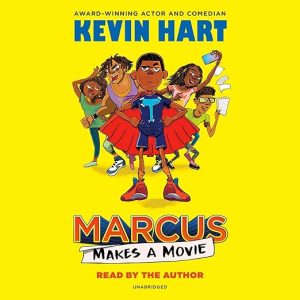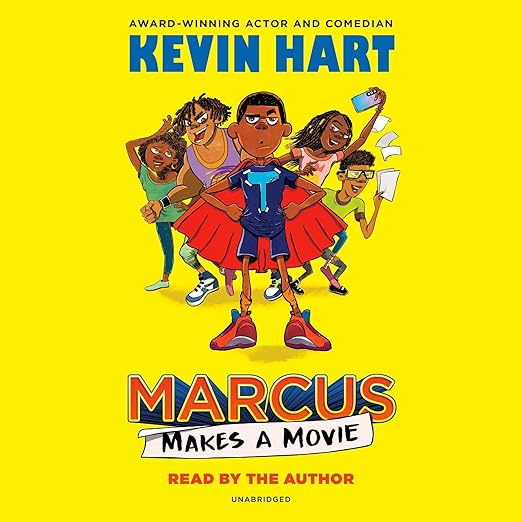
What happens when the person who wrote the story also performs it? In most cases, the result is a charming novelty that does not quite work. Kevin Hart's Marcus Makes a Movie is an exception, and this audiobook is the format through which it is most persuasively itself. Hart is a comedian who has spent decades calibrating performance to an audience, and the middle-grade listener, impatient, attuned to rhythm and timing, suspicious of condescension, is an audience he reads correctly. The story of Marcus, a kid with a self-created superhero called Toothpick and a scheme to turn that superhero into an actual movie, is performed with the kind of genuine comedic investment that cannot be faked in a recording booth.
The creative team here is worth noting. Hart collaborated with award-winning author Geoff Rodkey on the text, and illustrator David Cooper contributed artwork to the print edition. The audiobook strips the illustrations, but Hart's narration functions as its own kind of visualization: the voices he gives to Marcus's friends, the reluctant ally in Sierra, and particularly the bully Tyrell who turns out to be a better villain than Marcus expected, are fully inhabited rather than gestured at. At just over three hours, this audiobook is a practical length for its audience and holds attention throughout.
Marcus Learns the Execution Is Harder Than the Idea
The premise is specific enough to feel real. Marcus has been drawing his Toothpick comics for years before the after-school film class forces him to consider whether the character could exist in another medium. The discovery that the answer is yes, but everything about the execution is harder than the idea, is the emotional arc of the novel, and Rodkey and Hart handle it with the right balance of comedy and genuine feeling. Marcus is not a prodigy who gets lucky; he is a kid who has to recruit help, revise his ideas, negotiate with people he finds difficult, and accept that his creative vision is not entirely his own once other people are involved. That is a more honest story about creative collaboration than most middle-grade fiction attempts.
The teacher who reviewed the book and plans to use it at the start of the school year to introduce students to the work of writing properly, noting that it covers redrafting and the effort required to rewrite, has identified something real about the book's pedagogical value. Marcus's process of revision, of discovering that the first draft of anything is just the beginning, is dramatized rather than explained, which means it sticks. Hart's narration makes those revision scenes funny rather than tedious, which is a genuine achievement.
Kevin Hart's Comedic Timing Holds Everyone's Attention
The Kevin Hart narration is the argument for the audiobook over the print edition. Hart's comedic timing is calibrated for the specific kind of moment that middle-grade fiction generates: the misunderstanding that compounds itself, the plan that almost works, the adult who is helpful in exactly the wrong way. His Marcus has the voice of a real kid, not a sanitized TV kid, and the scenes where Marcus has to confront his own limitations as a filmmaker are played with enough self-deprecating humor that they feel honest rather than preachy. Parents who have been subjected to less engaging audiobooks on family drives will find that Hart's presence makes the difference between something that holds everyone's attention and something that entertains one person in the car.
The comparisons in the marketing copy to James Patterson's Middle School series and Lincoln Peirce's Big Nate series are accurate benchmarks. Listeners who have enjoyed either of those will find Marcus Makes a Movie in familiar territory, with the added dimension of Hart's performance bringing the comedy to life in a way that the print comparisons cannot quite match. The Marcus series also extends beyond this first book, which means the audiobook functions as an entry point to a longer listening relationship if the character connects.
Tyrell's Arc From Bully to Essential Collaborator
The novel has a genuinely interesting structural element that deserves attention: Tyrell, the local bully who is initially too intimidating to approach, becomes essential to the movie's success, and his arc from obstacle to collaborator is handled with more nuance than the setup suggests. Hart's performance of Tyrell shifts across the novel in a way that reflects the character's growth rather than just his role, and it is worth noticing how that vocal shift tracks the story's thematic development about who gets to be a creator and who gets cast as a villain.
There is a subplot involving Sierra that functions as a second story about creative ambition and the complications of collaboration when two people both want to be in charge. Sierra's presence prevents Marcus from treating the movie entirely as his property, and the negotiation between them about authorship and credit is a small but real piece of the novel's larger argument. Young listeners who miss it on first hearing will catch it on a second listen, which is a sign of well-constructed middle-grade fiction.
Grades Three to Seven Are the Natural Audience
The natural audience is children in grades three through seven with existing interest in movies, comics, superheroes, or creative projects of any kind. But Hart's narration widens that audience meaningfully: kids who would not typically choose a school-set novel will give this one a chance because of who is reading it, and the comedic energy keeps them there. Parents and teachers looking for audiobooks that model creative persistence, willingness to revise, and genuine collaboration will find Marcus Makes a Movie unusually useful on those dimensions.
Adult listeners who pick this up expecting sophisticated comedy will find it pitched correctly for its audience rather than for them, which is as it should be. The laughs are real but calibrated for ten-year-olds. Listeners outside that range who are Hart fans, or who are looking for something to share with a child in that age range, will have a better time than those approaching it as standalone adult entertainment.
- Narration: Kevin Hart narrating his own middle-grade novel is a genuine coup for the format, and his comedic instincts translate naturally into the material.
- Themes: Creative ambition, collaboration, overcoming fear of failure
- Mood: Energetic and funny with a warm emotional undercurrent
- Verdict: Kevin Hart performing his own story of a kid who refuses to let the obstacles outnumber the dream is exactly as entertaining as that premise promises.