Quick Take
- Narration: Nikki Giovanni reading her own work is the only version that matters. Her cadence, her breath, her emphases are inseparable from the poems themselves.
- Themes: Racial justice and pride, Black cultural memory, personal elegy
- Mood: Fierce and tender in equal measure, deeply personal
- Verdict: Hearing Giovanni perform her own poems is a distinct experience from reading them on the page, one that reveals layers of irony and grief that the printed text cannot fully carry.
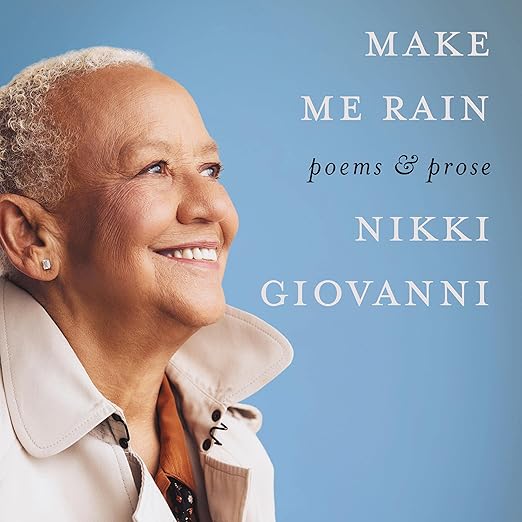
I came to Make Me Rain on a quiet Sunday afternoon, the kind of afternoon that feels slightly suspended from ordinary time. I had been reading a lot of criticism that week and needed something that worked differently, that arrived in the body before it arrived in the mind. Nikki Giovanni’s poetry has always done that for me. When I learned this Audible edition features Giovanni reading her own work, I put aside everything else and simply listened. Two hours and eight minutes later, I was taking notes I hadn’t planned to take.
Giovanni has been at this for more than fifty years, and there is something specific that happens when a poet of that longevity reads her own late work. You hear the accumulation. The poem called “I Come from Athletes” lands differently when you can hear the age in the voice that delivers it, the combination of pride and tenderness and hard-earned certainty. The collection does not sidestep anything. It calls out segregation directly. It addresses Donald Trump by name. It mourns relatives who protected Giovanni from an abusive home life. None of that is handled softly, and Giovanni’s reading doesn’t soften it either.
Our Take on Make Me Rain
What this audiobook does that most poetry collections cannot is collapse the distance between the poet’s intent and the listener’s reception. When Giovanni delivers “Unloved (for Aunt Cleota),” you are hearing grief performed by the person who survived to write it. That is not decoration on top of the literary experience. It is the literary experience. The tonal range across the collection is remarkable: caustic political commentary in some poems, grandmother tenderness in others, direct and almost documentary witness in still others. The 4.8 rating from over four hundred listeners reflects something real. Poetry audiobooks rarely accumulate that kind of consensus.
Why Listen to Make Me Rain
The self-narrated poetry audiobook is a specific form, and Giovanni is one of the few living poets whose recorded performances have genuine documentary value. Her voice has a quality that is hard to describe without hearing it: wry, authoritative, occasionally amused at its own sadness. Reviewers who came to this collection without prior Giovanni experience noted the directness of her imagery and the clarity of her perspective as a Black woman writing in a turbulent political moment. For listeners who know Giovanni’s earlier work, this collection is particularly interesting because she is writing from a different life stage, as a grandmother, as someone with decades of perspective on the injustices she began addressing in the 1960s. The continuity across that career gives individual poems an additional resonance.
What to Watch For in Make Me Rain
At two hours and eight minutes, this is a short listen by audiobook standards, and the brevity is worth understanding. Poetry collections are not structured like novels or even essay collections, and the listening experience is more cumulative than linear. Some poems will stop you and some will pass through you and you will only realize their weight later. The political poems, the ones addressing Trump and white nationalism directly, are the sharpest and most immediately accessible. The personal elegies require more patience and more willingness to sit with ambiguity. If you approach this expecting a smooth narrative arc, you will be slightly disoriented. If you approach it as a sustained encounter with a singular intelligence at a particular moment in her life, you will find it generous and demanding in equal measure.
Who Should Listen to Make Me Rain
Anyone who has read Giovanni on the page and wants to hear what her own voice does with these particular poems. Anyone interested in contemporary Black poetry that is unafraid of naming specific political targets. Listeners who enjoy the particular intimacy of poets performing their own work will find this essential. It is less suited to listeners looking for narrative structure or a beginner’s introduction to poetry as a form. But as an encounter with a living American literary voice, there is nothing like this version of the collection.
Frequently Asked Questions
Is Make Me Rain accessible to listeners who have never read Nikki Giovanni before?
Yes. Giovanni’s directness is one of her defining qualities. The political poems especially require no prior context, and her reading style is engaging rather than academic. Newcomers may want to look up a few biographical details to deepen the personal elegies, but it is not required.
How does the audio version compare to reading the collection in print?
The audio version adds something the print edition cannot replicate: Giovanni’s own voice, cadence, and the particular weight she places on specific words. For poetry, where sound is inseparable from meaning, this is a meaningful difference. If you have only read her work, hearing it performed by the poet herself is a genuinely different experience.
Are the political poems in Make Me Rain likely to alienate listeners who disagree with Giovanni’s views?
Some poems address Donald Trump and white nationalism directly and without ambiguity. Giovanni has never written to avoid discomfort, and this collection is no exception. Listeners looking for politically neutral poetry will find some of these poems confrontational.
At just over two hours, does Make Me Rain feel complete or like a short sampler?
It feels complete in the way a poem collection is complete: each piece contributes to a cumulative portrait. The brevity is appropriate to the form. Poetry collections are not padded to length, and at two hours Giovanni covers an enormous emotional and political range without overstaying her welcome.