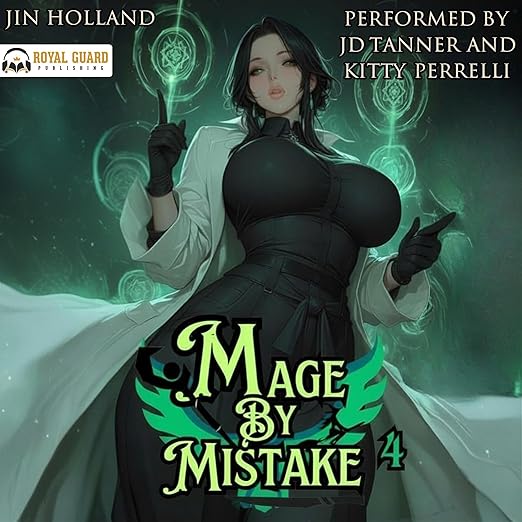
Series momentum is a particular feature of LitRPG fantasy: once a listener invests in the rules of a world, the pleasures of each successive audiobook installment come from watching a protagonist test those rules further and at higher cost. Mage by Mistake 4 is the fourth entry in Jin Holland's Assassin In Magic School Series, and it picks up where book three left off with a deliberately narrowed focus that most series followers will welcome. JD Tanner returns as narrator, and at just over ten hours the pacing keeps things moving in a way that rewards consecutive listening sessions.
Fewer Viewpoints Sharpen Book Four's Focus
The fourth book in any ongoing fantasy series arrives with built-in expectations. Listeners who are still here after three volumes are not strangers to the world or the protagonist. Levi's situation, his fraught relationship with his own unpredictable power, and the web of loyalties and threats surrounding him are all established ground. What Mage by Mistake 4 offers is a plot that focuses rather than expands. Earlier in the series, multiple perspectives could make the narrative feel diffuse; here, reviewers note the reduction to two or three viewpoints as a genuine improvement. Fewer characters anchoring the point of view means more time spent with the ones who matter most, and the result is a more pressured, more personal story.
Levi's Real Change Beneath Iris's Danger
The synopsis establishes the core stakes: Iris is in danger, Levi is determined to act, and new revelations about Foresight complicate everything. What the plot summary does not capture is the character work, the sense, carried through Tanner's narration, that Levi is not just reacting to events but actually changing in response to them. The fragile bonds mentioned in the synopsis are tested in ways that feel earned by the prior books rather than contrived for dramatic effect in the fourth installment.
One reviewer described this as the best entry in the series so far, and another noted that having four books available at once made it possible to sink into the story without waiting for releases. That binge-accessible quality is part of the series' appeal, and the audiobook format suits it particularly well. The first-person narration pulls the listener into Levi's perspective in a way that print sometimes diffuses.
JD Tanner Modulates Action and Quiet Moments
JD Tanner's performance is the consistent thread across the series, and in the audio format his delivery brings clarity to Levi's first-person narration. One reviewer described the series as storytelling that simply sucks you into it, that quality is amplified by Tanner's ability to modulate between action sequences and the quieter character moments that give the stakes their weight. The ten-hour runtime is substantial enough to provide genuine immersion without the sprawl that sometimes afflicts longer epic fantasy titles.
The series has been praised for its readable and entertaining quality, described by one listener as easy to follow and genuinely entertaining. What Mage by Mistake 4 adds is meaningful plot development rather than just scene-setting. One reviewer specifically noted that more significant events occurred that furthered the story along compared to some earlier volumes, and that the pacing feels more efficient. For listeners who had begun to wonder when the series would make decisive moves forward, this fourth installment provides them clearly and without excessive delay.
The series label, Assassin In Magic School, captures a premise that sounds almost parodic but that Holland executes with enough internal consistency to take seriously. Book four benefits from the accumulated logic of the world; the rules of Foresight and the nature of Levi's power have been established over three volumes and can now be deployed for dramatic effect rather than needing explanation.
More Plot Consequence in Less In-World Time
This is not an entry point. Anyone considering starting the Assassin In Magic School Series with book four will find themselves adrift. The character relationships, the world rules, and the established tensions all require the context of books one through three to register properly. Newcomers to the series should begin at the beginning, where the premise is set up and the characters are introduced with the space they need to become real to the listener.
One reviewer raised a concern about a teenage antagonist whose arc went in a direction they found unconvincing. Whether this lands as a narrative weakness or a deliberate character choice will depend on individual taste. The series has always been willing to take characters into uncomfortable territory, and book four is consistent with that willingness. Listeners who prefer their moral alignments clean and their antagonists clearly coded as such may find certain character turns less satisfying than the primary storyline.
The pacing in book four compresses the timeline more than earlier installments: less in-world time passes, but more happens in terms of plot consequence. For some listeners that compression is a virtue, events feel weightier when they arrive faster. For others it may feel like the world is contracting rather than expanding. Whether that tightening is preferable to the earlier books' wider scope is a matter of individual taste within the genre.
Tanner's First-Person Intimacy Rewards Series Fans
The core audience is straightforward: listeners who have completed books one through three of the Assassin In Magic School Series and are looking for the next installment in what has proved to be an entertaining and consistently developing fantasy. The audiobook format suits this series particularly well because the first-person narration, under Tanner's delivery, creates genuine intimacy with Levi's perspective that carries through action scenes and character moments alike. If you are on the fence about whether the series has run out of ideas, book four's tighter focus and genuine plot advancement should answer the question in the series' favor.
In Brief
- Read by: JD Tanner handles the first-person narration with dry, deadpan energy that suits a protagonist perpetually in over his head, consistent with the earlier installments and well-matched to the material.
- At its heart: power and control, found family under pressure, hidden enemies in plain sight
- Vibe: Fast-paced and character-driven, with a tighter focus than earlier volumes
- Short version: A satisfying continuation that trims some of the wider cast sprawl and delivers the plot momentum longtime series listeners have been waiting for.
Common Questions
Can Mage by Mistake 4 be listened to as a standalone audiobook without the earlier books?
No. The series is deeply continuous, and book four assumes familiarity with Levi's backstory, the Foresight mythology, and the established character relationships. Starting here would mean significant confusion about who the major players are and why the stakes matter.
How does JD Tanner's narration hold up in the fourth audiobook of the series?
Consistently solid. His first-person delivery suits Levi's voice, and listeners who connected with his narration in earlier installments will find the same energy here. The reduced perspective count in this book gives his performance more sustained focus.
Does the Mage by Mistake 4 audiobook end on a cliffhanger?
Series reviewers have noted that the storyline builds toward a fifth book, and several listeners expressed eagerness for the next installment. Whether the ending fully resolves or opens new threads is part of what makes the series compelling to continue.