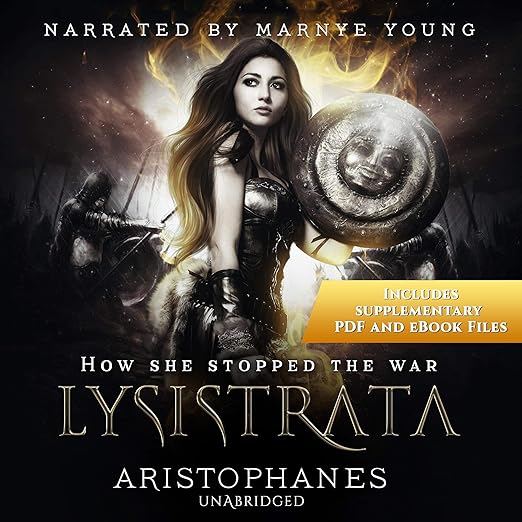
Quick Take
- Narration: Marnye Young brings the bawdy energy of Aristophanes’ comedy to life with timing and wit, treating the material as the performance piece it was designed to be.
- Themes: Gender and political power, the absurdity of war, collective action by the disenfranchised
- Mood: Irreverent, comic, and unexpectedly pointed
- Verdict: Under two hours of ancient comedy that lands with surprising contemporary force, narrated with the theatrical energy the text demands.
There is something almost vertigo-inducing about laughing at a play that is two and a half thousand years old. I came to this audiobook on a slow Sunday morning with genuine skepticism. Ancient Greek comedy feels, from the outside, like an academic obligation rather than an entertainment. Within fifteen minutes of Marnye Young’s narration, I had revised that assessment completely. Lysistrata is genuinely funny in ways that do not require any scholarly apparatus to appreciate, and at under two hours it is one of the most efficient listens in the classical canon.
First staged in 411 BC, the play arrives at a moment when Athens has been at war with Sparta for twenty years. Aristophanes gives us Lysistrata, the tough-minded Athenian who has had enough, convening women from across the warring city-states and proposing a sex strike until the men agree to make peace. The treasury is simultaneously seized by Athens’ older women, cutting off the silver that funds the war. The men resist. The women resist back. The comedy is inherent in the premise and Aristophanes plays it to its physical limits. This free audiobook is available through Audible and a companion PDF is included in the Audible edition for following the chorus sections.
A Translation That Earns Its Colloquialisms
The success or failure of any Aristophanes audiobook lives in the translation choice, and this edition makes a strong case for colloquial over formal. One reviewer, a student of rabbinic literature rather than classical scholarship, noted the value of hearing how these plays were performed orally in front of a live audience, and that colloquial translations serve that goal better than more formal academic editions. The translation used here includes phrases that feel as though they could be shouted across a modern street, and while one reviewer raised a cautious question about whether certain contemporary-sounding idioms are original or interpolated, the effect is largely that the play feels alive rather than preserved.
Another reviewer noted the disorienting sensation that the story could have been written a hundred years ago rather than two and a half millennia. That uncanniness is where the play’s enduring power lies. Aristophanes understood that the women’s grievance, that their sons, brothers, and husbands were dying in a war driven by male pride and political ego, was not merely a comic premise. The brief, quickly suppressed mention of the women’s dead sons during the negotiations is one of the play’s most affecting moments, and it works precisely because it emerges from within the comedy rather than standing outside it.
What Aristophanes Understood About Political Power
The play’s satirical logic is elegant: the women have no formal political power, so they leverage the only currency available to them within the social structure of ancient Athens. Seizing the treasury is the more radical act, honestly. Controlling the money that feeds the war machine is a more direct intervention than the sex strike, and Aristophanes has the older women of Athens execute it with practical ruthlessness. The two-pronged strategy, economic and personal, reflects a clear-eyed understanding of how power actually operates and where its vulnerabilities lie.
For modern listeners, the play operates as both comedy and argument. The absurdity of men negotiating for peace while visibly struggling with their own physical discomfort is the surface joke. The structural critique, that the people who bear the costs of war have no formal mechanism to end it, sits underneath every laugh. Reviewer Michael J. Moore noted that the play speaks to the 21st century reader in ways that cross the millennia, and I think that is exactly right. The scenario is ridiculous. The underlying logic is not. Aristophanes was a comic playwright who understood political science, and hearing this in audio rather than reading it privately restores the dimension of public argument that the original performance was designed to carry.
Marnye Young’s Performance and the Theatrical Stakes
Young brings genuine theatrical energy to the narration, treating the text as the staged piece it was designed to be rather than reading it flatly. The shift between Lysistrata’s commanding voice and the various choruses of men and women is handled with the timing the comedy requires. Ancient Greek comedy relies heavily on physical comedy that a narrator cannot directly reproduce, but Young finds the verbal equivalent of those moments through rhythm and emphasis. The bawdy passages are delivered without either excessive coyness or aggressive performance. She understands that Aristophanes’ humor works because it is specific and recognizable, not because it is shocking.
At under two hours, Lysistrata is genuinely one of the least intimidating entry points into classical literature available in audio form. The commitment is minimal. The return is disproportionately large, both as entertainment and as a reminder that people two and a half thousand years ago were asking the same questions about power, war, and who pays the cost of other people’s decisions.
Who Should Seek This Out and Who Should Pass
Listen to this if you have any interest in ancient drama, Greek history, or in a compact, genuinely funny work that happens to also function as political satire. Also a strong choice for anyone who associates classical literature with dry academic prose and needs a corrective. Skip it if you are sensitive to explicit sexual humor, since the play’s comedy is consistently bawdy and Young does not soften the more ribald passages. This is Aristophanes at his most cheerfully indecent, and the comedy would not survive without it.
Frequently Asked Questions
Does this audiobook require any background knowledge of ancient Greek history or theater to enjoy?
None at all. The premise is immediately legible and the comedy works without any scholarly apparatus. Listeners with no knowledge of the Peloponnesian War will follow the story without difficulty, and the underlying political satire is clear from context alone.
How does Marnye Young’s narration handle the play’s chorus sections and multiple characters?
Young brings genuine theatrical energy to the performance, treating the text as the staged piece it was designed to be rather than reading it flatly. The shift between Lysistrata’s commanding voice and the various choruses of men and women is handled with the timing the comedy requires.
This translation is described as colloquial. Does it update the language to the point of anachronism?
Some reviewers raised a question about whether certain modern-sounding phrases are original or interpolated by the translator. The majority opinion is that the colloquial approach serves the play’s comic energy better than formal alternatives, and the effect is a Lysistrata that feels contemporary without feeling transplanted out of its historical moment.
Is Lysistrata appropriate for listeners who typically read literary fiction rather than classical drama?
Yes, particularly at under two hours. It functions well as a standalone experience and shares more with witty contemporary satire than with the reputation ancient drama sometimes carries. The explicit sexual humor is worth knowing about in advance, but it is comic rather than graphic in tone and integral to how the play actually works.