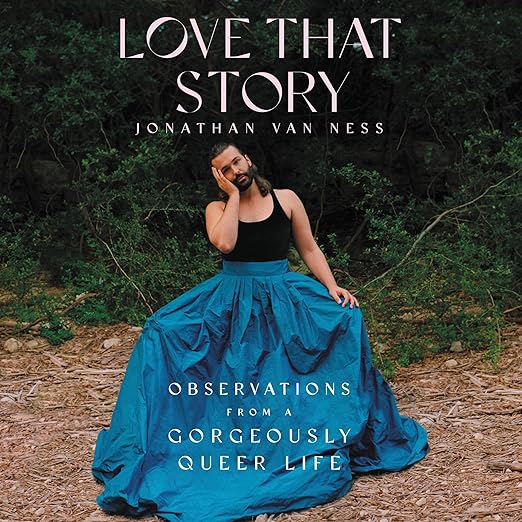
In Brief
- Read by: Jonathan Van Ness narrates his own work, and the result is essential listening: the essays were written in his voice and they can only fully land when delivered in it.
- At its heart: LGBTQIA+ advocacy, imposter syndrome, grief and self-acceptance
- Vibe: Candid and high-energy with genuine emotional weight
- Short version: An essay collection that earns its candor because JVN has already paid the admission price with his life experiences.
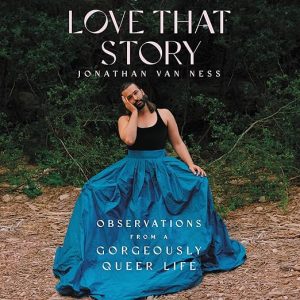
Jonathan Van Ness narrates Love That Story himself, and for this audiobook in particular that isn't a detail you can set aside. The essays collected here, covering grief and healing, cannabis reform, LGBTQIA+ rights, HIV advocacy, personal style, and imposter syndrome, are so thoroughly shaped by JVN's cadences and conversational register that hearing another voice read them would feel like receiving a handwritten letter through a text-to-speech system. Van Ness published his memoir Over the Top in 2019, where he wrote about surviving sexual abuse, addiction, and an HIV diagnosis alongside his public life as an Emmy-nominated host of Netflix's Queer Eye. Love That Story is the follow-up, and it functions less as a memoir sequel than as an expansion into essay form of the advocacy and perspective work that the memoir began.
The essays here operate in several registers, and Van Ness moves between them with more control than you might expect if your only reference point is his exuberant television persona. The opening sections on personal style and the craft of hairdressing are funny and warm in the way that his public work always is. But the investigative piece on the queer history of his hometown is something different: it is the kind of local reporting that usually disappears into regional publications, and Van Ness brings genuine research rigor to it. He is not simply recounting his own experience as a queer person from a small Midwestern city; he is doing historical work, finding the people and places and events that constituted a community, and taking that community seriously as a subject.
The essays on HIV and the fraying safety net for people living with the virus have a different quality entirely. They are angry in a way that is measured rather than reactive, and they demonstrate that Van Ness is genuinely equipped to make arguments, not just to tell stories. The distinction matters because the popular assumption about celebrity essay collections is that they are primarily personal rather than analytical. Van Ness tests that assumption directly. The policy dimensions of the HIV crisis are present in this book in specific, named terms: the programs being cut, the populations most affected, the political decisions that have made treatment access harder rather than easier. This is not decorative advocacy; it is substantive reporting delivered in the voice of someone with skin in the game.
The five-hour-forty-four-minute runtime is essentially perfect for this format. Essay collections can feel truncated at four hours or exhausting at eight, and Love That Story finds the right length. The essays vary enough in tone and subject matter that the audiobook doesn't feel like a single sustained mood piece, but they're connected by Van Ness's consistent perspective and willingness to be publicly uncertain. The piece on imposter syndrome is particularly useful because he applies the framework to his own ongoing experience rather than resolving it as a past struggle he's moved beyond. He is still inside it, and he says so clearly.
Highlights
Van Ness as a narrator has specific strengths that are worth naming directly. He is genuinely funny in the audio format, not in the way that reads as performed but in the way that reads as natural. The comedic timing that makes him effective on television translates to audio without losing spontaneity. But the more important advantage of hearing him narrate these essays is access to emotional registers that print cannot capture. When the essays turn serious, particularly in the sections about grief and HIV advocacy, his voice carries a weight that is qualitatively different from what the page delivers. One reviewer described hearing his voice in each chapter and feeling that it increased their affection for him, which is a useful description of what self-narration can do when the author has both the skill and the material to support it.
The essay on cannabis reform and the LGBTQIA+ community lands particularly well in audio because Van Ness is addressing an intersection of policy areas that affects people he knows personally, and you can hear that specificity in his delivery. He is not making abstract arguments about drug policy; he is talking about communities and people whose lives would be concretely different under different legal regimes. That texture is something the audio format preserves and the page flattens.
What to Watch For in Love That Story
If you haven't read Over the Top, this collection works as a standalone. The essays reference Van Ness's backstory but don't require intimate knowledge of the memoir's details. However, listeners who have read Over the Top will find that Love That Story adds dimension rather than simply repeating established ground. The tone here is more politically explicit in places, particularly around LGBTQIA+ rights and HIV policy, than the memoir was. Van Ness is less interested in personal narrative arc and more interested in using his experience as evidence for arguments about systemic failures.
The cannabis reform essay is probably the one that will date most visibly as legal and political landscapes continue shifting. Some of the policy context it describes has changed since publication. But the personal experience within it remains relevant regardless of where cannabis legislation lands, and the essay's argument about disproportionate enforcement is grounded in patterns that have not changed as quickly as the legal landscape.
Is This One for You?
Fans of Queer Eye who found Over the Top resonant will have an obvious home here. Listeners interested in LGBTQIA+ advocacy writing who want essays that are politically engaged without sacrificing personality will find Van Ness a distinctive voice in that space. Essay readers who appreciate authors willing to be publicly uncertain and incomplete rather than packaging their experiences into clean arcs of growth will get more from this collection than listeners who prefer tidy resolution. At under six hours, this is also a strong option for anyone who finds themselves short on listening time but wants something with genuine substance. Those who prefer political essays separated from personal memoir, or who find Van Ness's television energy grating, are unlikely to be converted here.
Good to Know
Does Jonathan Van Ness narrate this audiobook himself?
Yes. Van Ness narrates Love That Story throughout, and this makes a significant difference to the listening experience. The essays were written in his distinctive register, and self-narration means the comedic timing, emotional weight, and tonal shifts are all delivered as he intended them.
Do I need to have listened to Over the Top before this audiobook?
No. Love That Story works as a standalone essay collection. It references Van Ness's personal history, which readers of Over the Top will recognize, but the essays do not depend on prior knowledge of the memoir's details to be coherent or impactful.
Is this audiobook appropriate for listeners who are unfamiliar with Queer Eye?
Yes. Van Ness introduces himself and his perspectives through the essays themselves. Some cultural context around Queer Eye is helpful for understanding the imposter syndrome and public identity essays, but it is not required for the advocacy and policy sections, which stand entirely on their own as arguments.
How does this audiobook compare to typical celebrity essay collections?
More substantive than most. The advocacy sections on HIV policy and LGBTQIA+ rights are researched arguments, not just personal reflections. The essay on queer history in Van Ness's hometown involves actual local reporting. Listeners expecting a lighter celebrity perspective piece will find more analytical rigor here than the format typically delivers.