Key Details
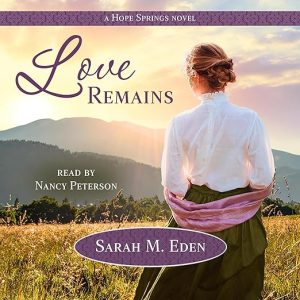
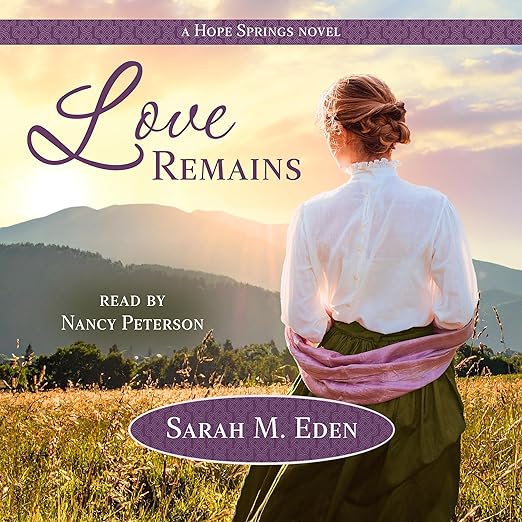
- Read by: Nancy Peterson narrates with a clean emotional register that suits the Western setting and the gentle pacing of Eden's romance writing throughout the 11-hour runtime.
- At its heart: Grief and caretaking, ethnic and national prejudice in a frontier community, the long psychological work of adjusting to sudden disability
- Vibe: Tender and emotionally generous, with a persistent undercurrent of communal grief that gives the romance more weight than the genre usually carries
- Short version: A Western historical romance with more emotional and psychological depth than the category typically delivers, particularly strong in its treatment of blindness and the labor of earned independence.
I came to Love Remains midway through a Sunday when I was looking for something that would ask something of me emotionally without being relentlessly dark about it. Sarah M. Eden's Hope Springs series occupies a specific tonal register that is hard to find in Western historical romance: genuinely tender without being saccharine, honest about suffering without wallowing in it. This third book in the Longing for Home series is perhaps the most emotionally demanding of the set, which is a recommendation rather than a warning.
The setup is specific and carefully built: Tavish O'Connor is caring for his younger brother Finbarr, who lost his eyesight in a violent attack born of ethnic hatred, while also shouldering the larger burdens of a small Irish-immigrant community in Wyoming still reeling from that same violence. Cecily Attwater arrives from England as a professional tutor to the newly blind, having herself navigated the loss of sight and the long, difficult work of building competence and independent life without it. She walks into a community that distrusts her on principle as an Englishwoman, and a man who initially sees her only as an obstacle to the practical arrangements he has made for his brother's life.
Where This One Lands
What distinguishes Love Remains from most Western historical romances is that Eden gives Cecily's professional work genuine content and treats it with sustained respect. Cecily is not a romantic interest who happens to have a conveniently useful skill. She has a methodology, a philosophy about what newly blind people need and do not need from the people around them, and a hard-won personal knowledge of the psychological journey from shock and grief through resistance to eventual competence and agency. Reviewer Marissa specifically noted the book's fascinating look at low vision and blindness skills as one of its distinctive qualities, and that observation is accurate.
Finbarr's refusal to learn is not just a plot complication that needs resolving before the romance can proceed. It is a psychologically accurate portrait of a young man who has lost something catastrophic and found it easier to refuse the future than to acknowledge the full dimensions of what the future now requires. He does not want to learn because learning means accepting that this is the life he now has. Cecily's patient, unyielding approach to his resistance, and the conflicts it creates with Tavish who loves his brother and does not want to see him hurt further, drives the middle section of the book with a tension that earns its eventual resolution rather than manufacturing it.
Why Listen to Love Remains
Nancy Peterson's narration is at its most affecting in the sections following Tavish's perspective. Eden writes Tavish with an unusual quality of weary, genuine goodness: he is not a brooding hero or a fundamentally troubled man waiting to be healed by love. He is someone who has been giving everything he has for a long time across multiple obligations and is now close to the point where there is nothing left to give. His initial harshness toward Cecily is not cruelty or arrogance; it is a man protecting resources, emotional and practical, that he cannot afford to spend.
Reviewer momisreading's description of Tavish as so giving and selfless that he takes everyone's struggles as his own is accurate, and Peterson conveys that quality without sentimentalizing it. The romance between Tavish and Cecily works because it develops as two competent, emotionally honest people who have both been carrying significant weight slowly recognizing that they see each other more clearly than anyone else does. That kind of mutual recognition is rarer in romance fiction than it should be, and Eden handles the approach to it with appropriate care.
What Gives Us Pause
The Hope Springs community is an Irish immigrant enclave in Wyoming, and Eden does not treat the Irish-English tension as mere atmospheric backdrop or convenient obstacle to the romance. The centuries of violence between the two cultures, and the fresh wound from the attack that cost Finbarr his sight, shape how the community receives Cecily in ways that require genuine navigation rather than quick resolution. The ethnic and national history is handled with more nuance than most Western historical romance brings to questions of colonial history and immigrant trauma.
Cecily's position as an outsider within the community's particular wound gives the romance an additional structural complexity. She is not simply facing the usual barriers of class or circumstance. She is asking people to trust her in a space defined by historical betrayal, and she has to earn that trust through consistent behavior rather than through a single dramatic gesture. Reviewer utemom captured this accurately in noting that the series does not give you the easy redemption arc but earns its emotional resolution through genuine difficulty. At 11 hours and 41 minutes, Love Remains uses its runtime to develop both the central romance and the community dynamics with a patience that rewards the listener who stays with it.
Who Should Pick Up Love Remains
What Sarah M. Eden does in this series that distinguishes it from most Western historical romance is treat the physical and historical wounds that her characters carry as ongoing rather than resolved. The violence that cost Finbarr his sight is not backstory that gets processed in a prologue and then set aside as the romance proceeds. It is a present reality that shapes every relationship and every decision in the book. The Irish community's historical wounds from centuries of English oppression are not atmospheric color. They determine whether Cecily can be trusted and how that trust must be earned over time.
That insistence on the ongoing nature of trauma, physical and historical, gives Love Remains a weight that the category's lighter entries do not carry. Reviewer utemom's account of being hesitant to return to Hope Springs because the previous book left her genuinely saddened at its conclusion is an honest description of what it means to be inside a series that treats its characters as people with real histories rather than as vehicles for romantic resolution. Eden earns the warmth of her endings by not pretending the difficulty that preceded them was anything other than what it was.
Questions Listeners Ask
Can Love Remains be listened to without the first two books in the Longing for Home series?
The romance plot follows Tavish and Cecily and is self-contained for new listeners. However, the community of Hope Springs, Finbarr's backstory, and the violence that underlies the community's mistrust of outsiders are established in the previous books. The full emotional context is richer with that foundation, particularly for understanding the depth of what the Irish community has survived.
How does Eden handle the representation of blindness and the process of adjusting to vision loss?
With notable care and apparent research. Cecily's methods as a professional tutor to the newly blind are presented as a genuine skill set with a real methodology, and Finbarr's psychological resistance to learning is rendered with accuracy rather than as a simple plot obstacle. Several reviewers specifically praised this aspect of the book as one of its defining qualities.
Does Nancy Peterson's narration differentiate effectively between the Irish and English characters?
Peterson reads both communities with appropriate tonal distinction without leaning on exaggerated or caricatured accents. She conveys the cultural and emotional distance between Cecily and the Hope Springs community through register and pacing, which is a more sustainable approach across an 11-hour runtime than heavy accent work would allow.
Is Love Remains appropriate for readers who do not typically read Western historical romance?
Yes, particularly for readers who appreciate character-driven fiction with historical and cultural texture. The treatment of blindness and rehabilitation, the Irish immigrant community dynamics, and the psychologically grounded romance give the book more substance than its genre classification suggests. The Western setting is functional rather than the point; the human and emotional material is.