Quick Take
- Narration: Stephanie Racine carries 21 hours of epistolary prose with restraint and warmth, the right match for a voice as singular and arch as Eileen Alexander’s.
- Themes: wartime resilience, epistolary intimacy, Jewish identity in WWII Britain
- Mood: Intimate and absorbing, occasionally difficult
- Verdict: A genuinely extraordinary document of a young woman’s inner life during the Blitz, complicated by the relationship dynamics she describes with such flair.
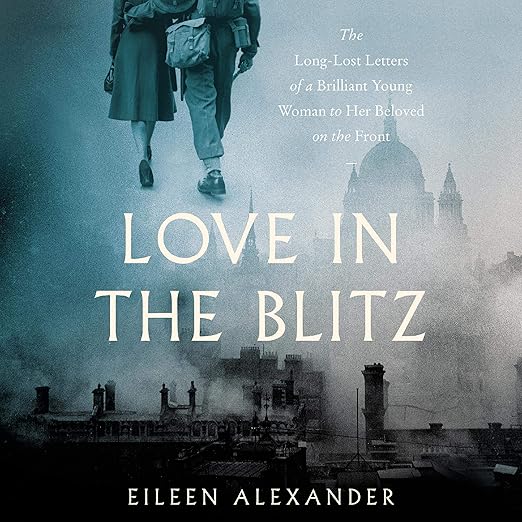
Twenty-one hours is a long time to spend with a single voice, and Love in the Blitz earns most of those hours. I started it on a grey Sunday afternoon and found myself still listening at midnight, not because the plot was driving me forward, there is no plot in the conventional sense, but because Eileen Alexander’s voice is so vivid and particular that putting her down felt like leaving a conversation midsentence. These are love letters, written to Gershon Ellenbogen over five years of wartime separation, and they are everything good letters should be: opinionated, funny, self-aware, saturated with literary quotation, and completely unguarded in a way that formal writing almost never is.
The marketing comparisons to Atonement and the Neapolitan quartet are doing the book a disservice. This is not novelistic fiction. It is a primary source that reads like literature, and the distinction matters. Eileen Alexander was real, Gershon was real, the Blitz was real, and the letters were written under the weight of that reality. What you are listening to across 21 hours is not a constructed narrative but an actual young woman’s mind, her Cambridge education, her wit, her romantic obsession, and her occasional cruelty, preserved because someone thought to save the paper.
Our Take on Love in the Blitz
The editorial question hanging over this book, raised explicitly by reviewer Nancy Kopald, is worth sitting with before you commit. Over 1,400 letters were written. The editor reduced them to this single volume in ten days. We do not know the criteria for inclusion or what was excised. That is not a trivial objection. Every collection of letters is also an act of editing, and editing is always an act of interpretation. What version of Eileen are we hearing? The most charming? The most quotable? The most favorable to a particular reading of the relationship? I do not raise this to discourage listening, but because anyone engaging seriously with this material deserves to know the selection apparatus is opaque.
Why Listen to Love in the Blitz
Reviewer Katherine Larson noted an element that many other reviews gloss over: the emotional abuse dimension of the relationship. Eileen’s letters toward Gershon can be manipulative, controlling, and at times unkind, and the book does not editorialize about this. You are left to form your own judgment about what you are witnessing. Some listeners will find this uncomfortable. Others will find it more honest than sanitized correspondence. Reviewer David Anderson called her extraordinary, her memory for English and French literary quotation, her British resolve, her matter-of-fact account of the bombing. That is all true. And it coexists with the parts that are harder to admire. Stephanie Racine’s narration handles this complexity well, maintaining Eileen’s particular voice without pushing the listener toward a verdict.
What to Watch For in Love in the Blitz
The 21-hour runtime is real, and some sections are slower than others. The book also presents only Eileen’s side of the correspondence, Gershon’s letters were lost, so the relationship dynamic is necessarily one-sided and filtered through her perspective. If you expect a balanced portrait of a wartime romance, this is not quite that. It is more accurate to describe it as a portrait of a remarkable mind under pressure, using love as its organizing frame. The historical content, the Blitz, the Air Ministry, the Jewish community in wartime Britain, the slow news from the front, is woven in naturally rather than explained didactically, which is one of the great pleasures of reading a genuine primary source.
Who Should Listen to Love in the Blitz
Listeners who love epistolary literature, wartime history, or British literary culture of the 1930s and 40s will find this deeply rewarding. It requires patience, this is not plot-driven listening, but rewards that patience with something rare: access to an actual historical consciousness, unmediated by novelistic convention. Those who want a cleaner, more comfortable love story, or who are sensitive to relationship dynamics that include manipulation and emotional imbalance, should know what they are getting into before they commit 21 hours.
Frequently Asked Questions
Since only Eileen’s letters survive, does the audiobook feel one-sided?
By its nature, yes. Gershon’s letters were lost to time, so listeners only have Eileen’s perspective on the relationship. The editor’s introduction provides some framing, but the dynamic is filtered entirely through her voice.
Is the 21-hour runtime justified or could the book have been shorter?
Reviewer Nancy Kopald raised the question of editorial selection, noting that 1,400 letters were cut to this volume in ten days. Some sections are slower than others, but the cumulative effect of Eileen’s voice builds over the runtime in a way that a shorter selection might not achieve.
Does Stephanie Racine’s narration suit Eileen Alexander’s voice?
Yes, from all available evidence. Racine maintains Eileen’s archness and wit without caricature, which is the challenge with epistolary prose, you need a narrator who can carry personal voice without slipping into performance.
How accurate are the marketing comparisons to Atonement and the Neapolitan quartet?
Loose at best. Atonement and the Neapolitan novels are fiction. Love in the Blitz is a primary document, actual wartime letters by a real woman. The comparison captures something about emotional intensity and prose quality, but the experience of listening is fundamentally different from reading literary fiction.