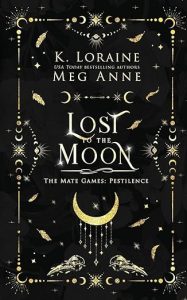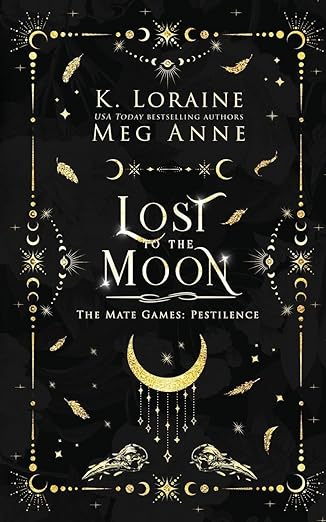
I will be honest: when I started Lost to the Moon, I was not sure I was the right reader for it. The synopsis opens in first person from the villain's perspective, someone who announces themselves as the demon who has been working against the protagonist throughout the series, who acknowledges openly that they are the villain of this story, and who then proceeds to charm you anyway. That kind of unreliable, self-aware narration is a specific taste, and Meg Anne either pulls it off or she does not. She pulls it off.
The audiobook is published through Ravenscroft Press and runs twelve hours and fifteen minutes, narrated by Teddy Hamilton. No reviews were available in the source data, but the book carries a 4.9 rating from 510 listeners, which, for a paranormal romance with a villain POV, represents a meaningful signal about how the existing readership has responded. The series context suggests this is a later entry in a broader world that includes Rosie (the protagonist referenced throughout), a vampire duke, an overprotective wolf, a cocky shifter, a human hybrid, and now a demon who has decided that stopping the Apocalypse is worthwhile primarily because losing it would mean losing access to his mate. The priorities are very clear and very funny.
What distinguishes this from standard paranormal romance is the voice. The demon narrator, referred to as the villain throughout without sentiment, is self-aware about his own nature in a way that generates genuine dark comedy. Lines like "I'll let you in on a little secret about villains: they're a whole lot of fun" land because Hamilton delivers them with exactly the right blend of sincerity and irony. The character believes what he is saying. He is not performing cynicism for effect; he genuinely thinks this is the appropriate way to approach both morality and desire, and that consistency of worldview is what makes the voice hold across twelve hours.
The plot mechanics involve stopping Pestilence, the villain's mother, which is its own complication, from ending the world, while also navigating the question of whether someone who has spent an entire series being the obstacle can be redeemed in the eyes of the woman whose other partners include a vampire duke and a wolf who wants nothing more than to remove the demon from the equation entirely. The apocalyptic stakes and the romantic stakes are intertwined in ways that keep both threads from going slack, which is harder to manage than it sounds in a genre where one can easily overwhelm the other.
What Works
Teddy Hamilton is the specific reason to choose the audio version of this book rather than print. He builds a consistent voice for the narrator, smooth, unhurried, faintly amused by everything including himself, that does not break even in the sections where the demon is genuinely threatened or cornered. The character's refusal to acknowledge vulnerability except obliquely is a performance challenge, and Hamilton navigates it without letting the affectation become wearying. Over twelve hours, that is a substantial achievement.
The genre, paranormal romance with reverse harem elements, is not for every listener, and the villain POV adds an additional layer of specificity that makes this unsuitable for readers who want their romance protagonists uncomplicated. But within its audience, the book delivers well above genre average. The combination of genuine wit, emotional complexity, and a narrator whose priorities are clearly ordered (mate first, then saving the world, then perhaps minor personal growth) is unusual enough in the space to stand out.
Before You Commit to Lost to the Moon
Series context matters here. The synopsis references characters and events from prior books, Rosie, the nature of the deal the demon made with her, the existing relationships with the other partners, that a listener coming in cold will have to piece together. The book is functional without that context, but it is clearly written for readers already invested in the world. New listeners should at minimum read a brief series summary before starting here.
The tone is consistently darkly comedic, which means the emotional beats arrive at angles that readers expecting a more conventional paranormal romance arc may find slightly disorienting. When genuine feeling breaks through the villain's facade, it is handled quickly and with characteristic deflection. Readers who want overt emotional declaration from their leads will find the demon a frustrating narrator. Readers who appreciate the romantic tension of a character who would rather lie, possess, or steal than admit they care will find this exactly calibrated to their taste.
Who It's For
Paranormal romance readers who are already in the series should not wait, this is a significant POV shift and the villain's perspective recontextualizes earlier events in ways that the long-running audience will appreciate. Readers new to the genre who want to try a villain POV paranormal romance as an entry point will find this more challenging without series context but will likely respond well to Hamilton's narration regardless. Not recommended for listeners who want their romance narratives morally uncomplicated or emotionally transparent, the demon narrator offers neither, and that is entirely by design.